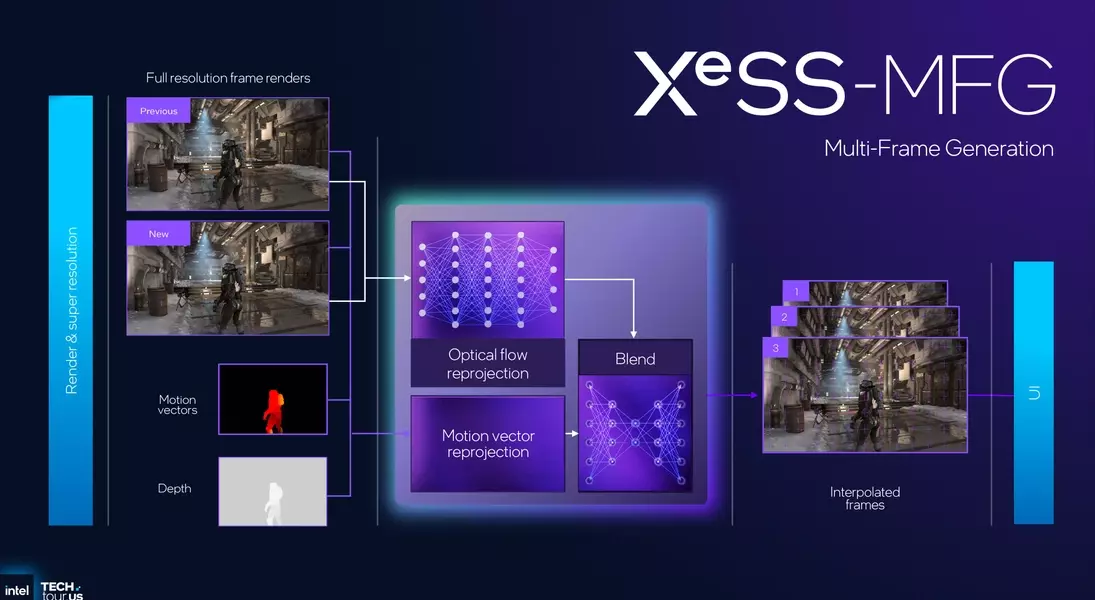


Intel has significantly broadened the reach of its XeSS 3 multi-frame generation technology, making it accessible to every graphics processing unit within the Arc series. This development marks a substantial enhancement in Intel's graphics capabilities, allowing a wider array of users to benefit from AI-powered frame interpolation for improved gaming experiences. The rollout, facilitated through the latest driver updates, extends this feature beyond its initial exclusive integration with specific CPU architectures, demonstrating Intel's commitment to advancing graphics performance across its product lines.
First unveiled in October during the Arizona Tech Tour, alongside the Panther Lake CPU architecture, XeSS 3 was introduced as a key update to Intel's AI-driven graphics suite. Its debut with the Core Ultra 300-series processors signaled a new era for Intel's graphics technology. Now, with the release of the WHQL-certified 32.0.101.8509 drivers, owners of any Intel Alchemist or Battlemage GPU can activate XeSS 3 MFG (multi-frame generation) directly through the Intel Graphics Software application. This includes not only dedicated Arc graphics cards, such as the A770 or B850, but also integrated GPUs found in Meteor Lake, Lunar Lake, and Arrow Lake processors. This broad compatibility is due to Intel's strategic decision to incorporate XMX units (Xe Matrix Extensions) across all tiers of its Xe graphics architecture, providing dedicated hardware for the intensive matrix and tensor calculations essential for AI algorithms, similar to Nvidia's Tensor cores.
However, it is crucial to note that XeSS 3 MFG is not universally applicable to all games. It requires games to have existing support for XeSS FG, specifically version 1.1 or newer. Currently, the roster of games supporting Intel's XeSS is comparatively smaller than those compatible with DLSS or FSR frame generation technologies. Despite this limitation, the introduction of multi-frame interpolation across all Arc GPUs places Intel in a leading position, surpassing AMD, which has yet to offer a similar multi-frame interpolation feature.
Preliminary evaluations using a Core Ultra 9 285K test setup, devoid of a discrete graphics card and relying solely on the integrated 'Intel Graphics' (equipped with 512 Xe shaders and a 2,000 MHz boost clock), showed varying results. In titles like Cyberpunk 2077, running at 1080p with medium graphics presets, the integrated GPU initially achieved an average of merely 20 frames per second. Activating the XeSS 3 MFG override at 2x boosted this to 31 fps, though the visual fluidity was noticeably inconsistent. Furthermore, an observed side effect was the disabling of screen scaling, leading to a smaller output window on a 4K monitor. This issue was mitigated by adjusting the Windows display resolution to 1080p, suggesting it might be specific to certain hardware configurations or game titles. Despite these early challenges, the technology shows promise for more powerful iGPUs, like the Arc B390 in high-end Panther Lake CPUs, where it is expected to provide significant performance uplifts. The capability for any Arc GPU owner to experiment with this technology, without the need for additional software or modifications, signifies a positive step forward for Intel's graphics ecosystem.
