


This report highlights the collaborative efforts of UNICEF, alongside key partners like The LEGO Foundation and Games for Change, in promoting child well-being within the gaming sector. The initiative, known as Responsible Innovation in Technology for Children (RITEC), aims to harness the immersive nature of video games to create beneficial experiences for young players, moving beyond mere entertainment to foster positive developmental outcomes.
Children are often deeply engaged by video games, drawn to worlds of exploration, skill development, creative expression, and social interaction. However, the very design elements that make games captivating, such as daily rewards and limited-time offers, can also make it difficult for children to disengage. This raises an important question: how can game developers leverage their influence to ensure these experiences contribute positively to children's growth?
UNICEF's research underscores that video games can indeed have a constructive influence on children's lives, provided they are thoughtfully crafted. Games offer avenues for creation, connection, experimentation, learning, and the achievement of personal milestones. The core challenge lies in building upon these strengths, making deliberate design choices that transform beloved games into tools for positive development.
The RITEC initiative, a global collaboration, has extensively researched the impact of digital play on children. By engaging nearly 800 children across 18 countries and gathering insights from designers at 35 gaming companies in 15 countries, RITEC has formulated a comprehensive framework for understanding and promoting child well-being in digital environments. This framework provides tangible tools for game developers to integrate these insights into their design processes.
At its heart, RITEC operates on the principle that games are neither inherently good nor bad; their effects are contingent on their design. A challenging level, for instance, can cultivate resilience and confidence as a child learns through trial and error. Conversely, it could foster a sense of frustration, leading to reliance on in-game purchases to progress. Similarly, a leaderboard can stimulate healthy competition or intensify anxiety about social status. Rewards can signify accomplishment or create apprehension about missing out if play ceases.
Even the act of concluding a game session is influenced by design. Players should be able to save their progress effortlessly and exit when ready, rather than being confronted with prompts for more play or unfinished tasks. While no single design element dictates a game's overall quality, collectively, these choices profoundly shape how children experience play, what they absorb from it, and how it impacts their self-assurance, imaginative faculties, and interpersonal connections.
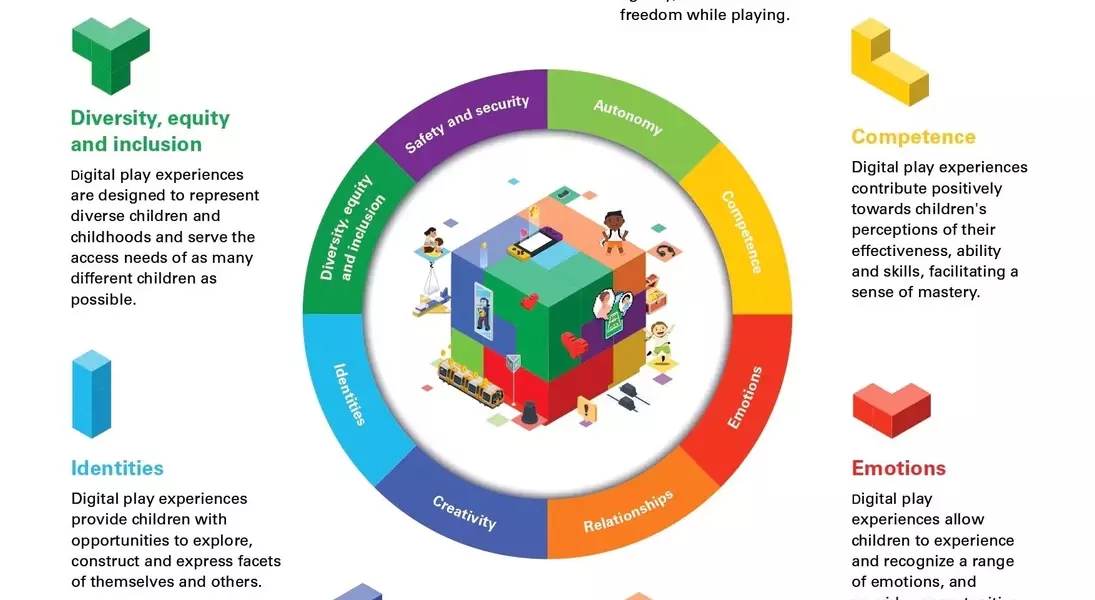
RITEC's extensive research has identified eight crucial dimensions of well-being that digital play can enhance: safety and security, diversity, equity and inclusion, autonomy, emotional intelligence, competence, relationship building, creativity, and identity formation. These dimensions manifest in various ways within games. Autonomy, for example, is the presence of meaningful choices that alter gameplay. Competence is the satisfaction derived from mastering a difficult move or independently solving a puzzle. Creativity involves constructing, customizing, storytelling, or devising innovative solutions.
An Australian 12-year-old, Ethan, shared his appreciation for a favorite game, stating, "I love that you need to be creative and try to figure out a way around things. I guess the game was designed so that everyone plays it differently. There's no one way to do things." Similarly, Nkosinathi, an 11-year-old from South Africa, found value in the inherent challenge: "It helps me do better, like never give up. And try again, even if it's hard. Try again until I get it." These anecdotes highlight how well-designed games can instill valuable life skills.
The development of positive relationships extends beyond mere player interaction; it depends on the types of connections games facilitate, how players support each other, and the behaviors that are rewarded. Another Australian participant, aged 12, emphasized the importance of community: "When someone's encouraging you, you feel like you can do it. It feels really good[...] That's what motivates me." RITEC's findings consistently show that when games are tailored to children's interests and needs, they can empower them, cultivate skills, facilitate self-expression, assist in navigating emotions, and strengthen social bonds.
Bridging the gap between research and practical game design is a core objective. While most game developers are committed to creating positive experiences for children, translating this intention into daily design decisions can be challenging. The RITEC-8 framework, coupled with the RITEC Design Toolbox, offers practical guidance for developers and industry leaders. It provides visual resources and an interactive card deck that links specific game features to various aspects of children's well-being, transforming abstract concepts into actionable design considerations.
This framework enables teams to evaluate initial concepts, refine reward systems, or test social features. It encourages designers to ask critical questions: Do players have impactful choices? Does a challenge genuinely build confidence or primarily cause frustration? What behaviors does this feature encourage? By providing a shared vocabulary, RITEC fosters collaborative discussions among designers, developers, product teams, and executives, allowing for early experimentation and adjustments to optimize the player experience.
For the gaming industry, integrating child well-being into design can yield significant benefits. Games must attract and retain players while generating revenue. Adopting a child-centric approach may necessitate re-evaluating traditional methods, balancing competing priorities, and looking beyond short-term engagement metrics. This paradigm shift requires a company-wide commitment, providing designers with the necessary tools and expertise, and ensuring support from product, commercial, and senior leadership teams.
Investing in child-friendly design practices offers compelling advantages. Games that prioritize positive experiences and child well-being can forge stronger relationships with players and their families. This, in turn, can lead to increased trust, enhanced brand reputation, and reduced safety and reputational risks for companies. The next phase of RITEC will involve collaborating with the industry to test these approaches in real-world scenarios, building a robust evidence base for what truly works. The accompanying Community of Practice will serve as a global hub for practitioners and experts to share knowledge, exchange ideas, and advance this vital work.
The gaming industry possesses extensive knowledge of what makes games compelling. Imagine the transformative potential when this expertise is combined with a dedicated focus on children's well-being. This approach aims to create games that children not only love to play but also thrive from, ensuring that every minute of digital engagement contributes meaningfully to their development. Practitioners passionate about shaping this future are encouraged to explore the RITEC Design Toolbox and join the growing Community of Practice to make child well-being an integral part of exceptional game design.
