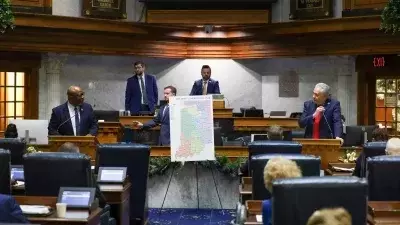
The Indiana Senate's recent decision to reject a congressional redistricting proposal, strongly advocated by former President Trump, signifies a notable political development. This outcome, with a 31-19 vote against the measure, represents the first instance where Trump's redistricting initiatives have faced opposition from within his own party. The move has sparked considerable discussion and revealed internal fractures within the Republican ranks, especially given the broad Republican majority in the Indiana Senate. This surprising turn of events could have far-reaching implications for the upcoming 2026 midterm elections and the national political landscape.
Indiana Senate Rejects Controversial Redistricting Proposal Amidst Political Turmoil
On a pivotal Thursday, the Indiana Senate delivered a significant blow to former President Trump's campaign for congressional redistricting, voting down the controversial plan by a margin of 31-19. This rejection marks a critical moment, as it is the first time Republican lawmakers have defied Trump's push for mid-decade redistricting, a strategy he employed in other states like Texas, Missouri, and North Carolina to bolster Republican chances in the 2026 midterm elections. Indiana, with 40 out of 50 senators being Republican, showcased an unexpected internal party dissent.
State Senator Spencer Deery, a Republican, articulated his opposition during the debate, emphasizing that his stance against "mid-cycle gerrymandering" was rooted in conservative principles. He voiced strong resistance to any federal attempts to "bully, direct, and control" the state, asserting that such measures would contradict conservative values by consolidating federal power. The proposal also faced staunch opposition from Indiana Democrats, who warned that the redistricting could undermine the voting power of minority communities, particularly given their current limited representation of two out of the state's nine U.S. House seats. Traditionally, states undertake redistricting following the decennial census, making the proposed mid-decade effort highly unusual.
The Senate vote followed weeks of intense political turmoil and thinly veiled threats. Trump and Indiana Governor Mike Braun, also a Republican, had previously threatened primary challenges against senators who did not support the redistricting. Amid these heightened tensions, Braun and several other Republican lawmakers reported receiving anonymous threats. Vice President Vance publicly criticized Senate President Pro Tempore Rodric Bray on social media platform X, alleging that Bray, despite privately indicating support for redistricting to the administration, was actively encouraging votes against it. Bray ultimately voted against the measure, further underscoring the deep divisions.
Conversely, Republicans who championed the redistricting argued for its necessity as a strategic move to maintain Republican control of the U.S. House, pointing to past instances where Democratic-led states had redrawn districts to favor their party. State Senator Mike Young underscored the high stakes, stating, "Only a handful of districts throughout the United States will determine who controls Congress. We may or may not do our part today to keep our nation in the hands of Republicans and do the right thing for our state." This statement highlights the perception among supporters that the vote was crucial for both state and national political trajectories.
This decisive vote in Indiana not only represents a significant setback for Trump's influence within the Republican party but also reflects a complex interplay of state sovereignty, party loyalty, and democratic principles in the contentious arena of electoral redistricting.
The Indiana Senate's rejection of the redistricting plan offers a compelling look into the dynamic and often unpredictable nature of political power. It highlights the potential for internal party dissent, even when facing pressure from influential figures like a former president. This event serves as a powerful reminder that local lawmakers can act as crucial checks and balances, prioritizing what they perceive as state interests and fundamental principles over party directives. For citizens, it underscores the importance of an engaged and informed electorate, as public pressure and individual legislative courage can significantly shape democratic processes. Ultimately, this outcome prompts reflection on the resilience of democratic institutions and the constant tension between party unity and individual conviction in the American political system.
