Recent independent evaluations have cast a critical eye on the actual performance of several prominent electric vehicles, revealing that many fall short of their advertised driving ranges and energy efficiency in real-world scenarios. This comprehensive assessment highlights the crucial difference between laboratory conditions and everyday use, prompting a deeper look into the transparency of EV manufacturers' claims.
Unveiling the Truth: Real-World EV Performance Under Scrutiny
Bridging the Gap: The Disparity Between Laboratory Claims and Actual Driving Range
Recent independent tests have highlighted a notable gap between the officially stated driving ranges of several popular electric vehicles and their performance in actual driving conditions. Leading models from manufacturers such as Tesla and Kia were found to offer significantly less range than their laboratory-certified figures suggest. One particular vehicle demonstrated a substantial 23 percent reduction in its practical range compared to its theoretical maximum, raising questions about the accuracy of current testing methodologies.
The Australian Automobile Association's Pioneering Real-World Evaluation Initiative
The Australian Automobile Association (AAA) has embarked on an ambitious Real-World Testing Program, marking its first dedicated evaluation of electric vehicles since its inception. This program rigorously assesses five distinct EV models, including widely available options like the 2024 Tesla Model 3, 2024 Tesla Model Y, and 2022 Kia EV6. Unfortunately, all vehicles examined in this initial phase underperformed when subjected to everyday driving scenarios, diverging from their manufacturer-mandated laboratory results.
Analyzing Range Discrepancies Across Key Electric Vehicle Models
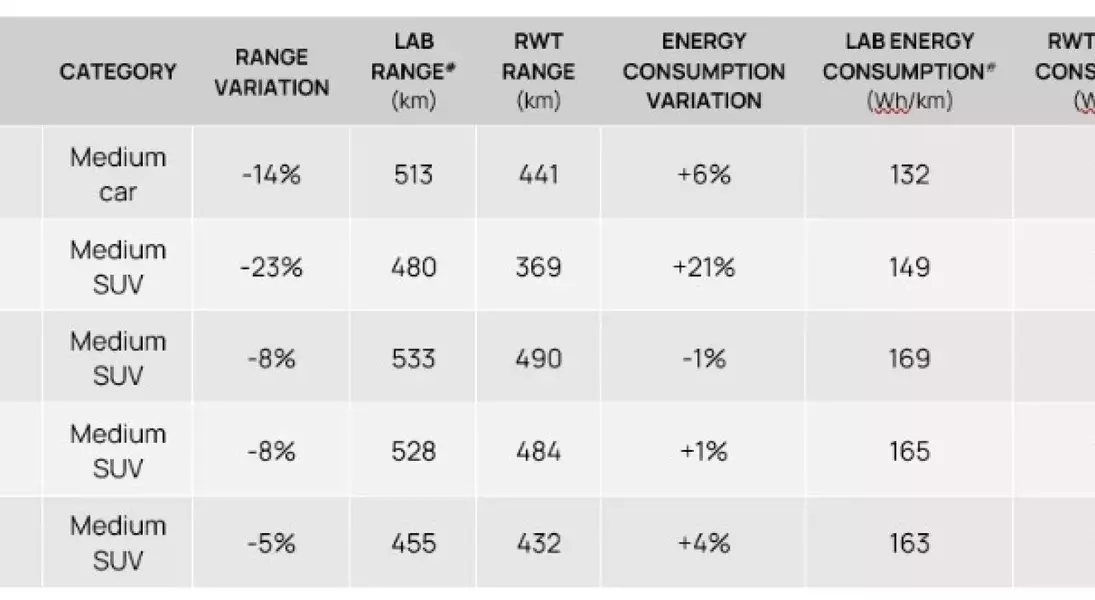
Detailed findings from the AAA's assessment revealed varying degrees of range discrepancy among the tested EVs. The 2024 Tesla Model 3 exhibited a significant 14 percent drop, achieving only 441 kilometers (274 miles) compared to its stated 513 kilometers (318.8 miles). The 2024 Tesla Model Y also showed an 8 percent decrease, reaching 490 kilometers (304.5 miles) against its 533-kilometer (331.2 miles) rating. Similarly, the 2022 Kia EV6 experienced an 8 percent reduction, covering 484 kilometers (300.7 miles) instead of its expected 528 kilometers (328.1 miles).
Performance Review of Additional EV Models: BYD Atto 3 and Smart #3
The AAA's testing extended to the 2023 BYD Atto 3 and the 2024 Smart #3. The Smart #3 performed most closely to its advertised range, with its real-world figure of 432 kilometers (268.4 miles) being only 5 percent less than its claimed 455 kilometers (282.7 miles). In contrast, the BYD Atto 3 displayed the most considerable deviation, delivering only 369 kilometers (229.3 miles)—a remarkable 23 percent less than its official 480-kilometer (298.3 miles) laboratory range. Although these models are not currently available in the U.S., the Atto 3 is a top-selling EV in Australia.
Examining Energy Consumption: A Mixed Bag of Results
While range figures were largely disappointing, the energy consumption aspect of the tests presented a mixed picture. The Tesla Model Y surprisingly showed a slight improvement over its lab results, consuming 1 percent less energy than anticipated. However, the other four vehicles demonstrated increased energy usage: the Kia EV6 consumed 1 percent more, the Tesla Model 3 6 percent more, and the Smart #3 4 percent more. Most notably, the BYD Atto 3's energy consumption was 21 percent higher than its stated figures, further compounding its poor range performance.
Methodology and Program Origins: A Commitment to Real-World Transparency
The Australian Automobile Association confirmed that its testing protocol for electric vehicles rigorously adheres to European regulatory standards, ensuring that results are consistent and objective. This meticulous approach minimizes variables such as driver behavior and traffic conditions. The AAA's Real-World Testing Program, which began in 2023 with government funding, was initiated in response to past emissions scandals, aiming to evaluate 200 vehicles over four years to verify manufacturer claims. Prior tests on conventional and hybrid vehicles have frequently shown discrepancies in both emissions and fuel efficiency, underscoring the importance of such independent assessments.
