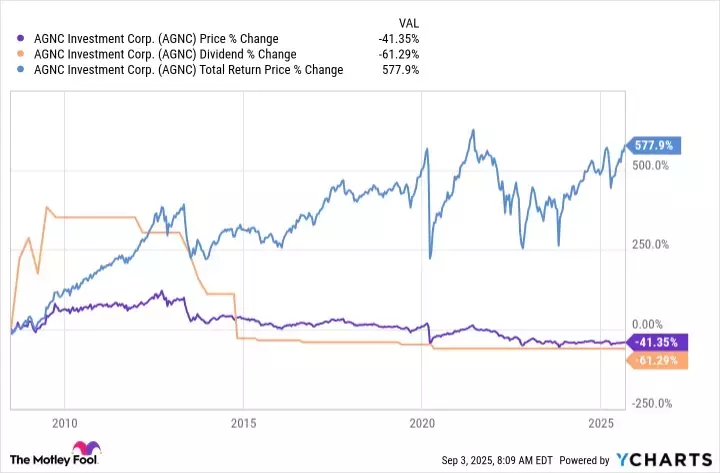

When constructing an investment portfolio focused on generating income, the allure of high-yield dividend stocks can be significant. However, a deeper examination reveals that a higher percentage yield does not always equate to a more dependable income stream for long-term investors. This analysis delves into the contrasting investment profiles of AGNC Investment and Federal Realty Investment Trust, illustrating why one might be a better fit for those seeking consistent dividend income, even with a seemingly lower yield, highlighting the crucial distinction between total return and reliable income generation.
AGNC Investment, a mortgage real estate investment trust (mREIT), presents a compelling dividend yield often exceeding 14%. As an mREIT, its operations involve investing in mortgage-backed securities, a more intricate and specialized area compared to traditional property-owning REITs. This complexity, while not inherently negative, implies a different risk profile and a greater sensitivity to interest rate fluctuations. Historically, AGNC Investment's dividend payments have shown considerable volatility, reflecting the nature of its underlying assets and the broader economic environment. While its total return, assuming dividend reinvestment, may appear strong over time, the fluctuating dividend payout can be a significant concern for investors who rely on predictable income for their financial planning, such as retirement expenses.
In stark contrast, Federal Realty Investment Trust, a retail-focused REIT with a portfolio primarily comprising strip malls and mixed-use developments, offers a comparatively modest dividend yield of approximately 4.5%. Despite this lower yield, Federal Realty boasts an exceptional record of dividend consistency, having increased its annual dividend for over five decades. This achievement grants it the rare status of a 'Dividend King' within the REIT sector. The company's strategy of focusing on high-quality properties in desirable locations contributes to its stable and growing cash flows, enabling it to consistently reward shareholders with dependable income. For an investor whose primary objective is to build a reliable and increasing stream of income, the stability and long-term growth trajectory of Federal Realty’s dividends far outweigh the higher, but less predictable, payouts offered by AGNC Investment.
The fundamental divergence between these two entities lies in their core business models and, consequently, their dividend characteristics. AGNC Investment's reliance on the mortgage market subjects its payouts to greater swings, whereas Federal Realty's real estate holdings provide a more tangible and steady revenue base. Ultimately, the choice between these investment avenues depends on an individual investor’s priorities. If the goal is total return and one is comfortable with potential dividend variability, AGNC Investment might align with that strategy. However, for those prioritizing a consistent, growing income stream to support living expenses, Federal Realty, despite its lower nominal yield, presents a more secure and suitable investment. The critical lesson here is that the sustainability and growth potential of a dividend are often more valuable than its current percentage, particularly for long-term income-oriented portfolios.
