
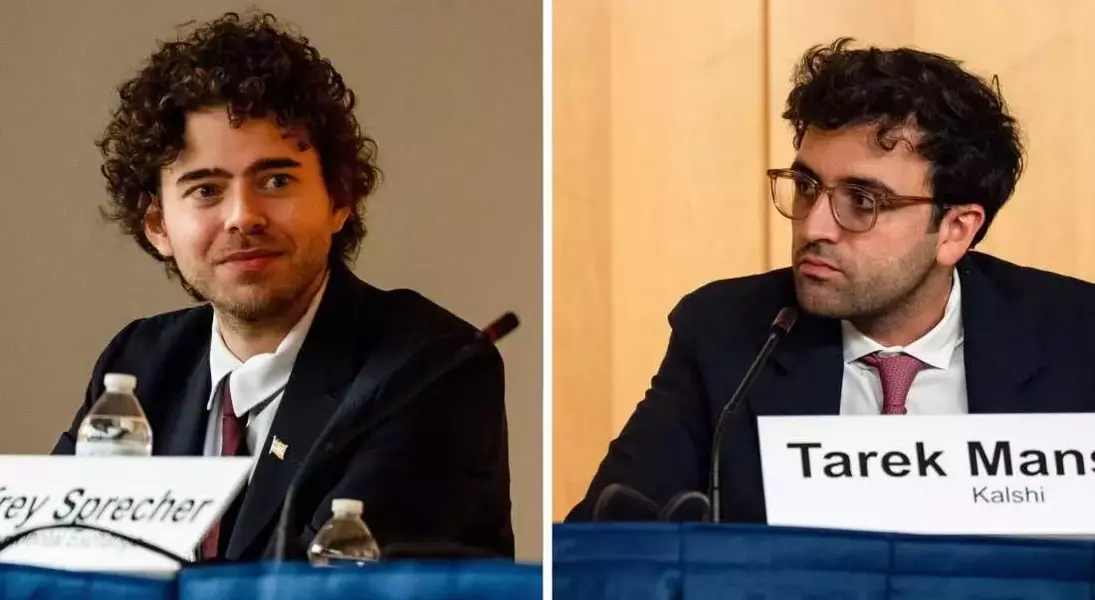
The burgeoning prediction market sector is witnessing an intense rivalry between two leading platforms, Kalshi and Polymarket. At the heart of this competition are their respective chief executives, Tarek Mansour and Shayne Coplan, whose contrasting visions for the industry's future are shaping its development. Their contentious relationship underscores the challenges and opportunities within this rapidly expanding financial technology space.
Details of the Prediction Market Feud
The rivalry between Kalshi CEO Tarek Mansour and Polymarket CEO Shayne Coplan, both successful entrepreneurs in their twenties, has become a defining feature of the prediction market landscape. Mansour, a Massachusetts Institute of Technology alumnus with a background in Wall Street, insists on a fully regulated operational model for Kalshi, actively seeking oversight from the Commodity Futures Trading Commission (CFTC). He views this approach as essential for the long-term legitimacy and widespread adoption of prediction markets in the United States. Kalshi's commitment to compliance means navigating complex legal frameworks and engaging with governmental bodies to secure regulatory approval, a path that has seen them gain support from the current Trump administration.
Conversely, Coplan, a New York University dropout and a veteran of cryptocurrency trading, initially launched Polymarket with a less constrained approach, often operating beyond the immediate reach of U.S. financial regulations. This strategy, while enabling rapid scaling and innovation, has also led to confrontations with authorities, including an FBI raid on his residence in late 2024. Despite these challenges, Polymarket has recently secured a path to operate a U.S.-based exchange, partly due to shifts in regulatory attitudes under the current administration. Both companies have even found common ground in their advisory board, with Donald Trump Jr. advising both firms through his venture capital firm, 1789 Capital.
The animosity between Mansour and Coplan is palpable, with Kalshi frequently discrediting Polymarket as an "unregulated, offshore platform." This was starkly illustrated when Kalshi's team reportedly orchestrated a social media campaign to mock Coplan following the FBI's investigation. Mansour himself has publicly likened their rivalry to legendary sports matchups, emphasizing its competitive intensity. Both companies are locked in a struggle for market dominance, with each claiming the title of the "world's largest prediction market" and having trademark applications pending to solidify their assertions. This competition extends to their business development strategies, as evidenced by Kalshi's partnership with CNN and Polymarket's subsequent deal with Dow Jones, the publisher of The Wall Street Journal. Even their philanthropic efforts take on a competitive edge, with one-upping each other in providing free groceries in New York City.
The dispute reached a new level when Kalshi announced the formation of the "Coalition for Prediction Markets," a trade group intended to advocate for clear regulatory frameworks within the industry. Notably absent from this coalition was Polymarket, further highlighting the deep division and competing philosophies at play. This ongoing feud, characterized by public jabs, competitive business maneuvers, and fundamental disagreements on regulatory engagement, is poised to significantly influence the trajectory and legitimacy of the prediction market industry.
The intense rivalry between Kalshi and Polymarket offers a compelling insight into the challenges and opportunities within emerging financial technologies. It highlights the delicate balance between innovation and regulation, suggesting that while rapid expansion can yield quick gains, a foundation built on regulatory compliance may offer more sustainable growth and public trust. This competition could ultimately benefit the industry by forcing platforms to refine their models, enhance user protection, and engage more constructively with legal frameworks, paving the way for a more mature and credible prediction market ecosystem.
