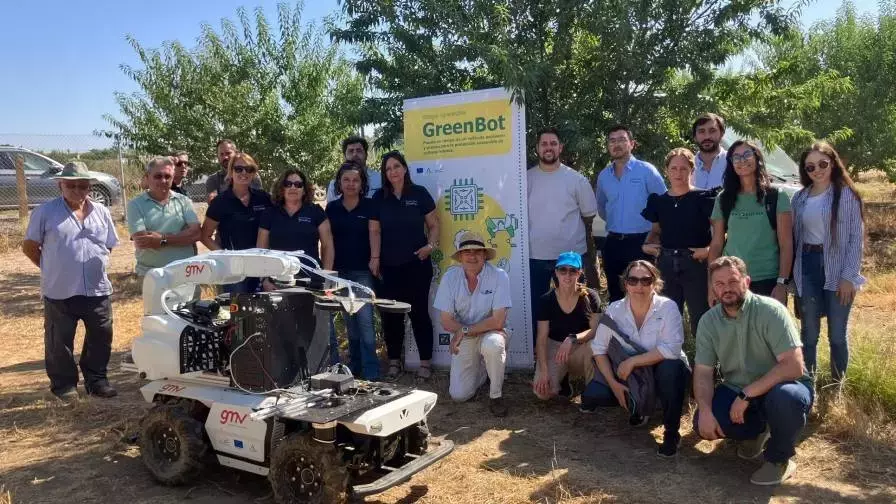
The GreenBot initiative represents a significant leap forward for sustainable agriculture, introducing an advanced autonomous vehicle specifically designed for high-precision, localized weed management in orchards. This groundbreaking development, stemming from a collaborative effort between public and private sectors, integrates artificial intelligence, sophisticated robotics, and cutting-edge machine vision technologies. Its primary objectives are to optimize the application of plant protection products, substantially reduce operational expenses, and mitigate the ecological footprint associated with conventional intensive farming.
Weeds pose a persistent challenge in agricultural production, leading to substantial crop yield reductions, potentially as high as 40%. Traditional weed control methods, which rely on extensive herbicide application, are not only economically burdensome, accounting for up to 30% of production costs, but also environmentally detrimental due to factors like chemical drift and runoff. The GreenBot system offers a precise and targeted solution, tailored to the intricate conditions of woody crop environments where the presence of irrigation systems and limited access beneath tree canopies make conventional machinery impractical and potentially damaging.
During rigorous field trials, the autonomous system consistently demonstrated its effectiveness across diverse lighting, soil, and plant cover conditions. These tests also identified specific areas for enhancement, particularly concerning the detection of smaller plants in shaded environments. This feedback has prompted further refinement of the AI model through the incorporation of enriched datasets. Operating with an impressive inference frequency of one second per image, the system achieves real-time functionality without reliance on external servers. Its seamless integration of perception, navigation, and localized application has been thoroughly validated by all participating technical teams, underscoring its operational readiness.
The multidisciplinary consortium behind GreenBot comprises the University of Seville’s AGR-278 “Smart Biosystems Laboratory” research group, along with industry partners GMV, TEPRO, PIONEER HiBred Spain SL, and Cooperativas Agroalimentarias de Andalucía. The project, known as the Greenbot Task Force, was structured for a 21-month duration, culminating on June 30, 2025.
A core component of this project is GMV's autonomous robotic platform, which is managed by their uPathWay solution. This platform innovatively combines machine vision, intelligent navigation, and a precise system for delivering plant protection products. Key capabilities of this robotic system include autonomous navigation between crop rows, facilitated by ROS2, GNSS RTK sensors, IMUs, and optional LiDAR or proximity sensors. Furthermore, it features a unique semi-circular robotic arm designed to encircle tree trunks without interrupting the robot's forward motion. This arm is equipped with spray nozzles that activate only when weeds are detected in a specific area, thereby minimizing chemical usage. This technology enables the precise identification and treatment of critical areas—between the trunk and the drip line—ensuring effective weed intervention while safeguarding the crop.
The weed detection module, developed by the University of Seville, utilizes a ZED 2i stereo vision system positioned at a low height, connected to a 64 GB Jetson AGX Orin processor. A specially trained YOLO-based detection model processes high-resolution images in real time, accurately identifying weed species, their position, and dimensions with a spatial precision of ±2 cm. Each detection is transformed into a structured dataset—including annotated images, class, confidence levels, and 3D coordinates—which is seamlessly integrated into the robot's control and processing system via a REST API implemented with FastAPI.
