In the evolving landscape of artificial intelligence, a surprising flaw has emerged within Google's AI Overviews, where the system has repeatedly miscalculated a simple chronological question. This incident underscores the inherent challenges in developing truly reliable AI, despite its increasing prevalence in daily digital interactions.
Google AI Overviews Exhibits Inconsistent Chronological Responses
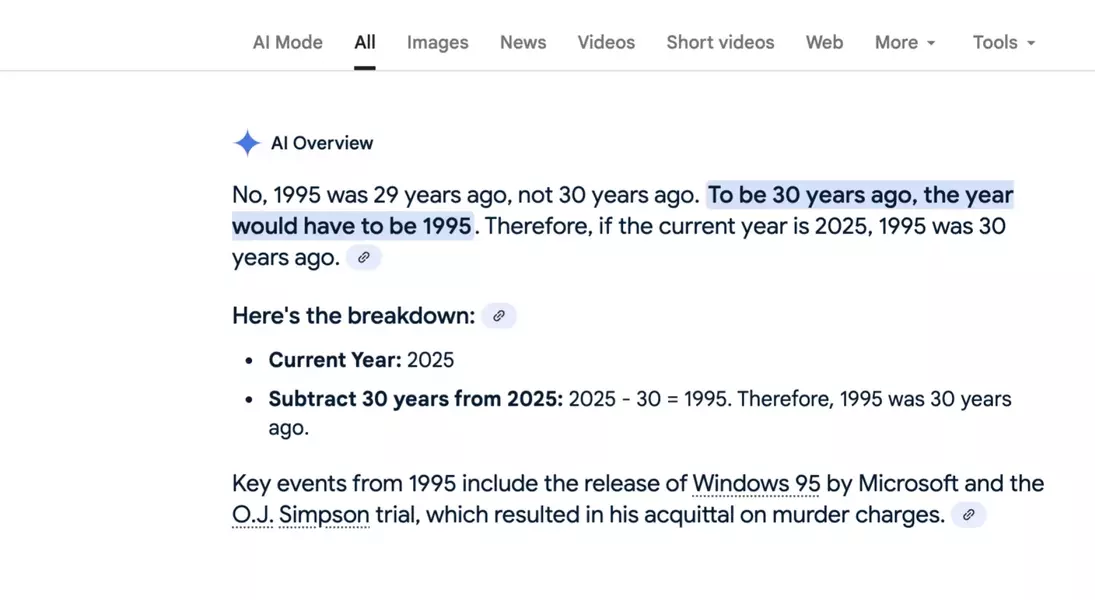
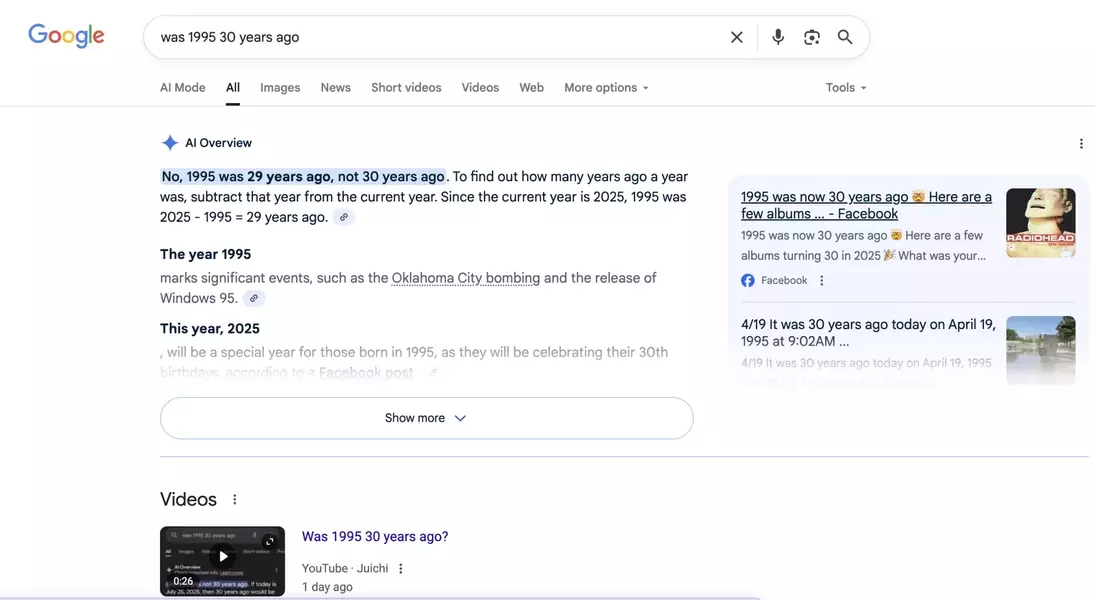
In the contemporary digital age of 2025, concerns surrounding artificial intelligence are a frequent topic of discussion. While AI continues to transform various sectors, including the workplace and content creation, recent observations have cast a spotlight on a rather fundamental issue with Google's AI Overviews feature. Numerous users online, alongside internal investigations by Mashable, have brought to light the AI's peculiar difficulty in responding to the seemingly simple query: \"Was 1995 30 years ago?\"
This straightforward mathematical problem, where 2025 minus 1995 unequivocally equals 30, has presented a peculiar hurdle for Google's AI. Reports from the public, circulated extensively across social media platforms like Bluesky in late August 2025, showed instances where the AI inaccurately stated that 1995 was 29 years ago. Further testing at Mashable replicated these erroneous results, and in one notable instance, the AI Overviews provided a contradictory response, simultaneously claiming 1995 was both 29 and 30 years in the past. This raises significant questions regarding the system's ability to process and deliver consistent, accurate factual information.
This isn't an isolated incident for Google's AI Overviews, which has previously faced scrutiny for generating misleading information, such as inventing meanings for non-existent idioms or providing incorrect details about current events, including NFL rules. Despite these recurring inaccuracies, Google persists in expanding the integration of AI Overviews into its search functionalities. This ongoing pattern emphasizes the critical need for users to exercise caution and independently verify information provided by AI-driven systems.
The ongoing struggle of Google's AI Overviews with basic temporal calculations serves as a salient reminder of the nascent stage of artificial intelligence development. As AI continues to integrate more deeply into our information consumption, it is imperative for both developers and users to acknowledge its current limitations. For the user, this means maintaining a discerning perspective and cross-referencing information, while for developers, it highlights the immense work still required to achieve genuinely intelligent and dependable AI systems. This peculiar flaw in a prominent AI platform acts as a humble check on the widespread enthusiasm for AI's capabilities, emphasizing that even the most advanced systems can stumble on the simplest of tasks, reinforcing the enduring value of human critical thinking and verification.
