In a dynamic landscape of global finance, several pivotal events have recently shaped market sentiments and economic outlooks. This overview encapsulates key developments ranging from international trade policy shifts and technological advancements to corporate performance and commodity market fluctuations. It highlights how political decisions, innovation in artificial intelligence, and environmental factors are intricately linked, influencing various sectors and investor confidence worldwide. The narratives presented offer a snapshot of the complex interplay driving current market trends.
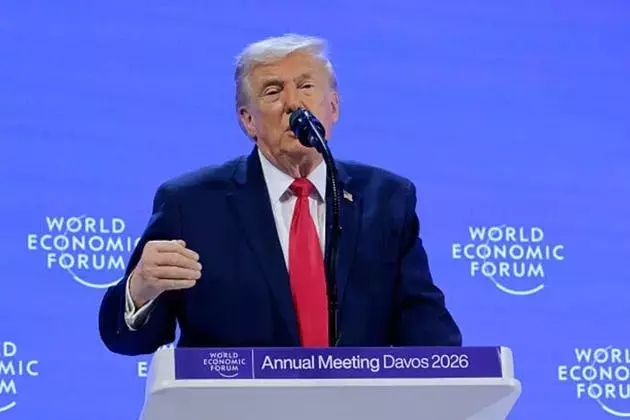
President Donald Trump's decision to retract the planned tariffs initially slated for February, following discussions in Davos concerning Greenland, significantly impacted market dynamics. This shift led to a sharp increase in stock values, a decrease in Treasury yields, and a strengthening U.S. dollar. Trump articulated that a productive dialogue with NATO Secretary General Mark Rutte had established a foundational agreement regarding Greenland and the broader Arctic region. This understanding precluded the imposition of tariffs, with further discussions expected on the Golden Dome missile-defense concept relevant to Greenland's strategic importance. His remarks at Davos underscored a preference for negotiation over confrontation, even jokingly referring to a desire for a 'piece of ice' for global protection.
Amidst these political and economic shifts, the technology sector also saw notable developments. Jensen Huang, CEO of Nvidia, highlighted the unprecedented infrastructure expansion driven by artificial intelligence. Speaking in Davos, Huang stressed the escalating need for energy resources, land, and skilled professionals to sustain this growth. He commended Anthropic's Claude as an indispensable coding tool and acknowledged OpenAI's ChatGPT for its widespread consumer adoption and user-friendliness. Concurrently, Meta's CTO, Andrew Bosworth, reported promising results from their Superintelligence Labs' initial AI models. These advancements underscore the transformative potential of AI across various industries.
In the financial realm, JPMorgan Chase CEO Jamie Dimon cautioned against a proposed 10% cap on credit card interest rates, arguing it could restrict credit access for a large segment of Americans and negatively impact numerous businesses reliant on consumer spending. Separately, Treasury Secretary Scott Bessent disclosed that Deutsche Bank's CEO personally intervened to disavow a contentious research note suggesting potential European divestment from U.S. assets, an unusual move in the banking world. Meanwhile, Netflix experienced a decline in stock value despite meeting guidance, primarily due to investors' high expectations. Analysts, however, maintained a bullish stance, forecasting robust free cash flow growth and continued market dominance for the streaming giant. Johnson & Johnson reported better-than-expected revenue driven by its pharmaceutical and medical technology divisions, though adjusted earnings fell short. The company also provided a strong 2026 outlook, surpassing market forecasts. Sandisk continued its remarkable rally, with shares surging over 1,000% in six months, fueled by its pivot towards high-performance, AI-centric storage solutions.
The commodity markets witnessed dramatic movements, with U.S. natural gas futures experiencing a surge of over 50% in two days. This spike was attributed to a severe cold snap across large parts of the country, significantly boosting heating demand. February Nymex natural gas contracts reached a new year-to-date high, on track for their largest weekly gain in over three decades. This extreme weather has also led to sharply higher energy prices globally, with Japan's power prices hitting a three-month high and European gas futures rising nearly 30% within the month. Forecasted snow in Texas, a major gas production hub, further exacerbated concerns about potential supply disruptions and reduced exports.
These diverse events—from trade policy adjustments and the burgeoning AI industry to corporate earnings and volatile energy markets— collectively paint a picture of an intricate global economic environment. They illustrate the interconnectedness of geopolitical decisions, technological progress, corporate strategies, and environmental impacts on financial markets and the broader economy.
