
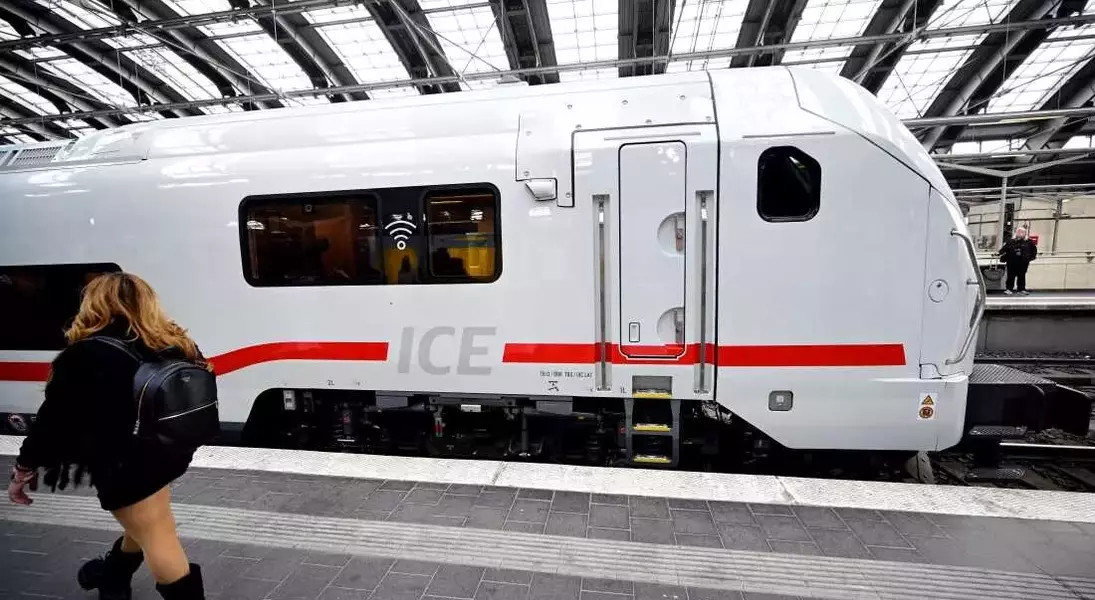
Germany's railway system, once a symbol of efficiency, is currently facing a significant crisis marked by widespread delays and declining service standards. This widespread decline has tarnished the reputation of Deutsche Bahn, the national rail operator, placing it among the least punctual in Europe. Passengers now frequently experience issues ranging from chronic delays and poor Wi-Fi connectivity to booking errors and unexplained technical faults, highlighting a deep-seated problem that extends beyond mere operational glitches.
Travelers journeying from the reliably punctual Swiss railway system often notice an immediate drop in service quality upon crossing into Germany. Long-time passengers like Elisabeth Eisel, who regularly commutes between Bern and Berlin, lament the stark contrast, noting that Swiss trains maintain their schedule unless originating from Germany. This sentiment underscores a widespread frustration among commuters who recall a time when German trains were synonymous with precision and reliability.
The root cause of this decline is often traced back to decades of insufficient investment in infrastructure. Since 1998, a lack of consistent funding has led to a dilapidated network of tracks and outdated signal systems. While the German government has recently pledged a substantial 100-billion-euro investment to revitalize the rail infrastructure, critics argue that financial injections alone will not solve the deeply entrenched problems. Lukas Iffländer, vice chair of the passenger advocacy group Pro Bahn, points to an overly complex and bureaucratic management structure within Deutsche Bahn as a major impediment to progress. He suggests that the company's top-heavy administration, characterized by an excess of managerial positions and a shortage of operational staff, hinders effective decision-making and project implementation.
Recent controversies have further eroded public trust. Reports from German news outlets, including Der Spiegel, allege that Deutsche Bahn management may have resorted to canceling trains to artificially inflate punctuality statistics, as canceled services are not factored into official delay calculations. Although Deutsche Bahn has refuted these claims, attributing them to internal chat messages rather than official data, the accusations have fueled public skepticism about the company's transparency and commitment to accurate reporting.
The current state of affairs is evident in everyday travel experiences. An incident on a train from Munich to Berlin saw passengers enduring overcrowded conditions and a lack of basic amenities, such as functioning restrooms, after a preceding service was abruptly canceled. French passenger Catherine Launay expressed surprise at the German public's relatively muted reaction, suggesting that similar conditions in France would provoke a far greater public outcry. In an attempt to address passenger discontent and mitigate potential confrontations with staff, Deutsche Bahn has launched a lighthearted social media campaign featuring fictional train crews dealing with absurd travel scenarios. These videos, ironically, are often unwatchable on board due to the very Wi-Fi issues they subtly highlight, blurring the lines between parody and reality for many travelers.
The German Federal Transport Minister, Patrick Schnieder, has emphasized the gravity of the situation, equating the malfunctioning railway system with a broader governmental inefficiency, suggesting the issue is more than just a transportation problem; it's a matter of national pride and competence. Hopes are now pinned on Evelyn Palla, the new CEO of Deutsche Bahn, whose previous success with Austrian Federal Railways has raised expectations. Palla has announced plans to streamline the company's executive structure to improve efficiency, but she cautions that transforming such a vast and complex system will require considerable time and sustained effort. As trains finally pull into Berlin stations, often late, passengers are left to ponder whether the myriad issues plaguing the network—be they technical failures, organizational shortcomings, or systemic neglect—signify a fundamental derailment of Germany's once-exemplary rail service.
