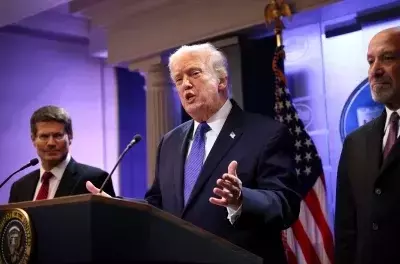
This report details former President Trump's strong reaction to a Supreme Court ruling that overturned his administration's tariff policies, examining the legal background, the financial implications for U.S. businesses, and the complexities within the Supreme Court's decision-making process.
A Legal Storm: When Presidential Power Meets Judicial Scrutiny
A Shift in Presidential Sentiment Towards the Judiciary
Just a year prior, former President Trump extended commendation to Chief Justice John Roberts for a ruling that bolstered presidential immunity from prosecution. However, recent events have seen a dramatic alteration in this dynamic. Following the Supreme Court's decision to nullify his administration's tariffs, the former president's tone has become markedly critical, reflecting a significant personal and political pivot.
The Genesis of the Tariff Controversy
The contentious tariff policies originated on the first day of Trump's second term, enacted through an executive order that imposed extensive tariffs on numerous international trade partners. These levies were primarily borne by American enterprises. The Supreme Court's recent intervention, led by Chief Justice Roberts, delivered a substantial blow to these policies. The Court's majority opinion emphasized that the authority to levy taxes, including tariffs, is constitutionally vested in Congress, a principle rooted in the nation's founding to ensure legislative accountability to the populace.
Presidential Defiance and Legal Ambiguities
Despite the judicial setback, the former president has indicated his intention to bypass the ruling by invoking alternative statutes that he believes grant him the power to impose tariffs without congressional approval. While some laws do permit presidential action on tariffs, they are typically circumscribed, often imposing time limits or requiring subsequent congressional endorsement. The assertion of unlimited executive authority in this domain remains a significant point of legal contention.
The Financial Repercussions of Tariff Reversal
The financial implications of the Supreme Court's decision are considerable. Billions of dollars in tariff revenue, initially intended to offset tax reductions, are now at stake. The federal government's monthly collection of approximately $30 billion in tariffs is expected to be halved by the ruling. While tariffs constitute a relatively minor portion of overall government revenue, the reduction will contribute to a larger, though not catastrophic, federal deficit. The stock market's stable reaction to the news, in contrast to its initial decline when the tariffs were imposed, suggests investor confidence that alternative revenue strategies may be pursued.
The Unresolved Question of Tariff Refunds
A pivotal aspect left unaddressed by the Supreme Court's ruling is the mechanism for refunding tariffs to U.S. businesses that have paid them over the past year. While some judicial opinions foresaw potential chaos, legal experts, such as trade lawyer Robert Leo, argue that the process is manageable due to electronic record-keeping. Calls from organizations like the National Retail Federation underscore the urgency for a streamlined refund process, emphasizing the financial relief it would bring to importers.
Decoding the Supreme Court's Internal Dynamics
The Supreme Court's decision offers insights into its current conservative majority. It highlights the Court's vigilance regarding fiscal matters and its commitment to upholding constitutional boundaries on executive power. Chief Justice Roberts' strategic handling of the majority opinion, securing broad support and providing clear guidance for lower courts, is particularly noteworthy. The ruling also reveals a Court marked by internal fragmentation, with multiple concurring and dissenting opinions underscoring a desire among justices to articulate their individual legal reasoning, even when aligning with the majority outcome.
