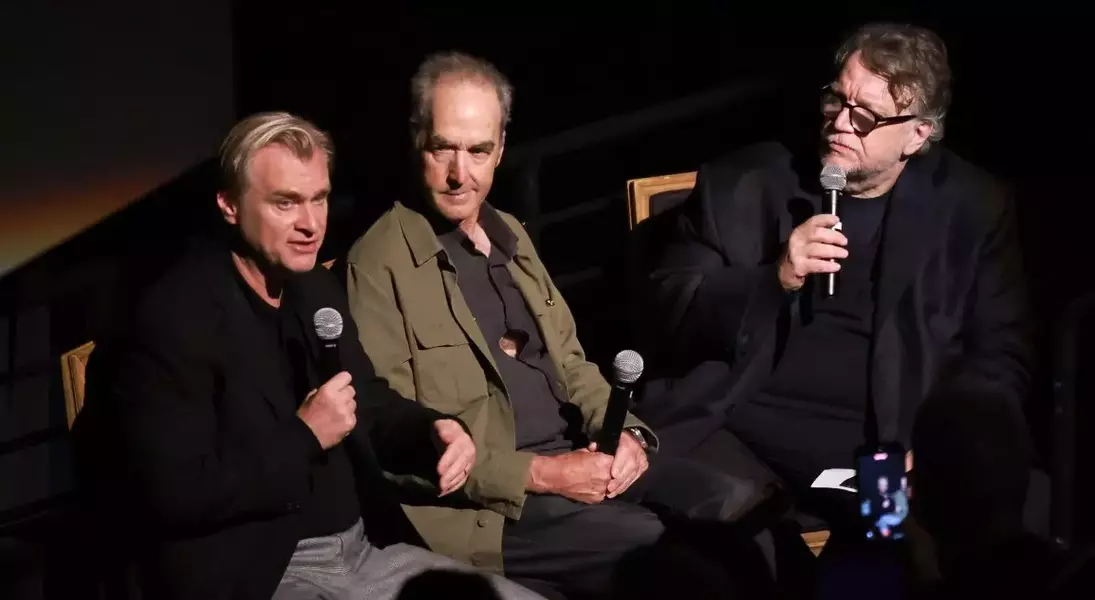
This report delves into a captivating dialogue among cinematic giants Christopher Nolan, Guillermo del Toro, and esteemed visual effects supervisor Andrew Jackson. The discussion took place during a special Visual Effects Society event following a presentation of Nolan's fantastical epic, 'The Odyssey.' The trio offered unparalleled insights into the intricate craft behind bringing mythical creatures and breathtaking sequences to life on the big screen. A central theme was the paramount importance of embedding the visual effects team deeply within the core production unit from its nascent stages, rather than treating VFX as a post-production afterthought. This collaborative philosophy, championed by Nolan and echoed by del Toro, underscored how early integration fosters a more cohesive and physically grounded approach to special effects. Furthermore, the panel engaged in a timely exploration of artificial intelligence's growing presence in filmmaking, unanimously advocating for robust human artistic guidance and oversight. They stressed that while AI offers new tools, it must not supersede the irreplaceable human element in the creative process, ensuring that the artistry of compositing and animation remains rooted in human vision and aesthetic judgment.
A cornerstone of their discussion revolved around the critical strategy of integrating visual effects teams from the very outset of film production. Nolan explicitly stated the necessity for the VFX department to be an integral part of the main unit throughout preparation and filming, rejecting the notion of them being brought in merely to augment the film later. Del Toro strongly concurred, advocating that the true beauty and respect for the craft lie in early integration, allowing visual effects to contribute to both physical and post-production solutions. This deep-seated collaboration is exemplified by Andrew Jackson, who has been a long-standing partner to Nolan, even being the first to review the 'Oppenheimer' script, highlighting the trust and essential role of VFX from a project's inception.
The panel provided a fascinating deep dive into the creation of pivotal scenes, notably the encounter with the Cyclops in 'The Odyssey.' This iconic monster was brought to screen through a sophisticated blend of animatronic puppetry, digital enhancements, and a compelling performance by veteran clown Bill Irwin. Jackson recounted how time constraints unexpectedly benefited the creative process, as they were 'forced' to simplify the marionette's design. This simplification, he noted, resulted in a more compelling and lifelike portrayal, proving that limitations can often spur innovative and superior outcomes. Nolan, humorously accepting his role in 'forcing' such decisions, acknowledged that the streamlined approach indeed led to a more impactful visual result, ultimately earning del Toro's praise for its seamless integration.
As anticipated in contemporary film industry dialogues, the conversation inevitably shifted to the burgeoning influence of artificial intelligence on filmmaking, particularly within the realm of visual effects. All three panelists—Nolan, Jackson, and del Toro—emphasized the non-negotiable requirement for human oversight in the implementation of this technology. Nolan articulated his expectation for compositors and animators to prioritize their 'eye rather than brain,' advocating for an impressionistic quality in their work, akin to traditional matte painters. Del Toro passionately argued for the urgent defense of human touch and craft against AI, suggesting that AI's rise was primarily driven by financial and time-saving motivations rather than artistic demand. Nolan further elaborated that this push for AI often stems from a fundamental misunderstanding of the intricate filmmaking process, while Jackson underscored that human artists remain crucial for evaluating whether AI-generated tools effectively deliver desired artistic results.
The insightful exchange at the Visual Effects Society screening illuminated the profound synergy required to craft cinematic spectacles like 'The Odyssey.' It underscored that groundbreaking visual effects are not merely technical feats but a deeply collaborative art form, demanding seamless integration and constant dialogue between visionary directors and their effects supervisors. The discussion served as a powerful testament to the enduring value of human ingenuity and artistic sensibility in an evolving technological landscape. As AI reshapes creative tools, the collective wisdom of Nolan, del Toro, and Jackson reinforces the critical need for human artists to remain the ultimate arbiters of aesthetic quality and narrative impact, safeguarding the soul of filmmaking against purely synthetic creation.
