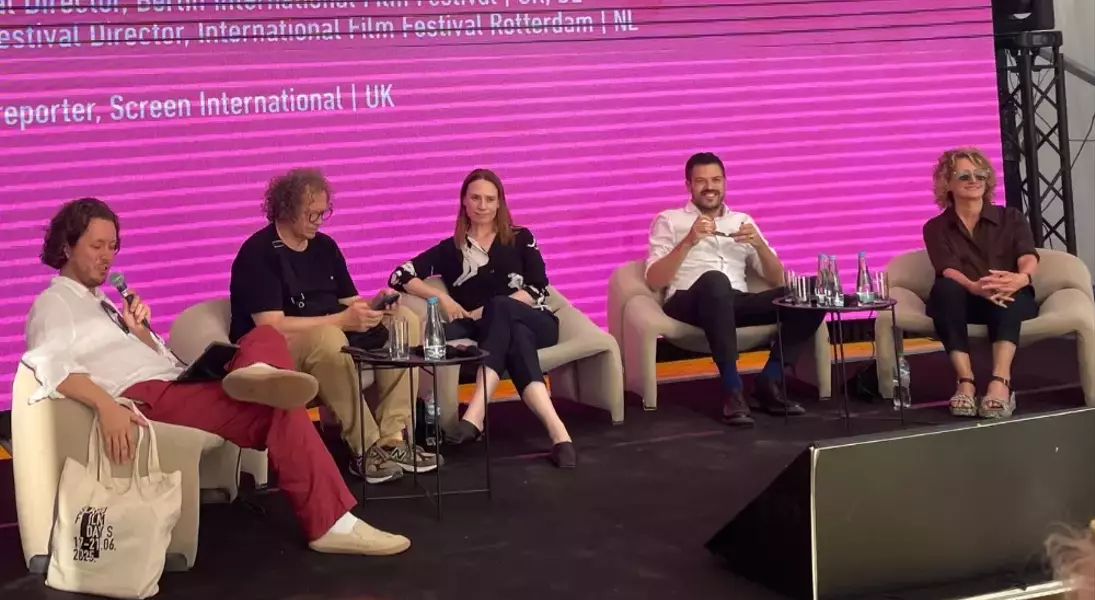
In an era of heightened political sensitivities, global film festivals are reaffirming their pivotal role not just as cultural showcases but as vital platforms for challenging societal norms and fostering crucial conversations. A recent gathering of prominent festival directors underscored their commitment to presenting "uncomfortable" and thought-provoking cinematic works, viewing this as an essential function to broaden perspectives and encourage deeper understanding. Beyond curation, the dialogue extended to navigating political landscapes, evolving audience engagement strategies, and addressing the persistent challenges within film distribution and exhibition.
Global Film Leaders Advocate for Challenging Cinema at Sarajevo Gathering
On a recent Tuesday, distinguished leaders from the world's most influential film festivals assembled at the prestigious Sarajevo Film Festival. The gathering centered on a profound exploration of the festivals' evolving mandate, delving into pressing issues such as cultivating audience interest and managing the intricate effects of escalating political divisions on both curatorial and strategic decision-making.
During the impassioned discussions, a pivotal question arose regarding the festivals' inherent responsibility to exhibit films that might provoke discomfort or spark division. Tricia Tuttle, the esteemed director of the Berlin Film Festival, unequivocally affirmed this obligation, stating with conviction that a fundamental aspect of their mission is to identify and champion artistic voices capable of unsettling conventional perspectives. She articulated that this capacity to challenge viewers is a unique and powerful contribution that film festivals are uniquely positioned to offer.
Echoing Tuttle's sentiments, Jovan Marjanović, the director of the Sarajevo Film Festival, provided a crucial clarification: film festivals should not be conflated with news sources. Instead, he emphasized their role as spaces for profound reflection and the acquisition of broader insights. Marjanović posited that by effectively communicating this distinction, festivals can significantly mitigate the heightened tensions often fueled by social media and the proliferation of misinformation. He acknowledged that while festivals inherently possess a political dimension, especially given the hyper-politicized environment of the past two years, there is a collective need to temper the intensity and embrace a more measured approach. He conveyed a sense of optimism, suggesting that despite the inherent difficulties, managing these complexities is achievable.
Tuttle further illuminated practical steps taken by her team at the Berlinale. Last year, under the guidance of Chief of Staff Florian Weghorn, they implemented specialized moderation training. These valuable sessions were designed to instill greater confidence in staff when navigating contentious discussions. The objective, Tuttle clarified, was never to stifle dialogue, but rather to equip individuals with the tools to acknowledge and address instances where audience members might feel unsettled by certain expressions. While these sessions didn't provide all-encompassing solutions, they empowered the team to confidently navigate what proved to be a particularly challenging festival season, a practice Tuttle intends to sustain.
Vanja Kaluđerčić of the Rotterdam Film Festival revealed a similar initiative within the Dutch festival's operations. The escalating political climate, she noted, has heightened her team's awareness of the critical importance of effective communication and moderation, particularly in politically charged environments. Rotterdam regularly conducts town hall meetings where all team members, including freelancers, engage in open dialogue. If a significant dilemma, internal critique, or a desire for deeper understanding emerges, the festival responds by organizing debates where diverse and even contrasting viewpoints can be expressed freely, reinforcing their commitment to continuous learning and cohesive teamwork.
The panel also critically examined the symbiotic relationship between film festivals and the broader distribution and exhibition ecosystem. Festivals continue to be paramount for the circulation of independent, experimental, and auteur-driven films. However, Tuttle voiced a shared industry concern regarding the widening disconnect between festival screenings and mainstream cinema attendance. She stressed the imperative of showcasing films unavailable elsewhere, cultivating an appreciation among audiences for diverse cinematic forms, and enhancing visibility. This necessitates greater industry collaboration and innovative communication strategies, especially targeting younger audiences aged 18 to 30, through platforms like social media.
Tuttle also highlighted the shrinking landscape for specialized film journalism, lamenting the decline of nuanced film commentary in favor of celebrity or news-driven content. She emphasized that alongside ensuring screen availability, visibility remains paramount for audiences to discover compelling films.
Tuttle passionately advocated for robust lobbying efforts, particularly in countries with public funding, to direct investment not just towards film production, but critically, towards exhibition and distribution. She underscored the alarming scarcity of screens for even critically acclaimed films, such as a recent Golden Bear winner in the U.K., emphasizing that without accessible venues, audiences cannot engage with these cinematic achievements. This strategic intervention, she concluded, is globally indispensable.
Despite the formidable challenges discussed, the panel concluded on a note of profound optimism. Marjanović powerfully articulated that the arduous period of the COVID-19 pandemic unequivocally demonstrated the irreplaceable necessity of film festivals, not only for the industry's vitality but, more importantly, for audiences themselves. He reflected that the pandemic, despite its difficulties, illuminated how essential communal film-watching experiences are, thereby profoundly reaffirming the enduring purpose and existence of film festivals.
