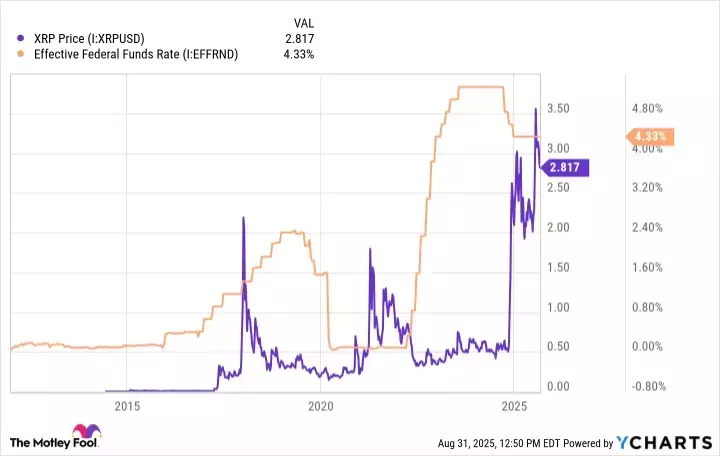

The financial landscape is buzzing with discussions surrounding the Federal Reserve's potential interest rate adjustments and their far-reaching effects across various asset classes. This analysis delves into the intricate relationship between central bank policies and the volatile cryptocurrency market, specifically focusing on XRP. Historically, interest rate shifts have significantly impacted digital asset valuations, much like their influence on high-growth technology equities. The market's current anticipation of multiple rate reductions presents a pivotal moment for understanding the trajectory of cryptocurrencies in the coming years.
Anticipated Interest Rate Adjustments and Their Impact on XRP
In the autumn of 2025, market indicators strongly suggest that the Federal Reserve is on the verge of its first interest rate cut in approximately nine months. Futures trading data points to a high probability of this event occurring within the month, followed by an expectation of six additional rate reductions by the close of 2026. While these projections are fluid and subject to constant change, they underscore a significant shift in monetary policy.
The cryptocurrency sector, a relatively nascent domain compared to established public stock markets, often exhibits price movements influenced by broader economic factors. Despite the inherent difficulty in precisely valuing digital assets like XRP due to their lack of traditional earnings, revenue, or cash flows, their prices have historically demonstrated a notable sensitivity to interest rate fluctuations. Specifically, XRP, currently ranking as the world's third-most valuable cryptocurrency, has often mirrored the behavior of high-growth technology stocks, which tend to thrive in environments of declining interest rates.
The rationale behind this correlation is multifaceted. Lower interest rates diminish the attractiveness of safer investment vehicles, such as U.S. Treasury bonds, compelling investors to seek higher returns in riskier assets. Furthermore, in discounted cash flow models, a reduction in interest rates leads to a lower discount rate, thereby inflating asset valuations. Compounding this effect, cryptocurrencies have traditionally shown an inverse correlation with the U.S. dollar, which typically weakens when interest rates fall.
Historical data since XRP's launch in 2012 reveals a consistent pattern: XRP's value generally decreases when the Federal Reserve's benchmark federal funds rate rises and appreciates when it declines. Although recent periods have seen XRP's value increase despite relatively high rates, this trend can be attributed to an ongoing deregulation drive initiated by President Donald Trump and the market's increasing anticipation of future rate cuts.
While a rate cut in September 2025 is widely expected to bolster XRP's value, it is crucial for investors to look beyond this immediate event. The market's long-term outlook, which includes five to six potential cuts through 2026, is primarily driven by concerns over a softening labor market. However, persistent inflation and the uncertain impact of Trump's tariffs on consumer prices introduce considerable variables. Should inflation remain elevated or the labor market prove more resilient than anticipated, the Federal Reserve might find it challenging to justify such aggressive rate cuts. Such a scenario could adversely affect the cryptocurrency market, including XRP, and other growth-oriented assets, which generally underperform in high-interest-rate environments. Therefore, a comprehensive understanding of both short-term market reactions and long-term economic indicators is paramount for navigating the future of digital asset investments.
As a financial reporter, observing the dynamic interplay between central bank policy and the evolving cryptocurrency market is endlessly fascinating. The anticipated interest rate cuts by the Federal Reserve highlight a critical juncture for investors, particularly those in the digital asset space. While historical data suggests a positive correlation between falling rates and XRP's performance, the inherent volatility and speculative nature of cryptocurrencies cannot be overstated. The real lesson here is the importance of a nuanced perspective. It's not merely about a single rate cut, but the broader economic narrative encompassing inflation, labor market stability, and global political factors. For any investor, this scenario underscores the need for vigilant analysis and adaptive strategies, reminding us that even in the most innovative markets, the foundational principles of economic forces remain profoundly influential.
