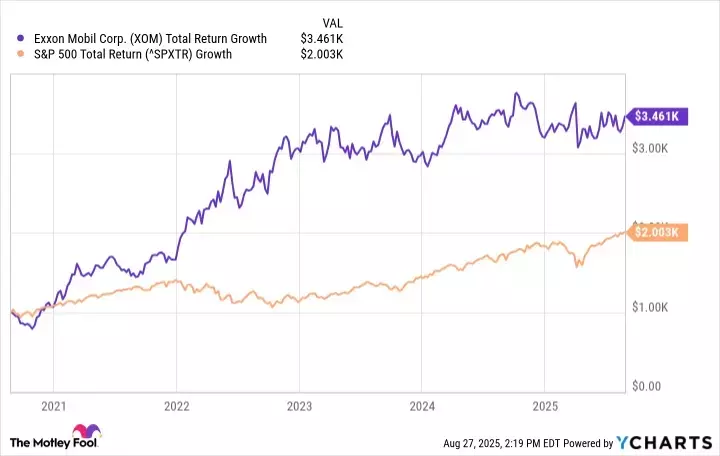

ExxonMobil's journey from a period of stagnation to significant market outperformance over the past five years underscores the impact of strategic foresight and capitalizing on market downturns. This remarkable turnaround demonstrates how a company deeply embedded in a cyclical industry can leverage its capital advantages and experienced leadership to achieve impressive returns, even amidst fluctuating global conditions. The narrative of its resurgence serves as a compelling case study for investors eyeing long-term value in established industries.
ExxonMobil's recent success also highlights the critical role of dividends in total shareholder returns. With a substantial dividend yield, the company has not only provided capital appreciation but also consistent income for its investors. This dual benefit of growth and income further solidified its appeal and contributed to its impressive outperformance compared to broader market indices like the S&P 500, particularly during a period of rising energy costs and geopolitical uncertainties.
The Trajectory of ExxonMobil's Market Performance
For many years, ExxonMobil's stock performance remained relatively flat, presenting a challenge for investors seeking growth. From 2007 to 2016, the share price saw little change, hovering around the $85 mark. This prolonged period of stagnant growth contrasted sharply with the subsequent five years, during which the company's stock experienced a significant upswing, far surpassing the returns of the general market index. This dramatic shift underscores a pivotal moment in the company's financial history, transforming it from a seemingly static investment into a dynamic one.
The catalyst for this impressive turnaround can be traced back to the downturn in oil prices around August 2020, following the initial uncertainty of the global pandemic. At that time, crude oil prices plummeted to as low as $20 per barrel before recovering to approximately $40 per barrel. Despite this recovery, prices remained well below pre-pandemic levels. However, as of now, oil prices have stabilized above $60 per barrel, representing a roughly 50% increase from five years prior. This sustained recovery in oil prices, combined with ExxonMobil's proactive investment strategies during the low-price environment, allowed the company to significantly improve its financial position and deliver exceptional returns to its shareholders, making it a standout performer in the energy sector.
Strategic Investments Fueling Shareholder Value
A crucial factor behind ExxonMobil's outstanding performance in recent years is its astute investment strategy, particularly during periods of market weakness. While oil prices were at their lowest, the company embarked on a series of "counter-cyclical investments." This approach involved deploying capital when assets were undervalued, allowing ExxonMobil to acquire and develop resources at significantly lower costs. Such strategic decisions provided a distinct advantage, positioning the company for substantial growth once market conditions improved and oil prices rebounded. This forward-thinking capital allocation during a bear market was instrumental in driving the subsequent surge in shareholder value.
The direct impact of these strategic moves on investor returns is evident in the numbers. An investment of $1,000 in ExxonMobil stock in August 2020 would have appreciated to approximately $3,460 today, factoring in dividend income. This notable return starkly contrasts with a similar investment in the S&P 500 over the same period, which would have grown to only about $2,000. ExxonMobil’s ability to generate such superior returns, even amidst the inherent volatility of the energy sector, showcases the effectiveness of its leadership in executing a long-term vision. This involved leveraging access to capital to make timely investments that ultimately paid off handsomely for its shareholders, establishing a strong precedent for resilience and profitability in a cyclical industry.
