
In the dynamic landscape of the global oil market, retirees seeking stable dividend income face crucial choices. This article delves into a comparative analysis of two energy giants, Exxon Mobil and ConocoPhillips, examining their first-quarter 2026 performance and strategic approaches to determine which might offer a more secure and rewarding investment for those in retirement.
Detailed Report: Navigating Oil Market Volatility in Q1 2026
The first quarter of 2026 presented a challenging environment for oil companies, marked by significant price swings in West Texas Intermediate (WTI) crude, which surged to $114.58 on April 7 following Middle Eastern supply disruptions, only to recede to $71.87 by late June. Amidst this volatility, both Exxon Mobil (NYSE:XOM) and ConocoPhillips (NYSE:COP) reported their earnings, showcasing distinct strategies for navigating the turbulent market.
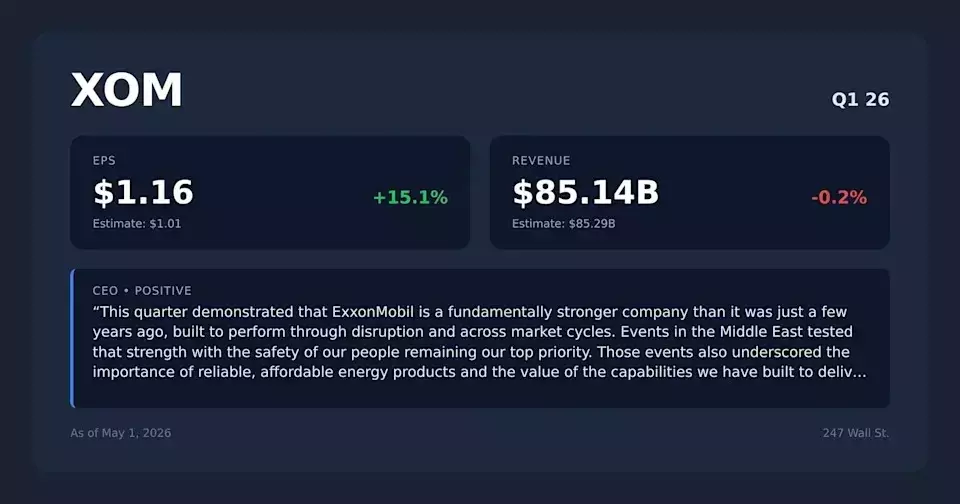
Exxon Mobil, with its integrated operational model spanning upstream, refining, chemicals, and specialized products, demonstrated resilience. The company reported adjusted earnings per share (EPS) of $1.16, surpassing the expected $1.0074. While headline net income was impacted by derivative timing and Middle East disruption losses, underlying earnings, excluding these factors, reached a robust $8.77 billion. A notable achievement was Guyana's oil production, hitting a record 900,000 gross barrels per day, coupled with strong refining margins of $16.3 per barrel. Additionally, its Golden Pass LNG Train 1 began shipping its initial cargo in April 2026. CEO Darren Woods emphasized the company's enhanced strength, stating it is "built to perform through disruption and across market cycles." Exxon's commitment to maintaining a 43-year dividend growth streak further underscores its stability for long-term investors.
ConocoPhillips, in contrast, pursued a more focused strategy centered on exploration and production (E&P), alongside liquefied natural gas (LNG) offtake. The company delivered an adjusted EPS of $1.89, exceeding the $1.7052 expectation, driven primarily by effective cost management. Despite a 6% year-over-year decline in realized prices to $50.36 per barrel of oil equivalent (BOE), adjusted earnings settled at $2.32 billion. Significant progress was made on the Willow project in Alaska, which reached over 50% completion. CEO Ryan Lance reiterated the company's objective to return 45% of its cash flow from operations (CFO) to shareholders, reinforcing its commitment to capital returns.
Comparing their financial frameworks, Exxon plans a 2026 capital expenditure between $27 billion and $29 billion, alongside an ambitious $20 billion share buyback program, with $4.9 billion already executed in Q1. ConocoPhillips projects a capital expenditure of $12.0 billion to $12.5 billion, complemented by a $1.0 billion buyback in Q1. In terms of valuation, Exxon currently trades at a forward price-to-earnings (P/E) ratio of 12, while ConocoPhillips stands at 10.
Since the April earnings announcements, both stocks have experienced declines, with Exxon down 11.3% and ConocoPhillips off 14.92%, highlighting the market's sensitivity to crude oil price fluctuations, particularly for pure E&P players. The upcoming second-quarter results will be critical, with analysts closely watching realized prices and the impact of Exxon's $15.6 billion in structural cost savings since 2019. For ConocoPhillips, the exclusion of Qatar LNG volumes from its guidance due to ongoing conflicts presents a potential upside surprise if the Strait of Hormuz reopens, easing geopolitical tensions.
Reflections on Investment Strategies in the Energy Sector
In evaluating these two energy sector stalwarts for retiree portfolios, the choice hinges on an investor's risk tolerance and outlook on oil market stability. Exxon Mobil's diversified, integrated model offers a compelling proposition for those seeking a more secure path through volatile periods. Its consistent dividend growth, strong refining margins, and strategic investments in new energy ventures provide a robust shield against crude price fluctuations. The company's vast operational scale and long-standing commitment to shareholder returns offer a comforting sense of predictability.
Conversely, ConocoPhillips, with its focused E&P approach and emphasis on disciplined capital allocation, presents a higher-leverage opportunity for investors who anticipate a significant rebound in crude prices. The company's proactive share buybacks and its growing portfolio of high-impact projects like Willow and Port Arthur LNG could unlock substantial value. However, this strategy inherently carries more risk in a choppy oil market. For investors willing to tolerate greater exposure to crude oil's ups and downs, ConocoPhillips could offer more aggressive growth potential. Ultimately, for retirees prioritizing steady income and capital preservation, Exxon Mobil's integrated strength and consistent dividend record currently appear to offer a more reassuring investment choice, especially given the current uncertainties in the global energy landscape.
