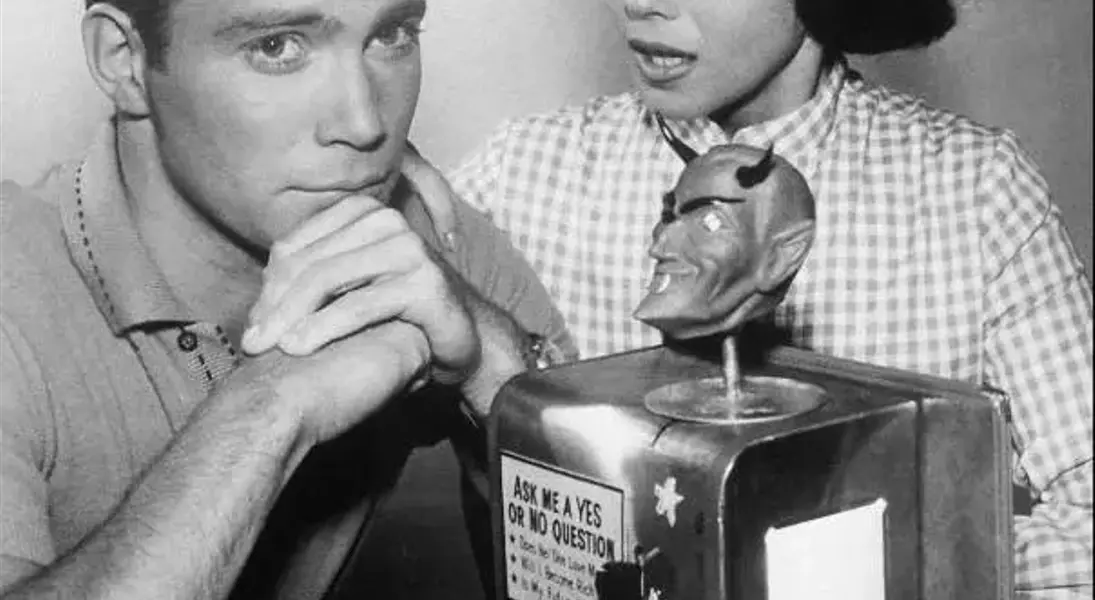
William Shatner's initial appearance in classic sci-fi television delivered an insightful study on human obsession and superstition. Stranded in a quiet diner, a superstitious traveler encounters a novelty fortune dispenser that seemingly predicts minor personal events. What begins as a harmless amusement quickly escalates into a gripping psychological ordeal, as the protagonist surrenders his personal agency to plastic fortune cards. The narrative serves as a powerful commentary on how individuals construct their own mental prisons through belief and fear. Enhanced by a simple yet striking villainous prop design, the storyline emphasizes that the true danger stems not from supernatural forces, but from man's inner willingness to be ruled by uncertainty and paranoia.
The Descent into Mechanical Obsession
When a young traveler finds his automobile disabled in a quiet provincial town, an ordinary pause during his trip transforms into an unexpected psychological test. Sitting in a local diner waiting for mechanical repairs, the protagonist discovers a tabletop fortune-dispensing mechanism that offers brief answers for a coin. Initial curiosity turns into acute anxiety as the fortune cards continuously coincide with real-life events, including career news. The protagonist's deep-seated superstition transforms a simple carnival novelty into an authoritative oracle, causing him to doubt his own decision-making ability. This shift illustrates how easily a rational mind can be swayed by perceived patterns, highlighting human vulnerability when faced with life's unpredictable moments. As the narrative unfolds, the focus remains on the psychological weight of surrender to external predictions. Every fortune card pulled adds another layer of mental restraint, turning a simple stopover into an intense exploration of fate, free will, and personal autonomy.
The story meticulously constructs a subtle, claustrophobic atmosphere within a seemingly mundane roadside diner setting. Rather than relying on otherworldly creatures or spectacular special effects, the tension builds entirely through human behavior and emotional escalation. As the main character repeatedly inserts coins into the fortune mechanism, his dependence on its ambiguous declarations deepens. Every affirmative or negative message dispensed by the device becomes a dictating force for his next movement. His companion attempts to introduce logic and reality into the situation, offering a grounded perspective against his growing fixation. However, the psychological trap has already taken hold, demonstrating how belief systems can distort objective reality. The protagonist becomes convinced that stepping outside the diner or making independent choices without consulting the mechanism will bring catastrophe upon his future. Through nuanced acting and precise pacing, the drama reveals the subtle mechanics of human compulsion and fear. What makes the narrative particularly resonant is its realistic portrayal of how superstition functions: it feeds upon insecurity, amplifies doubts, and gradually strips away an individual's confidence in their own judgment. Ultimately, the diner becomes a psychological arena where the ultimate struggle is not against an evil entity, but against one's own compulsion to seek certainty in an uncertain world.
Psychological Control and Symbolic Terror
The visual symbol at the heart of the narrative features a grinning devil figure mounted on the fortune-dispensing unit, serving as a constant reminder of psychological manipulation. This centerpiece captures the subtle irony of the protagonist's plight, mocking his willing submission to an inanimate piece of metal. Rather than possessing genuine supernatural capabilities, the device operates as a mirror reflecting the protagonist's internal fears and unfulfilled desires. The narrative underscores how human beings frequently assign profound meaning to random coincidences, building elaborate mental constructs that restrict their freedom. By focusing on the concept of self-imposed captivity, the episode delivers a timeless message regarding fear's ability to govern behavior. The protagonist's ultimate salvation relies not on destroying the machine, but on finding the inner resolve to walk away from its influence.
Central to the effectiveness of the story is its sharp exploration of how fear and anxiety construct invisible boundaries around human lives. The grinning devil prop atop the device functions as both a thematic anchor and a visual metaphor for mockingly observing human foolishness. Rather than establishing whether the fortune dispenser actually possesses foresight, the narrative deliberately leaves the mechanism's true nature ambiguous. This deliberate vagueness forces the focus entirely onto the protagonist's emotional state, emphasizing that the true antagonist is his own surrender to superstition. Throughout the narrative, the tension is amplified by the contrast between the mundane diner atmosphere and the protagonist's intense internal turmoil. His partner's persistent attempts to break the psychological spell highlight the importance of emotional support and rational thinking when confronting irrational panic. When the couple finally decides to abandon the device and step back into the outside world, it signifies a decisive triumph of human agency over fatalistic terror. The story concludes with a profound lesson on liberation, demonstrating that individuals possess the power to break free from self-constructed traps once they choose to trust their own capability rather than seeking external guarantees.
