
In recent times, the spotlight has predominantly been on artificial intelligence (AI) stocks, capturing significant investor attention. However, several other emerging technology companies have also demonstrated remarkable growth, with some even outperforming major AI players. These include innovations in quantum computing, electric vertical takeoff and landing aircraft (eVTOL), small modular nuclear reactors, and space-related ventures like rockets and satellites. The underlying sentiment is that the AI revolution has created a 'halo effect,' driving investors to seek out the next disruptive technology that could yield substantial returns, akin to early investments in platforms like ChatGPT. This speculative optimism has fueled dramatic increases in the stock values of many such tech firms.
Among these high-flying stocks, AST SpaceMobile, a company focused on establishing a satellite-based broadband network, stands out. Despite its nascent revenue generation, the firm's market valuation has soared to an impressive $31 billion. This surge is largely attributed to increasing excitement surrounding its business prospects and a series of new agreements, most notably an expanded partnership with Verizon. The company's innovative approach aims to provide global cellular broadband access to unmodified smartphones, bridging connectivity gaps in areas underserved by traditional terrestrial cell towers. While its technology holds considerable promise and its partnerships are growing, a critical examination of its current market valuation reveals potential overextension, especially when compared to established, revenue-generating telecommunication giants operating in a typically low-margin sector.
The Trajectory of AST SpaceMobile: Innovation and Market Frenzy
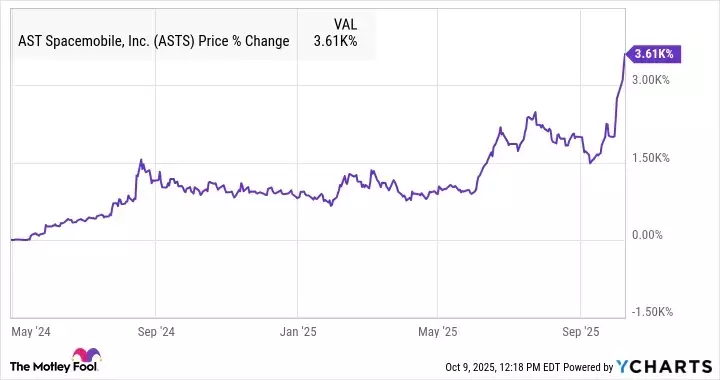
AST SpaceMobile, a pioneer in satellite-based broadband, has witnessed an extraordinary surge in its market value, primarily fueled by a broader investor enthusiasm for groundbreaking technological advancements. The company's unique proposition lies in its ability to connect standard smartphones directly to a global cellular network via low-Earth-orbit satellites, effectively bypassing the need for traditional cell towers in remote or underserved regions. This innovative approach has garnered significant attention and investment, leading to a substantial increase in its stock price, with some early investors seeing returns exceeding 3,000% within a relatively short period. The firm's strategy includes deploying a constellation of satellites and forging crucial partnerships with established telecom operators globally. These alliances, including a recently expanded collaboration with Verizon, underscore the potential impact of AST SpaceMobile's technology in revolutionizing worldwide mobile connectivity.
The company, established in 2017, initiated its mission by launching its first test satellite in 2019 and currently has six satellites orbiting Earth, with plans to expand this number to between 45 and 60 by 2026. These ambitious deployment goals aim to extend service coverage across major markets including the U.S., Europe, and Japan. Its partnerships with industry behemoths such as AT&T, Vodafone, and Rakuten are pivotal to its business model, which positions AST SpaceMobile as a key provider of satellite integration services for mobile network operators. The recent agreement with Verizon, involving the integration of AST SpaceMobile's network with Verizon's 850 MHz spectrum, highlights a strategic move to enhance coverage in previously inaccessible areas. While these developments paint a promising picture of future growth and technological leadership, the rapid appreciation of the company's stock price, reaching a market capitalization of $31 billion before significant revenue generation, raises questions about the sustainability of its current valuation.
Evaluating AST SpaceMobile's Sky-High Valuation Against Industry Realities
Despite AST SpaceMobile's impressive technological achievements and strategic partnerships, its current market capitalization of $31 billion presents a significant valuation challenge, particularly in the context of the mature and often low-margin telecommunications industry. The company anticipates generating initial revenues of $50 million to $75 million in the latter half of 2025, with projections of $254.9 million in revenue by 2026. However, these figures are modest when compared to its hefty market cap. For instance, established telecom companies like Verizon, with a market cap of $172 billion, generate nearly $20 billion in profits annually, while broadband providers such as Charter Communications, valued at $36 billion, reported $5 billion in net income last year. These comparisons suggest a potential disconnect between AST SpaceMobile's current valuation and the financial realities of its sector, where internet connectivity services typically command lower valuations due to intense competition and high infrastructure costs.
AST SpaceMobile's business model, which largely positions it as a subcontractor for larger telecom entities, ties its long-term financial prospects to an industry not known for blockbuster returns. While its global reach differentiates it from purely domestic service providers, the fundamental dynamics of the telecommunications market, characterized by significant capital expenditure and competitive pricing pressures, may cap its ultimate growth potential. The perceived 'total addressable market' for global wireless services, estimated at over $1.1 trillion annually, is indeed vast. However, achieving a substantial share of this market as an auxiliary service provider within an already established ecosystem might prove challenging. Consequently, while ongoing news of partnerships and satellite deployments could temporarily boost its stock, the company's valuation appears to be running ahead of its commercialization phase and the inherent nature of the telecom industry. Investors might face considerable risk, as the current market excitement could eventually give way to a more sober assessment of its long-term financial performance and market position.
