
Etsy, an online marketplace specializing in handmade and vintage items, has experienced a significant downturn since its removal from the S&P 500 index. Despite a substantial drop in its stock value, the company has maintained robust free cash flow and now trades at an unusually low valuation. This situation, combined with recent strategic developments, suggests that Etsy may be on the cusp of a turnaround, offering a potentially rewarding investment for patient shareholders.
Etsy's journey into the S&P 500 began in September 2020, a moment of considerable validation for the e-commerce platform. Its inclusion, notably preceding that of Tesla, signaled its emergence as a significant player in the U.S. market. However, this period of prominence was relatively short-lived. By 2024, just four years after its initial inclusion, Etsy was delisted from the index. The primary reason cited was that the company's market capitalization no longer accurately reflected a large U.S. enterprise, leaning more towards a small-cap designation. Following its peak in late 2021, Etsy's stock price plummeted by approximately 80% leading up to its removal, and it currently remains 76% below its all-time high. This dramatic decline has, however, created a scenario where the company's valuation appears exceptionally attractive to investors.
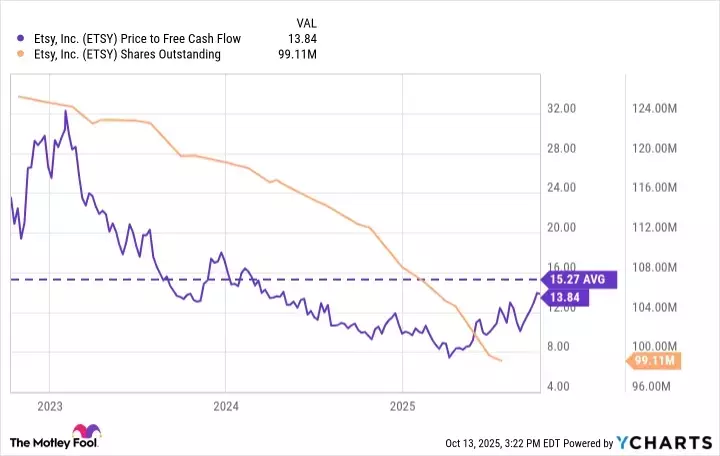
Despite the stock's steep decline, Etsy's underlying business has demonstrated remarkable resilience. The company has consistently generated substantial free cash flow, indicating a healthy operational core. Its current price-to-free-cash-flow valuation stands at less than 14, a level rarely seen since its initial public offering a decade ago. This low valuation has allowed management to execute significant share buybacks over the past three years, reducing the number of outstanding shares by 21%. Such aggressive buyback programs typically signal management's confidence in the company's intrinsic value and can enhance shareholder returns by increasing earnings per share.
Intriguingly, historical market data offers a beacon of hope for companies like Etsy that are delisted from major indices. Research by Rob Arnott and Forrest Henslee in 2024 revealed a pattern where stocks removed from the S&P 500, after an initial period of underperformance, tend to outperform the broader market by several percentage points annually over a five-year horizon. This phenomenon is attributed to the fact that delisted stocks often become significantly undervalued due to a lack of institutional support and retail investor disappointment. Once the market adjusts and recognizes their true value, these stocks frequently rebound. Etsy's current low valuation aligns perfectly with this historical trend, suggesting that its stock may have already reached its lowest point.
Beyond historical patterns, Etsy's future growth could receive an unexpected boost from a new partnership. The company recently announced an integration with ChatGPT, making it the first e-commerce platform to directly link with the AI. This collaboration could revolutionize how users discover and purchase products on Etsy, allowing them to find items without leaving the ChatGPT interface. If this integration proves successful in driving new user adoption and engagement, it could provide the much-needed catalyst to reignite Etsy's growth trajectory, which has seen active buyer numbers flatten or even decline recently. For instance, active buyers on the platform decreased by nearly 5% to 87 million in the second quarter of 2025, down from 96 million at the end of 2021.
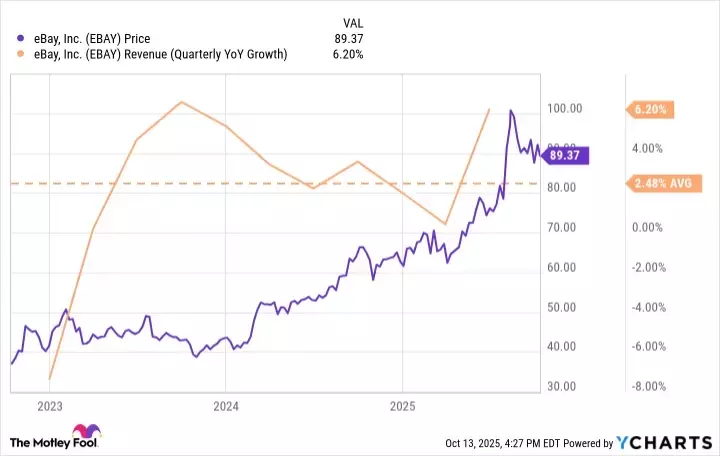
A compelling parallel can be drawn with eBay, another e-commerce giant that faced growth stagnation. Despite modest revenue growth averaging 2.5% over three years, eBay's stock surged by 141% during the same period. This was largely due to its management's strategic share buybacks, which reduced outstanding shares by 33% over five years, and an eventual return to stronger growth rates. If Etsy can leverage its current undervaluation, aggressive buyback strategy, and the potential impact of its ChatGPT integration to reignite its adoption rates, it could follow a similar path to market outperformance, proving that even after being cast out of a prestigious index, a strong business can find its way back to success.
