Global stock markets have recently scaled new heights, with major indexes achieving record closes. This upward trend is largely influenced by updated employment figures, which suggest a slowdown in U.S. job creation. Such data bolsters the case for potential interest rate cuts by the central bank later in the year. Concurrently, market participants are keenly awaiting forthcoming inflation reports, which are expected to offer critical insights into the economic landscape and guide future policy decisions.
Market Indices Soar on Shifting Economic Outlook
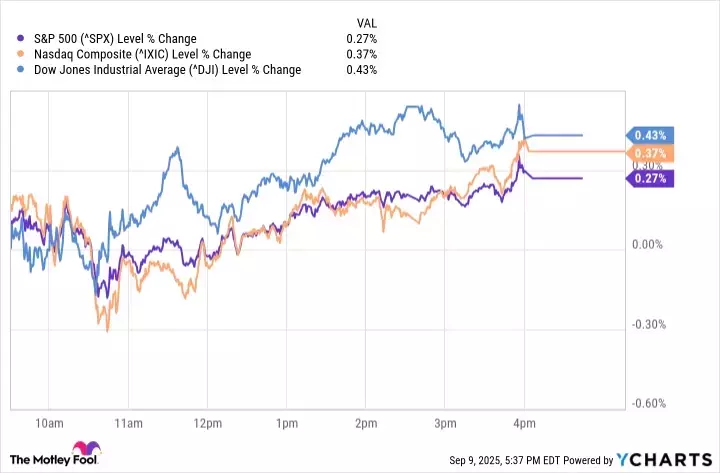
On Tuesday, leading market indicators, including the S&P 500, Nasdaq Composite, and Dow Jones Industrial Average, all closed at unprecedented levels. The S&P 500 advanced by 0.27% to 6,512.61, the Nasdaq Composite increased by 0.37% reaching 21,879.49, and the Dow Jones Industrial Average climbed 0.43% to 45,711.34. This broad market appreciation marks a continuation of a September rally, fueled by a growing consensus that the Federal Reserve might soon implement a rate cut. The catalyst for this sentiment was the revised payroll data, indicating a significant downward adjustment of over 900,000 positions through March, suggesting a softer U.S. job market than previously estimated. While this signals an economic cooling, it simultaneously reinforces the belief that the Fed could ease its monetary policy, making borrowing cheaper and potentially stimulating economic activity.
The record-breaking performance of the equity markets on Tuesday underscores a prevailing optimism among investors, driven by the latest economic indicators. The S&P 500, Nasdaq Composite, and Dow Jones Industrial Average each achieved new all-time highs, reflecting a robust September rally. This bullish trend is largely predicated on the expectation of an impending interest rate reduction by the Federal Reserve. The revised U.S. payroll data, revealing a weaker-than-anticipated job growth with a substantial adjustment of over 900,000 positions, has been a key factor. This moderation in labor market momentum, while signaling a cooling economy, paradoxically strengthens the argument for the Fed to consider easing its monetary policy later this year. The market is now poised for the release of crucial inflation reports, which will serve as a pivotal determinant for confirming the abatement of price pressures and influencing the Fed's next policy moves.
Corporate Performance and Future Economic Indicators
In corporate news, the healthcare sector demonstrated strong performance, with UnitedHealth Group Inc. leading the way. Concurrently, Nebius Group experienced a significant surge, gaining nearly 50% following its announcement of an artificial intelligence infrastructure collaboration with Microsoft Corp. These corporate developments reflect targeted growth areas within the market, even as broader economic concerns about inflation and interest rates persist. Investors are now intently focused on the forthcoming Consumer Price Index (CPI) and Producer Price Index (PPI) reports. These inflation metrics are crucial for assessing whether price pressures are indeed moderating, which would be a key condition for the Federal Reserve to consider adjusting its monetary policy. The outcomes of these reports are expected to significantly influence market sentiment and investor strategies in the lead-up to the Fed's next meeting.
The corporate landscape saw notable movements, particularly within the healthcare industry, where UnitedHealth Group Inc. showcased a strong performance. Meanwhile, Nebius Group’s shares saw a dramatic increase of nearly 50%, attributed to its strategic partnership with Microsoft Corp. in artificial intelligence infrastructure development. These individual company successes highlight specific sectors’ resilience and growth potential. However, the overarching market narrative remains tied to macroeconomic data, particularly inflation. The investment community is eagerly awaiting the release of the Consumer Price Index (CPI) and Producer Price Index (PPI) data. These reports are critical because they will provide the latest insights into the state of inflation, helping to confirm if inflationary pressures are indeed subsiding. Such confirmation is essential for reinforcing expectations of a Federal Reserve rate cut, which would have broad implications for various asset classes. The market's direction in the near term will largely be shaped by these upcoming economic data releases and their potential impact on monetary policy decisions.
