
The ongoing legal battle between Epic Games and Google has reached another pivotal point, with a recent appeals court decision affirming Epic's claims of monopolistic practices by Google. This ruling could fundamentally alter the landscape of app distribution on Android, promoting a more open and competitive environment.
A Landmark Decision: The Unraveling of Google's App Store Dominance
Appeals Court Upholds Monopoly Verdict Against Google
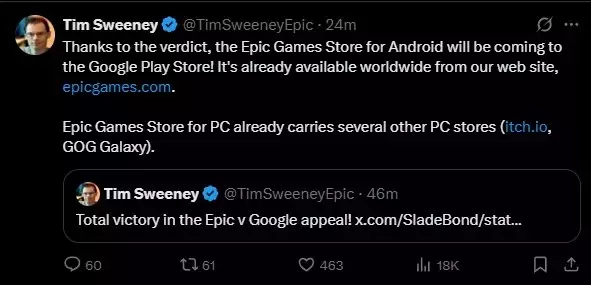
Epic Games has achieved a significant legal victory as the Ninth Circuit Court of Appeals reaffirmed the 2023 jury's finding that Google's app store and payment systems operate as unlawful monopolies. This decision is poised to reactivate a prior injunction, mandating Google to open its Android platform to alternative app stores. Epic's CEO, Tim Sweeney, celebrated this outcome, declaring it a comprehensive triumph.
The Impending Transformation of the Android Ecosystem
Following the court's affirmation, Google has indicated its intention to appeal to the Supreme Court. However, this appeal might not halt the enforcement of the injunction. Google may soon be compelled to allow third-party app stores on Android, a move previously ordered in 2024. This development could fundamentally reshape how applications are distributed and monetized within the Android ecosystem.
Unveiling Epic's Strategic Maneuvers and Google's Internal Concerns
The original lawsuit, initiated by Epic in 2020 after Fortnite's removal from app stores, strategically targeted the monopolistic practices of major tech platforms. Unlike its case against Apple, Epic's dispute with Google highlighted Google's secret revenue-sharing agreements and internal anxieties regarding potential competition from other app stores. These revelations underscored the jury's unanimous decision against Google.
Distinguishing Market Definitions: Google's Android vs. Apple's iOS
The appeals court explicitly distinguished between the market dynamics of Google's Android and Apple's iOS, rejecting the notion that Apple's competitive presence negates Google's monopoly on Android. The court emphasized the inherent differences in their business models, with Google's more "open distribution" approach contrasting sharply with Apple's "walled garden." This distinction was crucial in affirming Google's monopolistic control over Android app distribution and in-app billing.
