This analysis delves into the concept of "Pareto upgrades" within investment portfolios, detailing how judiciously switching to inherently better securities from the same issuer can markedly improve investment yield without introducing additional risk. It showcases the profound cumulative effect of these incremental gains, using historical and contemporary examples from various financial instruments. The discussion underscores how market inefficiencies frequently present such opportunities, often overlooked by the broader investor community.
Strategic Investment Enhancements: A Deep Dive into Pareto Upgrades
In the dynamic realm of investment, identifying opportunities to enhance returns while maintaining or reducing risk is paramount. One such sophisticated strategy gaining traction is the implementation of "Pareto upgrades." This method, rooted in economic theory, advocates for transitioning investments into securities that offer superior benefits in at least one aspect, without compromising on other critical factors.
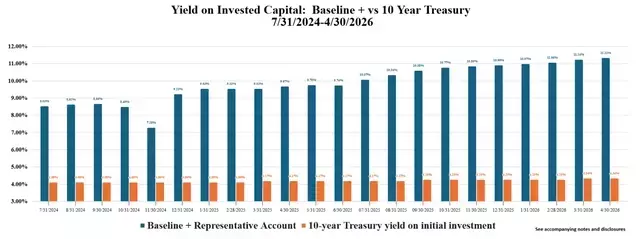
A recent case study vividly illustrates the power of this approach. Over a span of less than two years, a portfolio meticulously employing Pareto upgrades witnessed its yield on invested capital surge from 8.53% to an impressive 11.33%. This substantial increase underscores the efficacy of consistently pursuing marginal improvements.
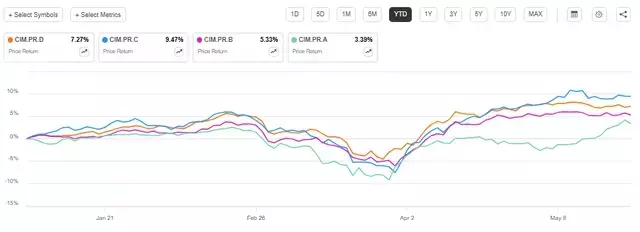
Consider the varying preferred stock series issued by the same corporation. While these typically carry identical risk profiles and represent equivalent claims on the issuer's assets, their market prices often diverge. This disparity creates a fertile ground for Pareto upgrades. For instance, if Series A preferred shares trade at a more attractive yield-to-maturity (YTM) or offer greater potential upside to par value compared to Series B, an investor holding Series B can execute a Pareto upgrade by switching to Series A. This tactical maneuver captures additional basis points in yield without altering the fundamental risk exposure.
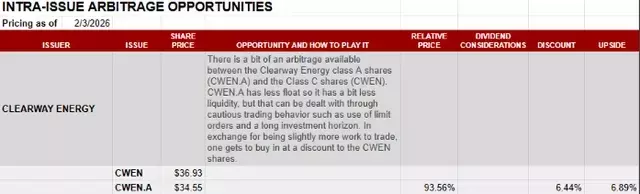
Historically, Clearway Energy provided a compelling example with its Class A and Class C common stocks. Despite representing claims on the same underlying company, the Class A shares consistently traded at a discount. Savvy investors who recognized this discrepancy and invested in Class A were handsomely rewarded when the company eventually consolidated its share classes, effectively realizing the arbitrage. Similarly, Lennar's Class B shares currently present a potentially superior opportunity compared to its Class A counterparts.
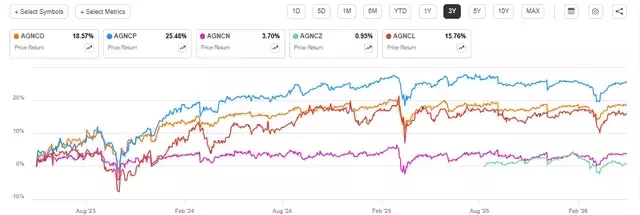
Even within the complex landscape of AGNC Investment Corp.'s preferred shares, where floating rate schedules introduce nuances, astute observation of market fluctuations has repeatedly unveiled opportunities for Pareto upgrades. By deftly moving between different AGNC preferred issues as their relative attractiveness shifts, investors can consistently capture incremental yield.
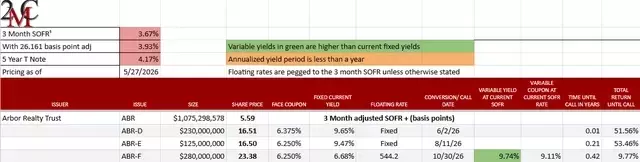
A concrete, actionable example exists today with Arbor Realty's preferred shares. Currently, ABR-D preferreds offer a yield of 9.65%, which is an 18 basis point advantage over ABR-E's 9.47%, with both trading at comparable prices and thus possessing identical upside potential to par. For investors holding ABR-E, a direct upgrade to ABR-D would yield an immediate, risk-free increase in income. Furthermore, ABR-D appears significantly more attractive than ABR-F, particularly given the substantial difference in upside to par, even though the latter's floating rate mechanism prevents a direct Pareto comparison.
The prevalence of these overlooked market inefficiencies, particularly in pari-passu preferreds and different share classes, highlights a critical area where informed investors can gain a distinct advantage. While each individual upgrade might seem minor, their cumulative, compounding effect on a portfolio's overall yield can be transformative.
The concept of Pareto upgrades, though seemingly focused on minor gains, holds immense potential for long-term investment success. By consistently identifying and executing these low-risk, yield-enhancing trades, investors can significantly amplify their returns. This strategy encourages a granular, meticulous approach to portfolio management, rewarding diligence and a keen eye for market inefficiencies. The cumulative power of small, strategic adjustments far surpasses the passive returns of conventional investment methods, demonstrating that even subtle improvements can lead to substantial wealth creation over time.
