This article delves into the concept of an economic 'soft landing,' a crucial objective for central banks aiming to manage inflation without precipitating a recession. It explores the definition, historical context, and the inherent challenges involved in steering an economy through periods of growth and contraction.
Navigating Economic Turbulence: The Quest for a Gentle Descent
Defining the 'Soft Landing' in Economic Terms: A Controlled Deceleration
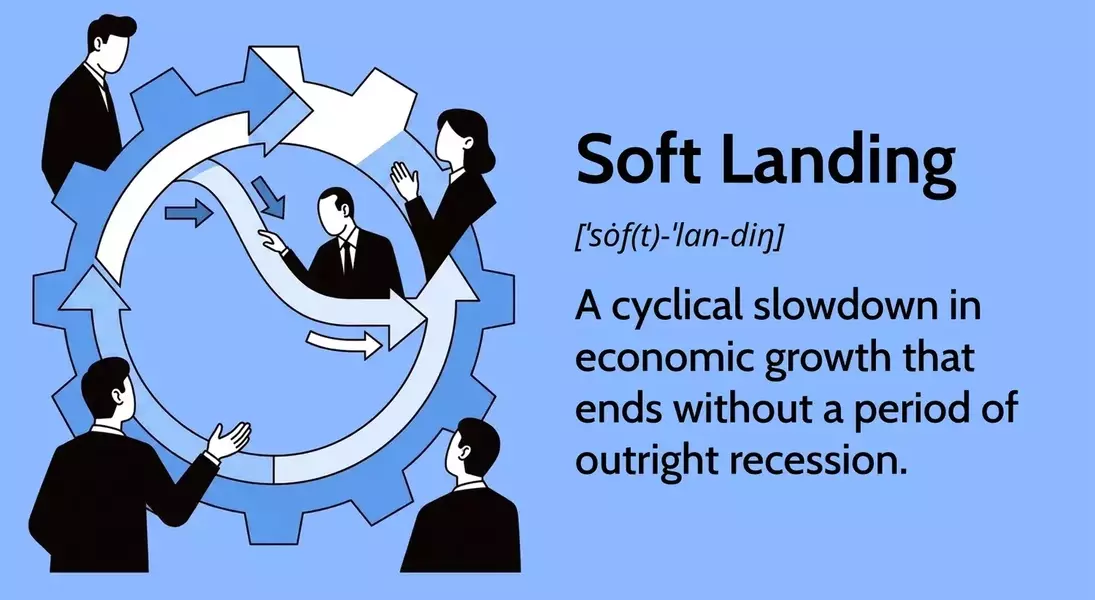
An economic 'soft landing' signifies a cyclical reduction in economic growth that concludes without escalating into an outright recession. This outcome is the aspiration of a central bank when it endeavors to elevate interest rates sufficiently to prevent an economy from overheating and enduring high inflation, yet not to such an extent that it provokes a severe economic contraction. The term 'soft landing' can also be applied to a gradual, relatively benign slowdown within a major industry or specific economic sector.
Historical Context and Practical Application of Soft Landings in Economic Management
Although modern air travel routinely achieves smooth landings, the Federal Reserve's history of interest-rate adjustment cycles has not demonstrated a consistent record of such routine success. The phrase 'soft landing' gained prominence during Alan Greenspan's tenure as former Federal Reserve chair, when he was widely credited with orchestrating one in 1994-1995. Jerome Powell, the current Federal Reserve Chair, has also pointed to successful soft landings in 1965 and 1984, and indicated that another was underway in 2020 before the intervention of the COVID-19 pandemic. Conversely, a recession followed each of the last five instances where inflation surpassed 5%, specifically in 1970, 1974, 1980, 1990, and 2008. In 2022, inflation once again exceeded 5%. The economy technically entered a recession, defined by two consecutive quarters of negative GDP growth, after the first and second quarters of that year. However, the third quarter showed a reversal, with positive growth in the gross domestic product (GDP). To counteract inflation, the Fed implemented interest rate increases throughout 2022, leading to a decrease in inflation coupled with economic growth in the third quarter.
The Intricate Balancing Act: Obstacles and Considerations for a Smooth Economic Transition
The Federal Reserve's track record in achieving soft landings is, at best, mixed, primarily because the central bank does not wield the same degree of control over the economy as a pilot does over an aircraft. The Fed's primary policy instruments—interest rates and asset holdings—are blunt tools incapable of resolving issues such as supply chain disruptions or pandemic-induced shocks. Former Fed chair Ben Bernanke once humorously dismissed another vehicular analogy, stating that "if making monetary policy is like driving a car, then the car is one that has an unreliable speedometer, a foggy windshield, and a tendency to respond unpredictably and with a delay to the accelerator or the brake." The events that have unfolded since then have not made the Fed's task appear any simpler.
Soft Landing vs. Hard Landing: Navigating Central Bank Policy
A central bank manages inflation by adjusting interest rates. Increasing rates aims to reduce spending when inflation is high. A 'hard landing' occurs if rates are raised too aggressively, pushing the economy into recession. Conversely, a 'soft landing' is the goal when rates are increased cautiously to control inflation without triggering a significant downturn. This delicate balance is challenging, as a hard landing carries severe negative consequences.
Understanding the Root Causes of Inflation
Inflation primarily stems from four key factors: demand-pull inflation, which arises when demand for goods and services outstrips available supply; cost-push inflation, caused by rising production costs; an expansion of the money supply; increasing wages; and the devaluation of a nation's currency. These elements can individually or collectively drive up prices across an economy.
Key Tools of Monetary Policy: Controlling the Economic Flow
Central banks employ three principal instruments to execute monetary policy. These include setting the reserve requirements for banks, which dictates the proportion of deposits banks must hold; adjusting the discount rate, the interest rate charged to financial institutions borrowing from the central bank; and conducting open market operations, which involves the buying and selling of government securities to influence the money supply.
The Complex Art of Achieving a Smooth Economic Transition
The Federal Reserve's efforts to achieve a soft landing are complicated by policy lags, as the economy does not immediately respond to changes in monetary policy. Consequently, the Fed must decide the pace of interest rate increases without fully observing the effects of previous adjustments. These limitations imply that chance plays a role as significant as skill in engineering a smooth economic transition.
