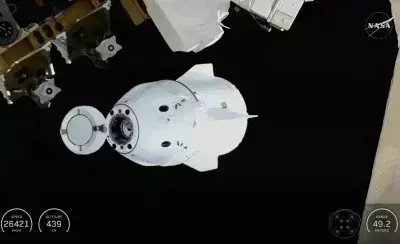
The Crew-11 mission, spearheaded by NASA, faced an unforeseen conclusion as its four astronauts were compelled to depart the International Space Station ahead of schedule due to an urgent medical situation. This event marks a notable moment in space exploration history, being the inaugural medical evacuation from the orbiting outpost and the first mission cut short by health concerns in over two decades of continuous human presence on the ISS.
A Precedent-Setting Return: Health Crisis Forces Early Space Mission Conclusion
Emergency Descent: The Crew's Unexpected Journey Home
The four astronauts comprising NASA's Crew-11 mission successfully landed in the Pacific Ocean near San Diego. Their SpaceX Dragon capsule completed a journey of roughly ten hours from the International Space Station, marking the conclusion of the first-ever medical evacuation from the orbital laboratory.
Undocking and Splashdown: A Swift Departure
On Wednesday, at 5:20 p.m. EST, the crew's spacecraft detached from the station as it orbited 260 miles south of Australia. The return culminated in a predawn splashdown at 3:41 a.m. EST on Thursday, facilitated by parachutes. This event signified the premature end of the Crew-11 mission, which was curtailed by approximately one month.
Historic Medical Evacuation: A First for NASA
This incident represents a significant milestone in NASA's history, being the first instance where a medical emergency led to an early termination of a space mission. Furthermore, it stands as the initial medical evacuation in more than a quarter-century of uninterrupted human occupation of the space station.
Confidential Health Concerns: Privacy in Space
In adherence to health privacy regulations, NASA has refrained from disclosing the name of the affected astronaut or the specific medical condition that prompted their early return.
Crew Composition and Early Return Decision: A United Front
The crew, consisting of NASA astronauts Zena Cardman and Mike Fincke, Japan Aerospace Exploration Agency (JAXA) astronaut Kimiya Yui, and Russian cosmonaut Oleg Platonov, had their mission abbreviated due to the medical necessity. The decision for their early return was finalized a week prior, following the notification of a serious, yet stable, medical issue affecting one of the astronauts. This health concern necessitated the cancellation of a scheduled spacewalk. Consequently, the entire crew was brought back to Earth for medical assessment, as the capsule served as their sole mode of transport to and from the space station.
Mission Duration and Orbital Achievements: A Journey Cut Short
The mission commenced on August 1, 2025, with the launch of a SpaceX Falcon 9 rocket from NASA's Kennedy Space Center in Florida. Over their tenure, the crew accumulated 167 days in space, with 165 days spent aboard the space station. During this period, they completed 2,672 orbits around Earth, covering an impressive distance of 70.8 million statute miles.
Reduced Station Crew: Implications for Operations
The departure of Crew-11 leaves the International Space Station with a reduced complement of three personnel. The remaining crew members include Roscosmos cosmonauts Sergey Kud-Sverchkov and Sergey Mikayev, alongside NASA astronaut Christopher Williams. They had arrived at the station in a Soyuz capsule on November 27, 2025, shortly after their launch from the Baikonur Cosmodrome in Russia.
Impact on Station Activities: Fewer Hands on Deck
Since SpaceX initiated operational missions to the station in 2020, the International Space Station has typically maintained a crew of seven. The current reduction in personnel implies a decrease in the number of scientific experiments and maintenance tasks that can be conducted on the ISS. The next crew rotation for the station, SpaceX's Crew-12 mission, is slated for launch no earlier than February 15 from Florida's Space Coast. This mission is expected to transport NASA astronauts Jessica Meir and Jack Hathaway, European Space Agency astronaut Sophie Adenot, and Russian cosmonaut Andrey Fedyaev to the station.
