
Dutch Bros, an emerging force in the beverage industry, is garnering attention for its robust growth trajectory and innovative business strategies. This article delves into the various facets that position Dutch Bros as a compelling investment opportunity, exploring its unique market approach, ambitious expansion goals, and strengthening financial standing.
Brewing Success: Why Dutch Bros is Poised for Long-Term Investor Rewards
A Distinctive Product Portfolio Driving Youth Engagement
Unlike conventional coffee establishments, Dutch Bros sets itself apart by focusing on a diverse range of handcrafted, often customized, beverages. A significant portion of its revenue, approximately 87%, stems from iced or blended drinks, while a quarter comes from its popular Rebel energy drinks. This strategic emphasis resonates strongly with younger demographics, particularly Generation Z, who exhibit a marked preference for such beverage categories over traditional hot coffee. This alignment with evolving consumer tastes positions Dutch Bros advantageously within the expanding energy drink market, projected to grow over 40% by 2032.
Ambitious Store Growth Targets and Geographical Reach
Dutch Bros has laid out an aggressive strategy for physical expansion. With over 1,000 existing locations, the company aims to nearly double its footprint to 2,029 stores by 2029. This ambitious target is supported by consistent new store openings, with approximately 160 planned for 2025, and a mid-teen percentage annual growth in new shops for the foreseeable future. Furthermore, Dutch Bros envisions an even larger long-term presence, targeting over 7,000 locations nationwide. Currently operating in only 18 states, with plans to enter five more in 2025, the brand's potential for geographical expansion remains vast, underpinned by the consistent performance of its newer outlets.
Achieving Financial Self-Sufficiency Through Positive Cash Flow
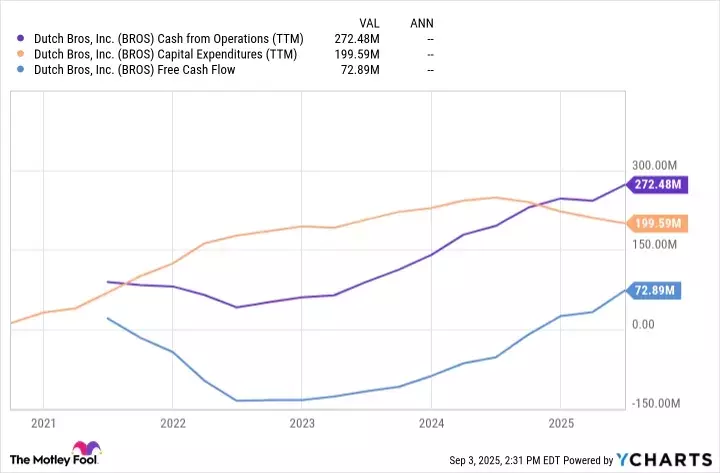
A pivotal development for Dutch Bros is its recent achievement of positive free cash flow (FCF). Despite substantial capital expenditures necessitated by its rapid expansion, the company has reached a point where its operations generate enough cash to fund its growth internally. This eliminates the need for external financing through debt or equity dilution, signaling a mature and sustainable financial model. Moreover, even without the heavy reinvestment in new stores, Dutch Bros demonstrates strong operational efficiency, converting 18 cents of every dollar in sales into cash from operations.
The Untapped Potential of Mobile Ordering
The recent introduction of mobile ordering across all Dutch Bros locations presents another significant growth avenue. While currently accounting for only 11.5% of total transactions, this channel offers considerable room for growth. Mobile ordering streamlines the customer experience, improving drive-thru efficiency and catering to consumers seeking convenience. Early indications show an increase in order frequency, particularly during morning hours, suggesting that this digital initiative can capture sales that might otherwise be missed due to time constraints.
Exploring New Revenue Streams: The Food Initiative
Food sales currently represent less than 2% of Dutch Bros' total revenue, indicating a substantial opportunity for diversification. While the integration of food into a beverage-centric business can be challenging, as evidenced by Starbucks' experience, leading coffee chains typically derive about a quarter of their sales from food items. Dutch Bros is actively piloting a food program, with a full rollout anticipated by 2026. Initial results show incremental growth in morning orders, suggesting that a successful food offering could significantly boost same-store sales and overall profitability.
Understanding Dutch Bros' Valuation in the Context of Its Growth Story
Although Dutch Bros' current price-to-earnings (P/E) ratio may appear high to some investors, a more nuanced perspective on its valuation is crucial. When examining its cash flow from operations relative to its market capitalization, the company trades at approximately 47 times CFO. While still a premium, this valuation appears more justifiable for a company with a clear path to doubling its store count within the next four years. Despite the inherent execution challenges, the collective strength of these growth catalysts suggests that Dutch Bros possesses the potential to deliver considerable value to investors, not only by 2030 but also in the decades that follow.
