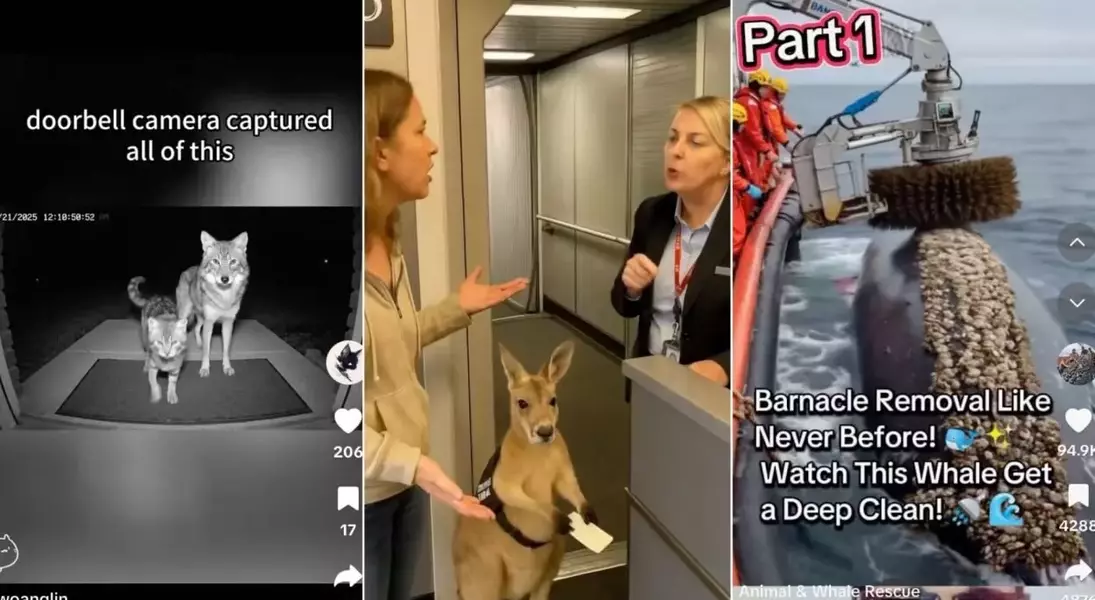
The rapid advancement of artificial intelligence has blurred the lines between genuine and fabricated visual content, particularly in the realm of online videos. With AI-generated clips achieving startling realism, it's becoming progressively difficult for the average viewer to discern what's authentic. This guide aims to equip you with the knowledge and tools to critically evaluate viral videos and recognize the subtle, yet telling, signs of AI manipulation.
Unmasking the Machine: Your Guide to Spotting Fabricated Digital Content
The Evolving Landscape of Synthetic Media: Recognizing AI's Influence
The realism of AI-generated video has reached an unprecedented level, becoming alarmingly convincing. Consequently, our digital feeds are inundated with seemingly flawless short clips—such as incredibly adorable animals bouncing on trampolines—amassing millions of views across popular platforms like TikTok, Shorts, and Reels. Given that AI content now blends almost imperceptibly into our daily scroll, discerning what's real is no longer straightforward. So, how can one effectively determine if a trending video is a product of AI?
The Challenge of Identification: The Elusive Nature of AI-Generated Content
Truthfully, there isn't a definitive checklist for pinpointing an AI-generated video. Negar Kamali, an AI research scientist at Northwestern University's Kellogg School of Management, noted last year that even without discovering a specific anomaly, it's impossible to be entirely certain a video is real, highlighting the core dilemma. The traditional signs—distorted faces, abnormal hands, or unnaturally smooth textures—are increasingly difficult to detect as the technology improves. Temporal inconsistencies are being refined. Yet, much like those uncanny animal clips captured by fake doorbell cameras, the truth often resides in the minute details. It's in these subtle imperfections that the artificial façade tends to crumble.
The Rise of Advanced AI Video Creation Tools: A New Era of Digital Artistry
A significant part of this challenge stems from the technology itself. Tools such as OpenAI's Sora and Google Veo 3 are now capable of producing cinematic footage complete with intricate camera movements, natural lighting, and convincing textures. These platforms are far from mere novelties; they are encroaching upon professional filmmaking territory, making the distinction between human-shot footage and AI-generated content remarkably thin. This means that identifying the 'tells' in popular AI videos requires keener observation and a healthy dose of skepticism.
Initial Assessment: Prioritizing Contextual Clues in Video Analysis
Many AI videos are designed within peculiar settings—frequently at night, utilizing a night vision effect with an onyx filter. This isn't merely an 'aesthetic' choice; dark filters conveniently conceal minor glitches and frame-to-frame inconsistencies that are prevalent in AI-generated footage.
Evaluating Authenticity: Scrutinizing Device Specifics
If a video purports to originate from a doorbell camera or security feed, look for characteristic elements like timestamps, manufacturer logos, and user interface overlays. Their complete absence should raise suspicion. Conversely, the presence of these indicators does not automatically confirm the video's authenticity.
Adherence to Physical Laws: Analyzing Movement and Interaction
Real-world motion adheres to specific physical rules. For instance, animals do not execute perfectly synchronized, repetitive jumps for extended periods. Observe, for example, the unrealistic movement of a whale's tail that appears to pull a worker onto a ship's deck, defying natural physics.
Duration as an Indicator: The Significance of Video Length
Shorter video clips provide AI with fewer opportunities to expose its imperfections. This is precisely why many viral synthetic videos conclude just before an anomaly might become apparent. Hany Farid, a computer science professor and digital forensics expert at UC Berkeley, emphasized that if a video is only 10 seconds long, viewers should be wary, as there's often a deliberate reason for its brevity. Similarly, if a longer video is composed of numerous very short, stitched-together clips, skepticism is warranted. Most AI video generators are currently limited to producing short segments. Google Veo 3, a leading generative AI video model, creates 8-second clips, while Sora, from ChatGPT-maker OpenAI, generates videos ranging from one to 20 seconds.
Auditory Examination: The Role of Sound in Detecting AI Content
Synthetic videos often feature unusually clear audio, mismatched ambient sounds, or a complete lack thereof. Aruna Sankaranarayanan, a research assistant at MIT's Computer Science and Artificial Intelligence Laboratory, highlighted the difficulty in disproving fabricated content that distorts facts. Silent or unnaturally pristine soundscapes can serve as significant clues.
Textual Inconsistencies: Unmasking AI's Linguistic Flaws
AI still struggles with rendering readable text. Examine any writing on clothing, signs, or packaging within the video frame; warped letters, random symbols, or nonsensical text are consistent indicators of AI generation. Farid observed that if an image gives the impression of clickbait, it likely is. A prime example is a viral video featuring an emotional support kangaroo; upon closer inspection, the text on its vest reveals inconsistencies.
Observing Unnatural Motions: The Subtle Art of Identifying AI Anomalies
Human and animal movements are characterized by subtle weight shifts, irregular gaits, and minute, often unconscious, actions. AI-generated creations frequently lack these nuanced details. A closer look can often reveal bizarre inconsistencies, such as multiple figures merging into one, or vice versa. Farid pointed out temporal inconsistencies where buildings might spontaneously add a story or cars change colors, actions that are physically impossible in reality.
Watermarks and Digital Signatures: Identifying Hidden Markers of AI Origin
Some AI video generators, including Sora and Veo 3, automatically embed watermarks or metadata to identify synthetic content. These marks can appear as subtle corner indicators, faint overlays, or hidden digital signatures within the file's data. While digital watermarks like SynthID from Google DeepMind show promise, it's important to note that watermarks can be removed or cropped from viral videos.
Investigating Account History: A Crucial Step in Content Verification
Many AI videos are mass-produced by content farms. If a video seems suspicious, examine the account that posted it. Often, you'll discover a history of dozens, or even hundreds, of nearly identical AI-generated videos uploaded within a short timeframe. This pattern is a significant red flag indicating that the video you just watched was created by AI.
