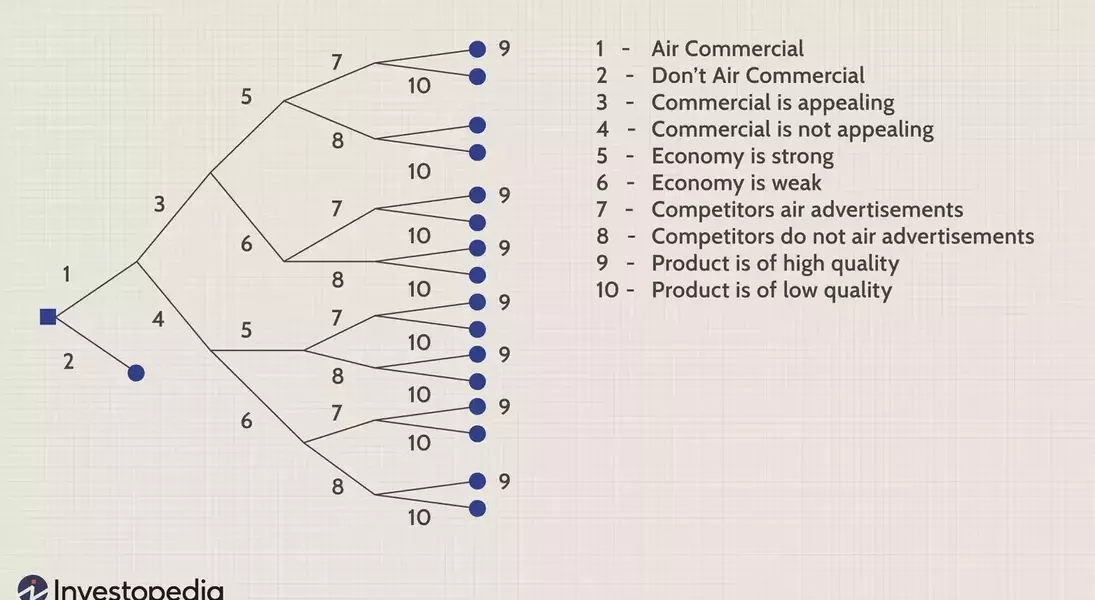
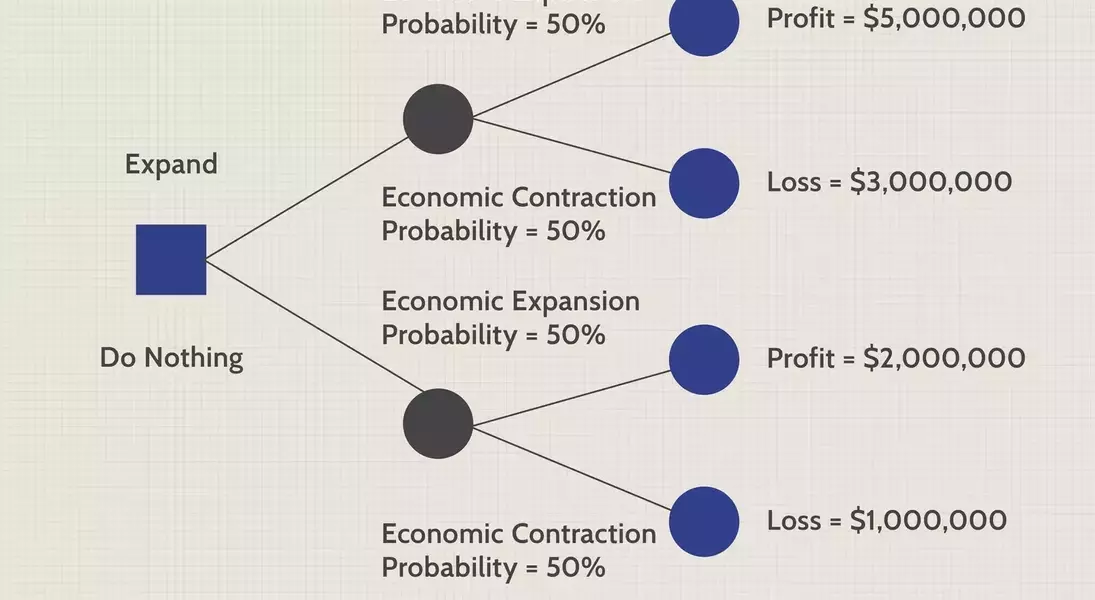


Decision trees are fundamental instruments in finance, offering a clear framework for navigating complex choices and evaluating potential outcomes. These graphical representations facilitate strategic decision-making by illustrating various paths, risks, and probabilities associated with different courses of action. While widely recognized in academic settings, their practical application in corporate finance and economic forecasting is often underestimated.
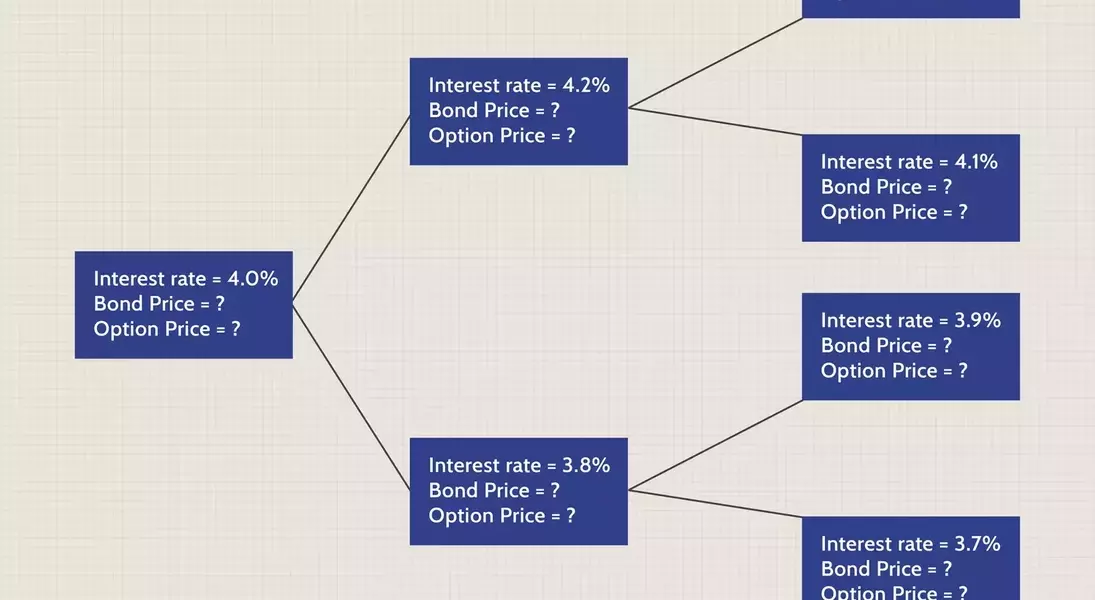
One prominent application of decision tree analysis is in the realm of option pricing, particularly with the binomial option pricing model. This model utilizes discrete probabilities to ascertain an option's value at its expiration date. For European options, simpler binomial models assume an asset's value will either increase or decrease based on predetermined probabilities. However, the complexity escalates with American options, which can be exercised at any point before maturity. In such cases, the binomial tree accounts for numerous price trajectories the underlying asset might follow. As the number of nodes expands, this model increasingly aligns with the Black-Scholes formula, although advanced software can simulate infinite nodes for more precise pricing, especially for exotic options and dividend-paying stocks.
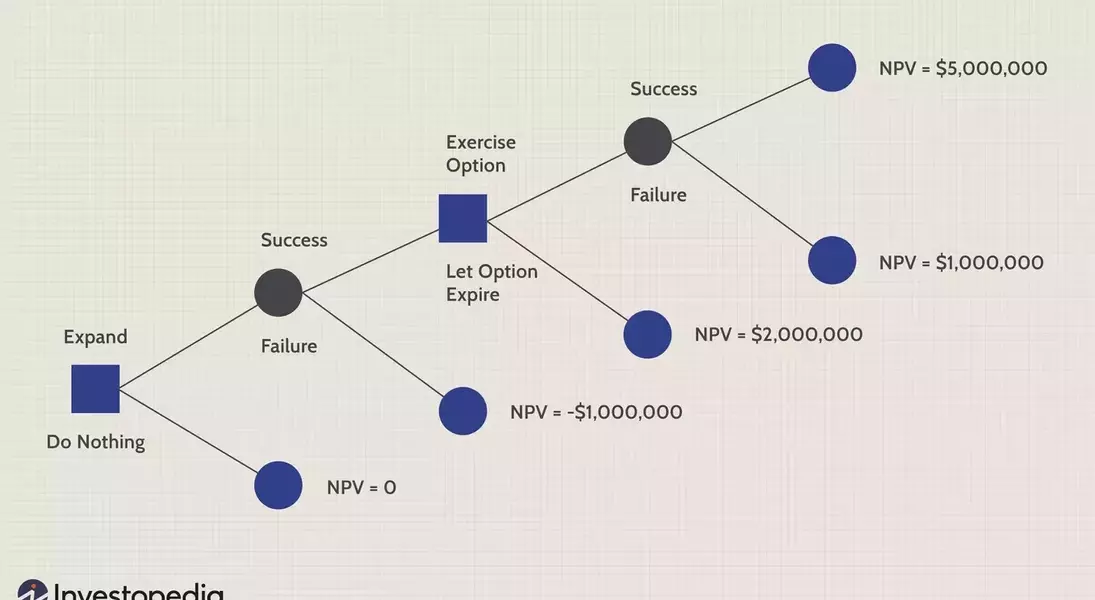
Beyond option valuation, decision trees are indispensable for real options analysis, a method not amenable to the Black-Scholes formula. Real options pertain to tangible business decisions, such as scaling operations up or down. For instance, an energy firm might use a decision tree to evaluate purchasing land for drilling. If initial explorations are successful, the company can then acquire adjacent plots. Conversely, if drilling proves unproductive, the option to buy more land would simply lapse. By integrating real option values, projects initially appearing to have a negative net present value (NPV) can reveal a positive one, underscoring the importance of decision trees in capital budgeting. This analytical approach also extends to competitive business scenarios, helping companies systematically assess alternatives in areas like product development, human resources, operations, and mergers, and acquisitions. While not suitable for every minor decision, decision trees offer a robust structure for tackling significant strategic challenges and understanding the ramifications of crucial choices.
Although decision trees are invaluable, they do have limitations. Their complexity can become unwieldy with many variables, leading to the “curse of dimensionality.” They also depend on subjective probability estimates, which might not always accurately reflect future market behavior or risk. Furthermore, decision trees may struggle with correlated variables common in finance, such as the interdependencies between interest rates, inflation, and stock prices, often oversimplifying these intricate relationships. For handling continuous data and non-linear patterns prevalent in financial markets, more advanced techniques like neural networks might offer superior insights. To manage complexity and enhance accuracy, techniques like pruning are employed to remove branches that do not significantly contribute to decision-making, ensuring the model remains efficient and effective. Analysts use various software, from Microsoft Excel for basic models to R and Python for sophisticated analyses, and specialized platforms like Palantir for robust institutional applications, to leverage the power of decision trees in their financial strategies. These tools empower organizations to navigate complex financial landscapes, optimizing outcomes through structured, probability-based reasoning.
