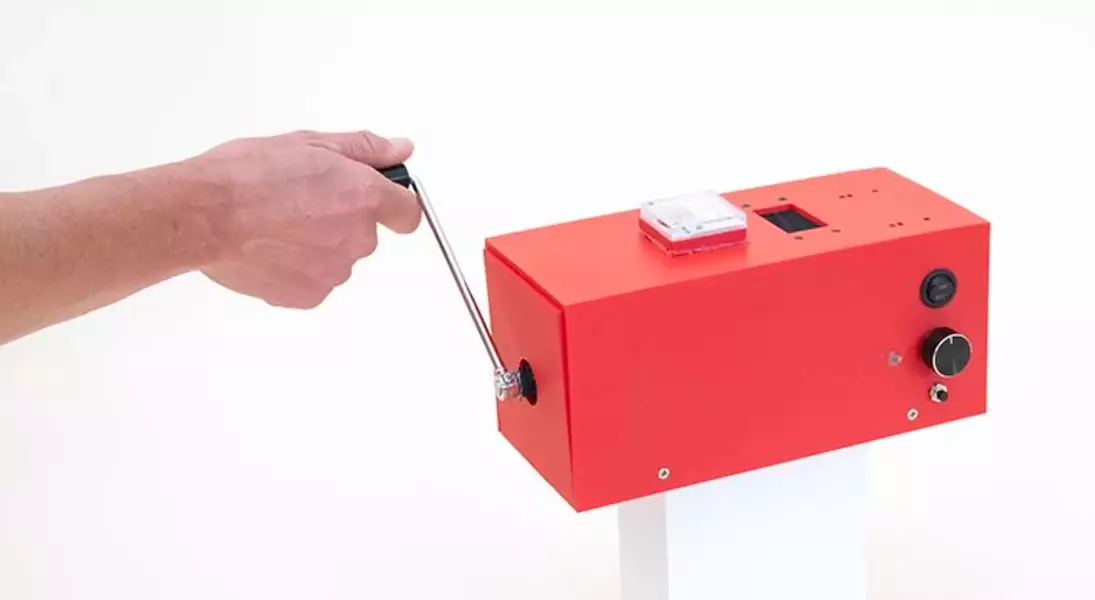
The rapid expansion of artificial intelligence has raised concerns about its environmental impact, energy consumption, and the increasing demand for high-end computing resources. However, an innovative project called CrankGPT from Squeez Labs presents a compelling alternative, proving that AI doesn't always necessitate vast data centers and immense power. This compact, hand-cranked device showcases a potential path toward more sustainable and localized AI solutions, offering a glimpse into how future AI development might address the ongoing memory crisis.
Details on CrankGPT: A Glimpse into Sustainable AI
Developed by Squeez Labs, the ingenious CrankGPT device utilizes a standard 8 GB Raspberry Pi to operate a localized AI voice assistant. This miniature system handles the entire AI workflow, from voice recognition and a local large language model (LLM) to text-to-speech output, all powered by a simple hand crank. The device's creators developed their own 'edge voice agent' to efficiently process the complete algorithm on this minimal hardware. A brief demonstration on the project's website reveals its functionality, requiring approximately 30 seconds of cranking to boot up and become ready for user interaction. This innovative approach significantly reduces the need for constant power supply and extensive computing infrastructure, diverging sharply from the industry's trend towards power-hungry data centers.
From a technological standpoint, CrankGPT serves as a powerful illustration of the viability of edge AI. Its entirely offline operation and reliance on a local LLM ensure unparalleled privacy. Crucially, the hardware requirements are exceptionally modest: a small processor, 8 GB of LPDDR4X memory, and a compact SD card for the operating system and data. This highlights that many existing devices—laptops, smartphones, and even wearables—already possess the necessary computational capacity for such localized AI applications. The primary challenge lies in developing suitable AI models and agents to effectively utilize this distributed hardware. Should this paradigm shift occur, it could dramatically reduce the demand for high-bandwidth memory (DRAM) and NAND flash, which are currently heavily consumed by large-scale AI machines, thereby offering a practical solution to the looming memory crisis. While the AI industry continues to invest heavily in centralized training and inference, CrankGPT illuminates a promising, more resource-efficient direction, demonstrating that profound change often begins with a clear, innovative example.
