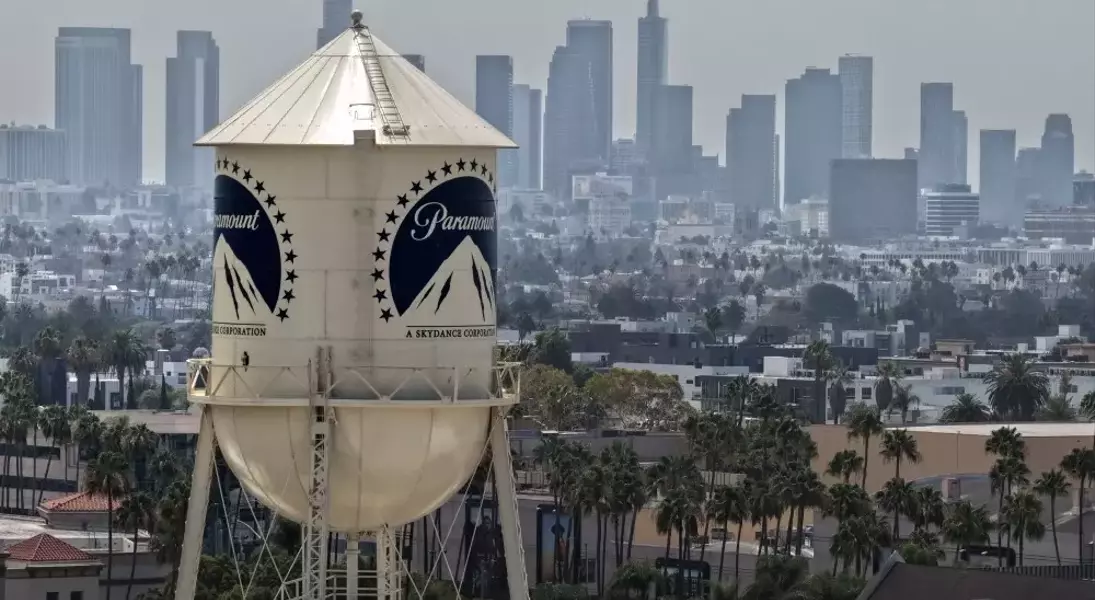
A significant legal battle is unfolding as a judge reviews a request to temporarily halt the proposed merger between entertainment giants Paramount and Warner Bros. Discovery. This case highlights ongoing concerns about market concentration within the film and television industries, with states arguing for consumer protection and the companies defending their strategic business decisions.
Judicial Review: The Battle Over Media Consolidation
States' Push to Prevent the Merger: Initial Arguments Presented
On a recent Friday, a judicial proceeding took place where a judge listened to legal arguments concerning a request from a coalition of states for a temporary injunction. This injunction aims to put the brakes on the consolidation of Paramount and Warner Bros. Discovery. The presiding judge indicated that a decision on this matter would be rendered by the upcoming Wednesday.
Paramount's Stance and Judicial Inquiry into Potential Harms
During the proceedings, Judge Araceli Martinez-Olguin made an observation, suggesting that Paramount had seemingly acknowledged it would not incur detriment if a temporary restraining order were to be issued. Such an order would effectively postpone the merger for a period of up to 28 days.
Concerns Over Market Competition: The States' Perspective
California is leading a group of 12 states in an effort to block this significant merger. Their primary concern revolves around the potential negative impact on competition within both the cinematic distribution and traditional cable television sectors. Conversely, Jeffrey Kessler, the lead counsel for Paramount, contended that the states have not adequately demonstrated that the proposed transaction is anti-competitive. Paramount's defense points to the success of recent film releases from companies like Apple ("F1") and Amazon MGM Studios ("Project Hail Mary") as evidence that the theatrical landscape remains accessible to new entrants.
Mobility of Talent and the Enduring Power of Major Studios
Kessler further elaborated on the dynamic nature of the entertainment industry, stating that creative professionals such as actors, writers, and directors frequently move between different studios. This, he argued, underscores a fluid environment where talent is not exclusively tied to any single entity. However, James Weingarten, representing the states, countered this by highlighting that "F1" was, in fact, distributed by Warner Bros., thereby emphasizing the established dominance of major players in an already mature market. Weingarten critically remarked, "That's the power of the five majors. Apple is not in the movie business. They're in the cell phone and laptop business."
Judicial Scrutiny on Market Concentration and Merger Irreversibility
Judge Martinez-Olguin appeared receptive to the argument that questions surrounding market concentration were sufficiently contentious to warrant at least a temporary restraining order. Drawing upon the evidence presented by Paramount, she posed a direct question to Kessler: "Why doesn't that just bolster the conclusion that there are serious questions here as to the legality of the merger?" Furthermore, the judge raised concerns about the practical difficulties of undoing the merger if it were to proceed and subsequently be deemed unlawful, asking both parties to consider the challenge of "unscrambling the egg."
Key Deadlines and the Economic Impact of Delay
Kessler explicitly stated Paramount's primary objective: to receive a ruling on a preliminary injunction by early September. He proposed an agreement to stipulate that the merger would not finalize within the next month if the parties consented to an injunction hearing in late August. A critical deadline looms on September 30, after which Paramount would incur daily penalties of $7 million payable to investors if the deal remains unclosed. Paramount had previously committed to not closing the transaction before July 22.
Market Statistics and the Scope of the Dispute
The hearing, which spanned approximately 75 minutes, saw Kessler challenging the states' market concentration statistics, citing a decline in basic cable subscribers. Weingarten retorted that basic cable still reaches 50% of TV households, or 67 million Americans. He further asserted that the five leading theatrical distributors—Paramount, Warner Bros., Disney, Universal, and Sony—have maintained a consistent market share for the past decade or more. Weingarten underscored the economic significance, stating, "These are not dying industries. These are $10 billion, $40 billion, industries in movie theater distribution and cable, respectively."
Anticompetitive Claims and Contentious Market Definitions
The states' core argument posits that the merger could lead to increased prices, reduced output, and ultimately harm consumers, theaters, and cable and satellite distributors. Their complaint alleges that the combined entity would command 30% of the market for "anticipated top-grossing films." Kessler, however, previewed Paramount's challenge to this market definition, noting that a film like "Obsession" would not be categorized as a blockbuster under the states' criteria simply because it didn't open on at least 3,000 screens. He also pointed out that Lionsgate, not one of the top five distributors, produced one of the year's biggest hits with "Michael."
Complementary vs. Overlapping Offerings: The Cable Market Debate
Kessler also contended that the cable offerings of Paramount and WBD are complementary rather than overlapping, suggesting their combination would not harm competition. Weingarten dismissed this argument, asserting, "You don't need a fancy degree in economics to understand that if one company owns both of the packages, they'll have increased bargaining leverage." He highlighted that the merged company would control 50 of the 189 basic cable channels. Weingarten further emphasized the lack of new entrants in the cable market, stating, "There has not been a new one since 2020. Not a single new basic cable channel since 2020. That shows how little entry there is into this market.
