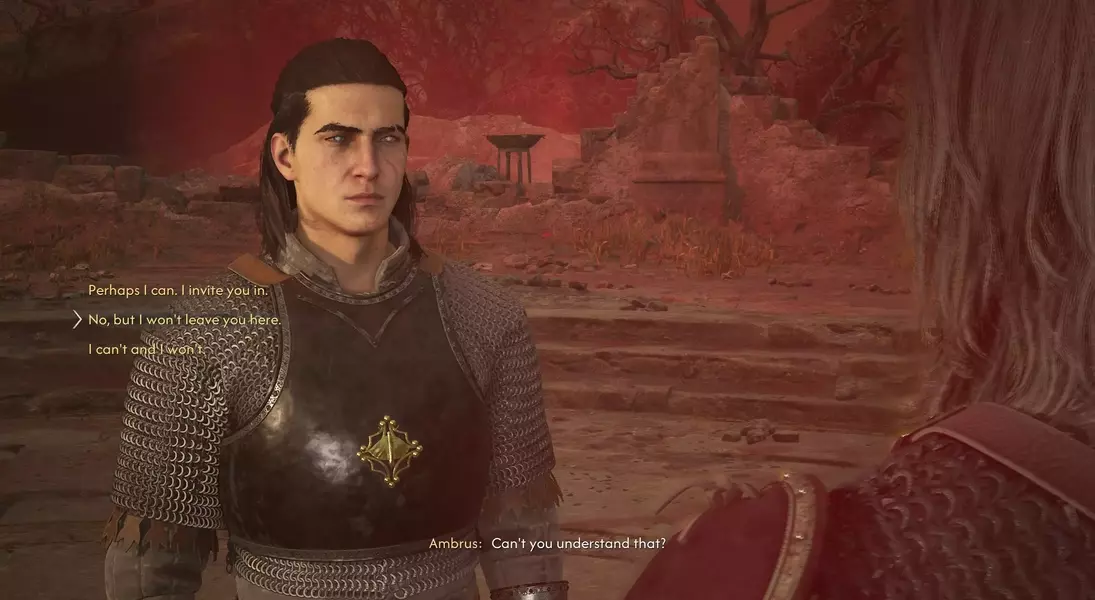

In the expansive world of Blood of Dawnwalker, a pivotal decision awaits players: whether to welcome Ambrus into their journey. This choice, while seemingly complex, primarily influences the narrative experience rather than the game's fundamental progression or character abilities. Ambrus, a rogue Vrakhir burdened by a past filled with transgressions against the inhabitants of Vale Sangora, presents a dilemma that delves into themes of redemption and consequence.
Opting to invite Ambrus transforms him into a persistent presence, offering a stream of commentary that reacts to the player's actions, decisions, and combat encounters. This constant internal dialogue adds a layer of depth and often humor to the gameplay, providing insights into his character and past. While this interaction doesn't drastically alter the game's outcome, it significantly enhances the player's immersion and understanding of the game's lore and characters. The decision to embrace or condemn Ambrus, and other Vrakhir boyars, is more about personal narrative preference than strategic advantage, allowing players to shape their ethical journey within the game.
Embracing Ambrus: A Narrative Companion
Choosing to allow Ambrus to join you in Blood of Dawnwalker primarily enriches the game's narrative by introducing him as a constant internal commentator. His voice will accompany you throughout your adventures, interjecting with observations and remarks as you navigate challenges and make critical decisions. This unique dynamic transforms Ambrus from a morally ambiguous figure into a spectral companion, offering a different perspective on the unfolding events and your character's actions. His occasional humorous comments further lighten the mood, providing unexpected moments of levity amidst the game's darker themes. This decision is less about gaining a tactical advantage and more about deepening the personal connection to the story and the complex character of Ambrus himself.
The impact of inviting Ambrus is predominantly on the narrative experience, providing a consistent stream of dialogue that reacts to the player's choices and combat situations. This constant interaction allows for a deeper exploration of Ambrus's personality and past, adding nuance to his character beyond his initial depiction as a villain. While he may offer some assistance in the final confrontation, the core gameplay mechanics, such as abilities, Corruption, or vampiric powers, remain unaffected. Players will still possess the potent Scarlet Shield ability, acquired from drinking his blood, irrespective of their decision to invite him. The choice therefore becomes a personal one, weighing the desire for his potential redemption and the added narrative depth against the severity of his past actions.
The Lack of Tangible Gameplay Consequences
Despite the moral weight of the decision to invite Ambrus, the immediate and long-term gameplay consequences in Blood of Dawnwalker are surprisingly minimal. The game's core mechanics, including your character's abilities, Corruption levels, and vampiric powers, remain unchanged. The primary effect is the addition of Ambrus's running commentary, offering a continuous stream of observations and reactions to your actions. This verbal presence is more a narrative flavor than a strategic modifier, enhancing the storytelling without altering combat or progression.
The decision to allow Ambrus into your mind does not lead to significant shifts in power dynamics or game difficulty. While he might briefly assist during the final boss encounter, there's an equal chance he could become an obstacle, creating a balanced, non-game-breaking outcome. This "swings and roundabouts" situation ensures that players are not penalized or overly rewarded for their choice. The excellent Scarlet Shield ability, obtained from consuming his Vrakhir blood, is accessible regardless of your decision, proving to be an invaluable asset in combat by restoring health through successful Perfect Blocks. Ultimately, the choice regarding Ambrus serves as a moral compass for the player, allowing them to decide his fate based on their interpretation of his character and the concept of redemption.
