
This guide explores the intricacies of Real Estate Investment Trusts (REITs), providing a foundational understanding for investors. It delves into their operational mechanisms, regulatory frameworks, and diverse categories, offering a holistic view of these investment vehicles.
Unlock the Potential: Master REIT Analysis for Smarter Investments
Understanding the Core: What Defines a REIT?
Real Estate Investment Trusts (REITs) are companies that own, manage, or provide financing for properties that generate income. By law, they are mandated to distribute a minimum of 90% of their taxable profits to shareholders as dividends. This unique structure allows individuals to invest in real estate without directly owning physical properties.
Exploring the Spectrum: Different Categories of REITs
REITs come in various forms, primarily categorized into equity REITs and mortgage REITs (mREITs). Equity REITs typically specialize in owning specific types of buildings, such as apartments, shopping centers, office complexes, or hospitality facilities. Some are broadly diversified, while others focus on niche markets. Mortgage REITs, on the other hand, do not directly own real estate but instead finance it, deriving income from interest on their investments, which include mortgages and mortgage-backed securities. While hybrid models exist, equity REITs, which manage tangible real estate assets, are the most common focus of investment analysis.
Strategic Evaluation: Approaches to REIT Analysis
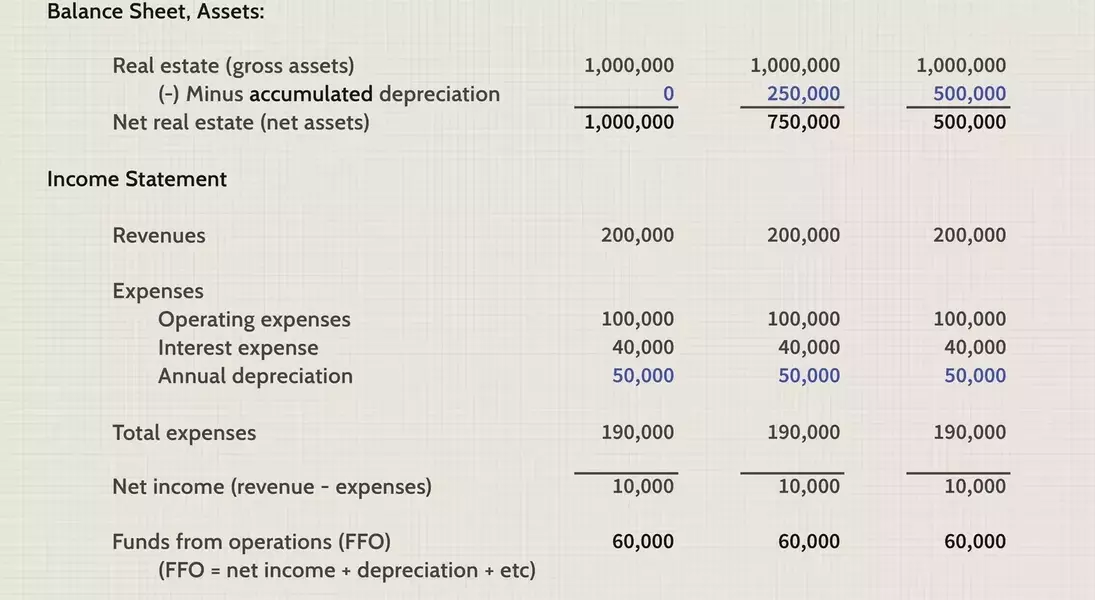
REITs, as dividend-paying equities, are subject to similar analytical frameworks as other stocks, but with distinct considerations due to real estate accounting practices. Traditional financial metrics like earnings per share (EPS) and price-to-earnings (P/E) ratios are often insufficient for REITs because of the significant impact of depreciation on their financial statements. Instead, specialized metrics like Funds From Operations (FFO) and Adjusted Funds From Operations (AFFO) offer a more accurate representation of a REIT's performance and cash flow.
Deciphering Performance: The Role of Funds From Operations (FFO)
Depreciation, while a necessary accounting entry, does not represent an actual cash outflow for REITs. To better reflect a REIT's operational cash flow, Funds From Operations (FFO) is calculated by adding back depreciation and amortization to net income, along with other non-cash adjustments. This metric provides a clearer picture of the cash generated by a REIT's core operations, as the value of real estate often appreciates rather than depreciates over time.
Refining Cash Flow: Adjusted Funds From Operations (AFFO)
While FFO improves upon net income by accounting for non-cash depreciation, it still doesn't fully capture all capital expenditures necessary for property maintenance and improvements. Adjusted Funds From Operations (AFFO) further refines this measure by incorporating recurring capital expenses, offering a more precise estimate of a REIT's distributable cash flow after accounting for property upkeep.
Valuation Insights: Understanding Net Asset Value (NAV)
Given the limitations of book value in reflecting the true worth of real estate assets due to depreciation, Net Asset Value (NAV) becomes a crucial metric for REITs. NAV aims to assess the market value of a REIT's properties, rather than their depreciated book value. This involves appraising the properties and deducting any debt, providing an estimate of the company's intrinsic equity value. In theory, a REIT's share price should closely align with its NAV per share.
Dual Perspectives: Top-Down and Bottom-Up Analysis
Effective REIT analysis requires both top-down and bottom-up approaches. A top-down perspective considers broader economic factors such as population growth, job creation, and interest rate trends, which influence the supply and demand for real estate. An improving economy, for instance, generally benefits REITs by increasing demand for rental spaces. Conversely, a bottom-up analysis focuses on the specific fundamentals of individual REITs, including revenue growth from rental income, service charges, and FFO, as well as unique strategies for enhancing occupancy and rental rates.
Efficiency and Growth: The Concept of Economies of Scale
REITs often pursue growth through strategic acquisitions, seeking to achieve economies of scale by integrating less efficiently managed properties into their portfolios. This strategy aims to reduce operating expenses relative to revenue, thereby improving profitability. However, acquisitions can also be a double-edged sword; if a REIT fails to enhance occupancy or increase rents in acquired properties, it might resort to poorly considered purchases in a bid to stimulate growth. Additionally, the role of debt, particularly the balance between fixed-rate and floating-rate obligations, is a critical balance sheet consideration due to its impact on interest expenses and overall equity value.
Taxation Nuances: REIT Dividend Treatment
Most dividends from REITs are not classified as "qualified dividends" by the Internal Revenue Service (IRS), meaning they are typically taxed at ordinary income rates, which can be higher than capital gains rates. However, there's a potential benefit: because REITs are pass-through entities, a portion of these ordinary dividends may qualify for the 20% Qualified Business Income (QBI) deduction, effectively reducing the taxable amount. This tax treatment underscores the importance of considering tax-advantaged accounts like IRAs or 401(k)s for holding REIT investments.
