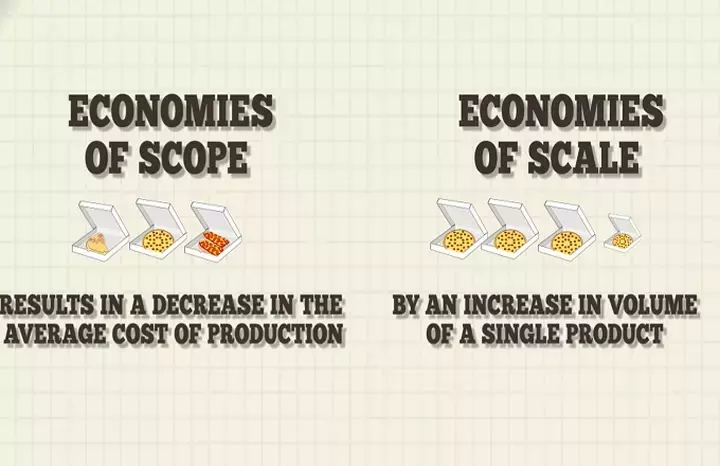
This article explores the key differences and similarities between two fundamental economic principles: economies of scope and economies of scale. Both concepts explain how businesses can achieve cost efficiencies, but they do so through distinct mechanisms. Economies of scope focus on minimizing average costs by producing a wider range of goods, leveraging shared resources. Conversely, economies of scale concentrate on reducing per-unit costs by increasing the production volume of a single good. Understanding these principles is vital for strategic business planning and identifying opportunities for growth and profitability.
Economies of scope refer to the cost advantages gained by a company when it produces a diverse array of products, especially those that are complementary or can share common resources. The core idea is that the average total cost of production decreases as the variety of goods manufactured expands. For instance, a single facility capable of producing multiple electronic devices, such as laptops, tablets, and smartphones, can distribute its operational costs across these different product lines, leading to lower average costs compared to operating separate facilities for each product. This principle is often observed in mergers and acquisitions, where combining operations allows for shared assets and expertise, or when newly discovered uses for byproducts from one production process can be applied to another.
Consider the example of a transportation company utilizing a single train to transport both passengers and cargo. This integrated approach is more cost-effective than running separate trains for each purpose, as it maximizes the utility of existing infrastructure and personnel. The diversification of output means that the net marginal benefit of a shared input factor is enhanced, providing a competitive edge. This concept underpins why many successful corporations strategically offer broad portfolios of related goods and services, capitalizing on their existing capabilities and infrastructure to expand their market reach without incurring proportional cost increases.
In contrast, economies of scale describe the cost benefits a company realizes as its production output of a specific good or service increases. This phenomenon is characterized by an inverse relationship between the volume of production and the fixed costs allocated per unit. A classic illustration involves purchasing raw materials or components in large quantities. For example, if a computer manufacturer buys a large volume of processors, the per-unit cost of each processor significantly decreases, even if the total expenditure rises. This reduction occurs because the fixed costs associated with the processor's design and initial setup remain constant, regardless of the quantity produced. The producer then passes these cost savings on to the buyer, who can in turn offer more competitive pricing for their final products.
This cost advantage allows companies to improve their profit margins as more units are produced, making them more competitive in the market. Retail giants that sell bulk items, such as warehouse clubs, are prime examples of businesses that thrive on economies of scale. However, there are limits to this principle; marginal costs do not continuously decline. Eventually, operations can become so vast that further increases in production no longer yield significant cost efficiencies, or may even lead to diseconomies of scale. At this point, companies may need to explore new technologies, refine their working capital management, or maintain their existing production levels to optimize profitability.
Ultimately, both economies of scope and economies of scale serve as powerful mechanisms for businesses to enhance efficiency and reduce expenditures. While economies of scale achieve cost savings through increased production volume of a single product, economies of scope realize efficiencies by diversifying product lines and leveraging shared resources across different goods. Both strategies are critical for large companies to maintain competitiveness and profitability in dynamic markets, by optimizing their cost structures and maximizing resource utilization.
