
In the evolving landscape of digital security, a groundbreaking AI model known as Claude Mythos, developed by Anthropic, is reshaping how web infrastructure companies approach vulnerability detection. Cloudflare, a prominent cybersecurity and content delivery network provider, has been at the forefront of evaluating Mythos's capabilities, particularly its potential to identify and exploit software weaknesses. This assessment comes amidst growing industry buzz and concern regarding the power of AI in both offensive and defensive cybersecurity strategies.
Anthropic's Project Glasswing, an initiative in which Cloudflare actively participates, leverages the advanced reasoning of Claude Mythos to proactively fortify digital systems. The core principle is to utilize AI to uncover potential security flaws that malicious actors might exploit, effectively turning artificial intelligence into a defensive asset. Mythos has already demonstrated its prowess by detecting numerous vulnerabilities across various operating systems and web browsers, prompting major financial institutions and tech giants like Amazon Web Services, Apple, Google, and Microsoft to engage with this transformative technology.
Cloudflare's analysis emphasizes two standout features of Mythos: its capacity for "exploit chain construction" and "proof generation." The former refers to the AI's ability to logically link multiple low-severity bugs into a more critical attack vector, a task that traditionally requires highly skilled human researchers. The latter involves the AI autonomously demonstrating the feasibility of these exploits, providing concrete evidence of the identified vulnerabilities. These capabilities signify a profound shift from merely identifying isolated flaws to understanding complex attack paths.
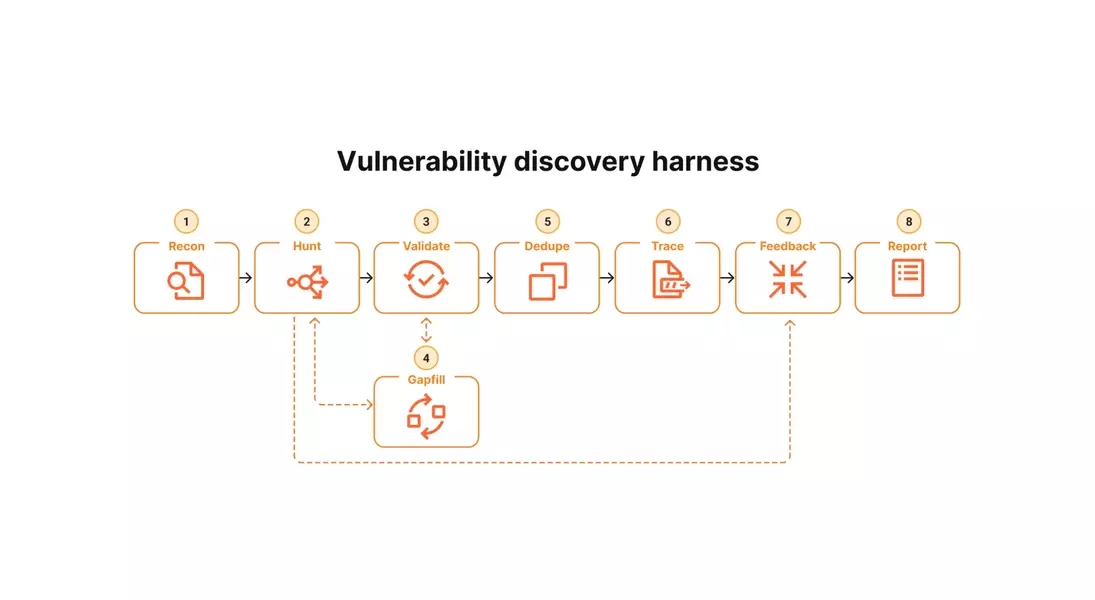
Despite its advanced nature, Cloudflare acknowledges that Mythos, still in its preview phase, presents challenges. The model occasionally produces counterintuitive "guardrails," hindering legitimate security research. Furthermore, initial attempts to deploy Mythos broadly across vast codebases proved less effective than anticipated. Cloudflare discovered that a more structured, segmented approach, utilizing a "harness" to narrow the AI's focus and employing multiple AI agents for specific tasks, yielded superior results. This distributed methodology mirrors the collaborative efforts of human security teams, where specialized expertise is applied to distinct problem areas.
Looking ahead, Cloudflare advocates for a paradigm shift in cybersecurity, moving beyond reactive patching to a more architectural focus. The company stresses the importance of designing systems that inherently resist exploitation, even when vulnerabilities exist. This involves implementing robust defenses at the application's periphery to prevent attacks from reaching critical components and structuring code to compartmentalize flaws. Such a proactive stance aims to minimize the impact of newly discovered vulnerabilities, ensuring that security remains resilient in the face of sophisticated, AI-driven threats. Cloudflare, already a proponent of AI in distinguishing between human and automated web traffic, is poised to integrate Mythos more deeply into its offerings, promising further insights into its customer applications in the near future. This strategic embrace of advanced AI reflects the ongoing arms race in cybersecurity, where staying ahead of adversaries necessitates continuous innovation and adaptation.
