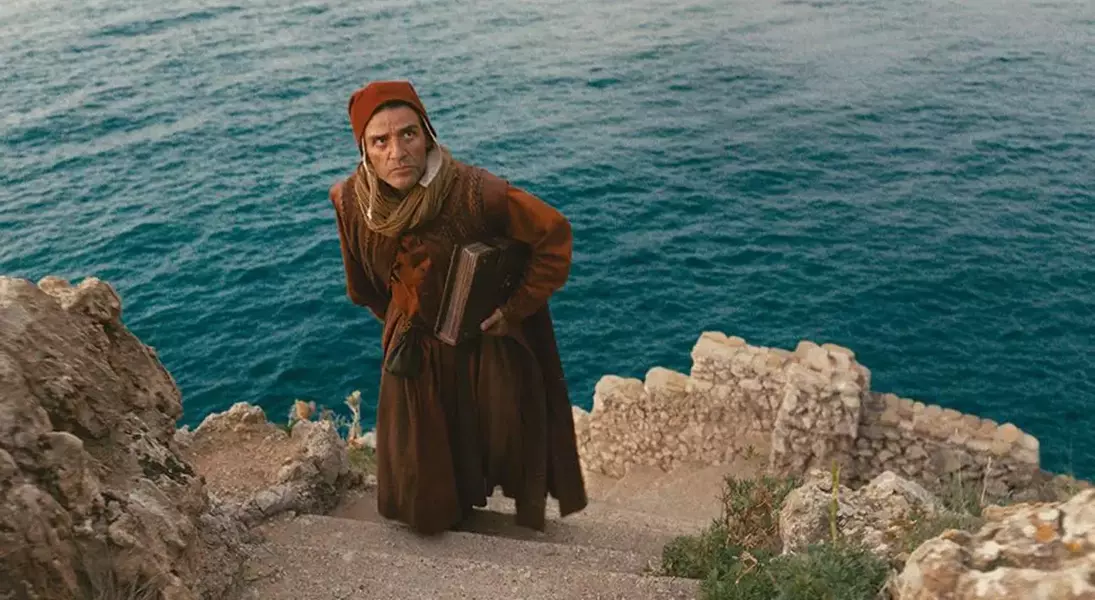
Julian Schnabel's latest cinematic endeavor, 'In the Hand of Dante,' embarks on an audacious journey, aiming to bring to life the intricate world of Dante Alighieri's 'Divine Comedy.' This film, a bold adaptation of Nick Tosches' 2002 novel, showcases Schnabel's characteristic artistic flair, yet ultimately delivers a viewing experience marked by a fascinating duality: moments of profound artistry juxtaposed with instances of narrative disarray. The movie's core strength lies in its gripping contemporary storyline, portrayed in stark black and white, which often overshadows the visually rich but conceptually muddled historical segments set in the 14th century. Despite its notable cast and an ambitious premise that daringly intertwines past and present, 'In the Hand of Dante' struggles to fully realize its grand vision, leaving audiences with a memorable, albeit wildly inconsistent, cinematic impression.
A Tale of Two Timelines: Unraveling 'In the Hand of Dante' at the Venice Film Festival
On a crisp September 3, 2025, at the prestigious Venice Film Festival, Julian Schnabel's much-anticipated film, 'In the Hand of Dante,' premiered out of competition, drawing both intrigue and mixed reactions. The narrative intricately interweaves two distinct periods: the tumultuous 14th century, painted in vivid color, and a gritty 21st-century New York, presented in evocative black and white. This ambitious structure, a direct homage to Dante's 'Divine Comedy,' sees lead actor Oscar Isaac brilliantly navigate dual roles, embodying both a contemporary writer named Nick and the legendary poet Dante himself.
The modern storyline, set in 2001, follows Nick, a New York writer with a mysterious past, as he becomes entangled in a dangerous quest for a handwritten Dante manuscript. His journey takes him from the sun-drenched tranquility of Bora Bora to the ancient, crime-ridden streets of Palermo, and further to the historic cities of Verona and Paris. Along the way, he encounters a spectrum of compelling characters: the menacing crime boss portrayed by John Malkovich, the ruthless assassin Louie played by Gerard Butler, and a brief but impactful appearance by Al Pacino as Nick's uncle, offering a pivotal life lesson in a flashback scene. The contemporary segments, marked by their high-stakes thriller elements, resonate with a raw, almost grimy authenticity, beautifully captured through Schnabel's composed cinematography and washed-out gray tones.
Conversely, the 14th-century narrative delves into Dante's arduous process of crafting his magnum opus. These scenes, while visually stunning with their opulent costumes and breathtaking scenery, sometimes falter in their philosophical exposition. Oscar Isaac, as Dante, endeavors to convey the poet's sincerity and struggles, yet the character occasionally appears somewhat static. A notable moment includes Martin Scorsese's cameo as Isaiah, a wise rabbinical figure, whose cryptic pronouncements, though intriguing, occasionally veer into unintended theatricality. The film features Gal Gadot in a dual role as Gemma, Dante's wife, and Giulietta, Nick's love interest in the modern era, further reinforcing the thematic echoes between the two timelines. As the narrative progresses, the two worlds eventually converge in a surreal and explosive climax, involving Jason Momoa as a new, formidable mob boss, culminating in a dramatic showdown and a truly unexpected, yet fittingly artistic, finale featuring Benjamin Clementine as a mysterious pianist.
From a critical standpoint, 'In the Hand of Dante' emerges as a film that defies easy categorization. It's an experience that, despite its occasional missteps and narrative disconnections, remains undeniably engaging. The sheer ambition to tackle such profound themes and interweave complex narratives across centuries is commendable, a testament to Schnabel's bold directorial vision. As a viewer, one is left with a profound sense of the film's artistic courage. Even when the plot veers into the absurd or the philosophical discussions feel forced, the movie consistently offers arresting visual artistry and powerful performances, particularly from Oscar Isaac, who anchors the sprawling narrative with his dynamic presence. It serves as a reminder that even a cinematic endeavor that doesn't perfectly coalesce can still be a mesmerizing spectacle, a \"wackadoo-ambitious\" work that, against all odds, achieves a peculiar form of miracle in its audacious attempt to capture the essence of a literary masterpiece.
