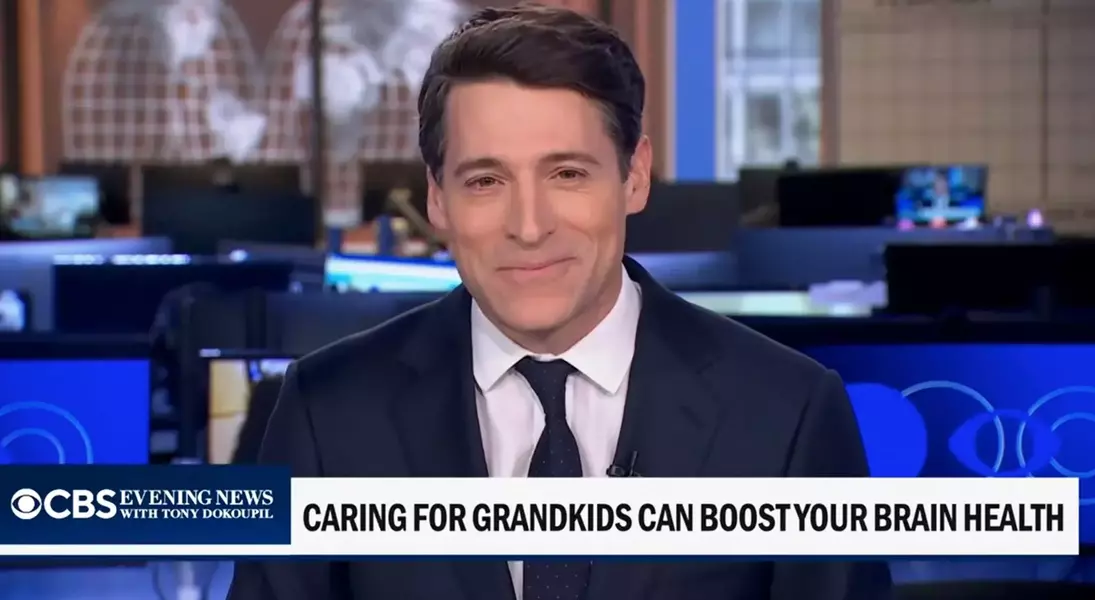


CBS Evening News anchor Tony Dokoupil has once again drawn public scrutiny, this time for an unconventional report that featured his own mother. The segment, broadcast during a recent episode, highlighted a study exploring the positive effects of grandparental childcare on cognitive function, sparking a debate about journalistic standards and the evolving nature of news reporting.
The segment, aired on Tuesday's program, showcased a study indicating that grandparents who actively participate in raising their grandchildren tend to exhibit improved memory and linguistic abilities, experiencing a slower rate of cognitive decline compared to their non-caretaking peers. To provide firsthand perspective on these findings, Dokoupil turned to his mother, Gail, as a primary source. Gail shared her personal experience, stating, "I find that they give me a sense of purpose. They energize me more than drive me down," referring to her grandchildren. Dokoupil, who recently took on the role of CBS Evening News anchor, has four children—two with his current spouse, MSNBC anchor Katy Tur, and two from a previous marriage to Danielle Haas.
Concluding the report, Dokoupil reflected on the unique bond between generations, noting, "Something magical happens when a parent becomes a grandparent." He humorously added, "And to think, the next time I call my mom for help with the kids, I can use the line she used on me as a kid: 'It's for your own good, Mom.' I love you."
While some viewers connected with the personal narrative and the study's implications, others voiced strong disapproval of what they perceived as an overly familiar and unprofessional approach to serious news. This reaction follows previous instances where Dokoupil made headlines for emotional displays, including tearing up during a discussion on CBS Miami as part of his "Live From America Tour." Media analyst Brian Lowry satirically commented on social media, suggesting a parallel to historical attempts to humanize news anchors with lighthearted content, while another user expressed frustration, stating, "Real hard hitting journalism... please keep CBS focused on the real issues currently facing Americans vs telling us what we all know." Further critical remarks included observations like, "The dumbing-down continues. Now we're asking Mom to pitch in?" and "Jesus Christ this is a clown show."
This particular segment felt notably out of place given recent statements by Bari Weiss, the new Editor-in-Chief of CBS News. Appointed in October following David Ellison's acquisition of her independent news platform, The Free Press, Weiss recently convened an all-staff meeting. During this meeting, she articulated a vision for the network that prioritizes "a huge emphasis on scoops. Not scoops that expire minutes later, but investigative scoops, and, crucially, scoops of ideas. Scoops of explanation." She emphasized the need for CBS News to transition from a "linear mentality" to a "streaming mentality," underscoring a commitment to in-depth, thoughtful journalism.
Weiss further elaborated on her strategic outlook, asserting, "To cover America as it is, we in this building need to reflect more of the political friction that animates our national conversation. That means recruiting and hiring editors, reporters, producers, and correspondents about whom our viewers will say, 'They understand me. They will give me a fair shake. They respect me.'" This renewed focus on substantive reporting and a more balanced representation of diverse viewpoints aims to restore trust and engagement with the audience. The network's news division has faced considerable scrutiny, including a recent jab from Golden Globes host Nikki Glaser, who, during a live broadcast on CBS, humorously criticized the network for producing what she termed "BS news," highlighting ongoing challenges in public perception and journalistic integrity.
The decision to feature a personal interview with a family member in a news segment has generated debate regarding the network's commitment to its recently articulated editorial vision. Such personalized content appears to diverge from the stated goal of focusing on rigorous investigative reporting and intellectual discourse, raising questions about consistency in journalistic practice. The public and media critics alike are closely observing how CBS News navigates these internal and external expectations as it strives to redefine its journalistic identity.
