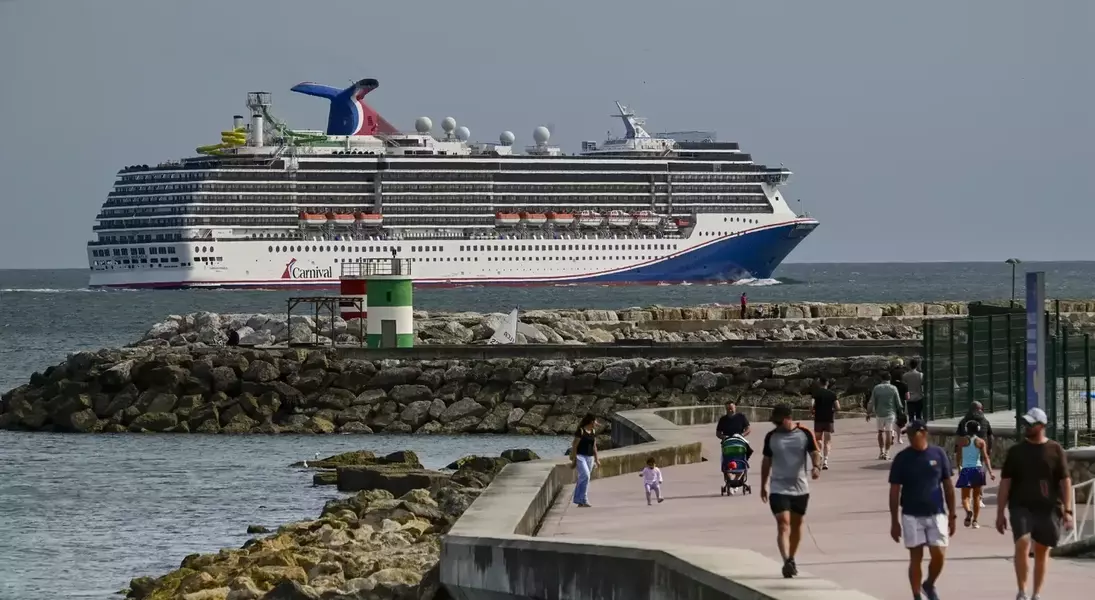
Carnival Corporation has solidified its position as a global leader in the cruise industry through a series of strategic acquisitions, transforming from a single-ship operation to a vast enterprise catering to diverse travel preferences.
Charting a Course for Global Dominance: Carnival's Expansion Through Acquisition
Carnival Corporation: A Global Cruise Powerhouse
Carnival Corporation & plc stands as a prominent entity within the cruise industry, serving as both a leading brand and an overarching company for several other cruise lines. Operating as a dual-listed company with Carnival plc (CCL.L), these two legal entities function as a unified economic force through intricate contractual agreements. While CCL shares are traded on the New York Stock Exchange (NYSE), CCL.L shares are listed on the London Stock Exchange (LSE). The company's diverse portfolio of brands caters to a broad spectrum of price points, lifestyles, cultures, and entertainment preferences. Carnival reported an impressive $26.6 billion in total revenue for its 2025 fiscal year, marking a 6.4% increase from FY 2024. As of March 19, 2026, its market capitalization stood at approximately $34.4 billion. Founded in 1972 by entrepreneur Ted Arison, Carnival Cruise Line began its journey with a single refurbished ocean liner, the Mardi Gras. Its subsequent growth trajectory has been largely defined by the strategic acquisition of other notable brands, five of which are detailed below.
Holland America Line: Expanding Passenger Capacity and Heritage
Holland America Line N.V. was a pivotal early acquisition for Carnival, significantly boosting its passenger capacity by approximately 50%. This established cruise line traces its roots back to 1873, originally operating as the Netherlands-American Steamship Co., ferrying cargo and passengers between Holland and the Dutch East Indies. Today, Holland America Line commands a fleet of eleven vessels, offering over 500 itineraries that span all seven continents.
Seabourn Cruise Line: Venturing into Ultra-Luxury
Seabourn Cruise Line Ltd. joined the Carnival family through a phased acquisition, beginning with a 25% stake in 1992, an additional 25% in 1995-1996, and the remaining 50% in 1998-1999. Established in 1988, Seabourn was conceived by a group of luxury hospitality and cruising executives aiming to redefine high-end cruising. The initial 50% stake was secured through two loans from Carnival totaling $25 million. In 1998, Carnival finalized its ownership of Seabourn and concurrently merged it with Cunard Line Ltd. Currently, Seabourn operates a fleet of five ships, including three 458-passenger vessels and two 600-passenger ships, delivering unparalleled ultra-luxury experiences to over 400 global destinations.
Costa Cruises: Strengthening European Market Presence
Costa Cruises S.p.A. was initially acquired by Carnival in a joint venture with Airtours in 1997, with each company purchasing a 50% stake. Three years later, Carnival acquired the remaining stake from Airtours for approximately $515 million. Originating in 1948 with its first voyage from Genoa, Italy, Costa had grown to become Europe's largest cruise line by the 1960s. This acquisition significantly bolstered Carnival's footprint in the rapidly expanding European cruise market. Carnival now serves as the parent company for both Costa Cruise Lines and AIDA Cruises. Today, Costa operates nine ships visiting over 260 ports worldwide, while AIDA leads the German-speaking cruise market with a fleet of thirteen vessels.
Cunard Line: Becoming the World's Largest Cruise Operator
Cunard Line Ltd., a luxury cruise line, was acquired by Carnival in stages, with an initial 68% stake purchased in 1998 and the remaining 32% in 1999 for a combined total of $705 million. Founded in 1840 by Samuel Cunard, the company began by providing mail service in Canada before expanding across the Atlantic to become an international shipping powerhouse. By the 1880s, Cunard had transported over a million people to the United States. In 1998, Carnival's acquisition of a majority interest in Cunard, coupled with its consolidation with Seabourn, solidified Carnival's position as the world's largest cruise company. Cunard currently operates four luxurious vessels: the Queen Mary 2, the Queen Victoria, the Queen Elizabeth, and the Queen Anne.
P&O Cruises: Establishing a Global Cruise Footprint
P&O Cruises, established in 1837 as the Peninsular & Oriental Steam Navigation Co., initially focused on mail transport before introducing its first leisure cruise in 1844. Cruising gained significant popularity by the mid-1880s. In 2003, Carnival acquired the cruise operations of P&O Princess Cruises plc for an estimated $7 billion to $8 billion. This landmark acquisition included Princess Cruises, P&O Cruises, P&O Cruises Australia, and Princess Tours. This merger led to the formation of the dual-listed Carnival Corp. and Carnival plc, marking Carnival as the first truly global cruise company. Until 2025, Carnival managed P&O as two distinct brands: P&O Cruises (United Kingdom) and P&O Cruises (Australia). P&O Cruises (Australia) ceased operations in 2025 and was integrated into the broader Carnival brand.
