
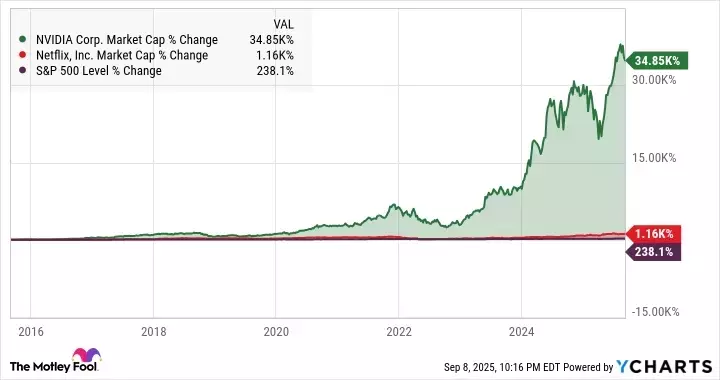
Nvidia has uniquely ascended to a $4 trillion market valuation, propelled by a groundbreaking era of artificial intelligence. While Netflix cannot realistically mirror this swift surge, the streaming pioneer maintains a robust track record of investor returns and a capacity for innovation. This analysis delves into Netflix's prospects of attaining a multi-trillion-dollar valuation over time, suggesting that a consistent annual growth rate of 15% could see its market capitalization exceed $1 trillion by 2030 and reach $4 trillion by 2040. The company's sustained relevance and forward-thinking leadership are identified as crucial elements for its enduring prosperity, contrasting its steady, long-term growth with Nvidia's more sudden, explosive trajectory.
Netflix's journey to potential multi-trillion-dollar status hinges on sustained expansion and strategic adaptability. Unlike the rapid, AI-driven growth witnessed by Nvidia, Netflix's path involves continuous evolution in the dynamic media landscape. The company's established ability to reinvent itself, from a DVD rental service to a global streaming powerhouse, underscores its potential for future growth. Maintaining a 15% compound annual growth rate over the coming decades would position Netflix among the market's most valuable entities, offering substantial wealth-building opportunities for patient investors who recognize its fundamental strengths and adaptive nature.
Nvidia's AI-Driven Market Dominance
Nvidia's impressive ascent to a $4 trillion market capitalization is fundamentally attributed to its central role in the artificial intelligence revolution, particularly in generative AI and large language models. The company's specialized AI accelerator chips are indispensable for powering these advanced computing applications, leading to an unprecedented demand from major technology firms. This unique market position has enabled Nvidia to generate immense revenues and deliver extraordinary shareholder returns, marking a rare and significant opportunity in the tech industry. This explosive growth highlights a distinct advantage that other companies, including Netflix, are unlikely to replicate in the near future due to the singular nature of the AI boom and Nvidia's proprietary technology.
The unprecedented demand for Nvidia's AI chips has created a highly lucrative revenue stream, cementing its status as a leader in a transformative technological era. This scenario is a testament to the company's foresight and strategic positioning, allowing it to capitalize on the burgeoning AI market. The magnitude of Nvidia's success underscores that opportunities of this scale are exceptionally rare, making it challenging for other companies to achieve comparable rapid growth. While many firms aspire to significant market valuations, few possess the unique convergence of innovation, market timing, and product necessity that has propelled Nvidia to its current pinnacle. Its dominance in AI hardware provides a compelling case study of how a company can leverage a technological paradigm shift to achieve unparalleled market leadership and financial success.
Netflix's Sustainable Path to Elevated Valuations
Netflix is charting its own course toward substantial market capitalization, emphasizing consistent, long-term growth rather than the rapid, explosive gains seen in sectors like AI. While it may not achieve the swift 1,130% return that Nvidia saw in three years, Netflix's strategy focuses on a steady, sustainable expansion. Projections indicate that if Netflix maintains a compound annual growth rate of 15%, its market value could exceed $1 trillion by late 2030 and reach $4 trillion by 2040. This trajectory, though more gradual, promises market-beating returns that comfortably surpass the S&P 500's average. This demonstrates a robust and patient investment outlook, aligning with Netflix's history of strategic evolution and adaptability in the dynamic entertainment industry.
The path to greatness for Netflix is characterized by its consistent innovation and adaptability. The company has a proven track record of reinventing its business model, moving from DVD rentals to a global streaming service, and continuously evolving its content strategy. This capacity for reinvention and strong leadership, as evidenced by its past transitions and current strategic direction, suggests a long-term viability that is crucial for achieving high market valuations. Even without the 'lightning in a bottle' moment of an AI boom, Netflix's commitment to content, global expansion, and evolving consumer experiences positions it well for sustained growth and profitability. This enduring relevance makes Netflix an attractive long-term holding, capable of generating significant returns for investors with a patient mindset.
