BYD, a prominent electric vehicle manufacturer from China, is embarking on an audacious journey to transform its market perception and expand its financial horizons. While globally recognized for its accessible and high-volume EV offerings, the company is now venturing into the lucrative luxury automotive segment. This strategic pivot involves significant investments in brand elevation, including the creation of public test tracks and the development of high-priced, opulent vehicle models. The ambition is clear: to rival established luxury car brands and unlock new avenues for substantial revenue and brand prestige.
BYD's Ambitious Foray into High-End Automotive Experiences
In a compelling strategic move, the renowned Chinese electric vehicle giant, BYD, is meticulously orchestrating its entry into the ultra-luxury automotive market. This pivotal shift was conspicuously highlighted on September 3, 2025, when the company, headquartered in Shenzhen, officially unveiled its plans to build a network of sophisticated automotive testing and racing facilities accessible to the public. This initiative is designed not only to showcase the extraordinary capabilities of its emerging high-end models but also to fundamentally redefine its brand identity from a mass-market producer to a purveyor of elite automotive experiences.
This bold direction marks a significant departure from BYD's established success in delivering affordable electric vehicles that have garnered considerable market share, even surpassing industry pioneers like Tesla in specific segments over the past five years. While Tesla's stock saw an impressive 157% appreciation, BYD's shares soared by an astounding 377% during the same period, underscoring its robust growth trajectory and investor confidence. The introduction of models like the Atto 2 in the United Kingdom, albeit at a slightly higher price point than its most economical offerings, demonstrates BYD's capability to offer competitive products across various price ranges.
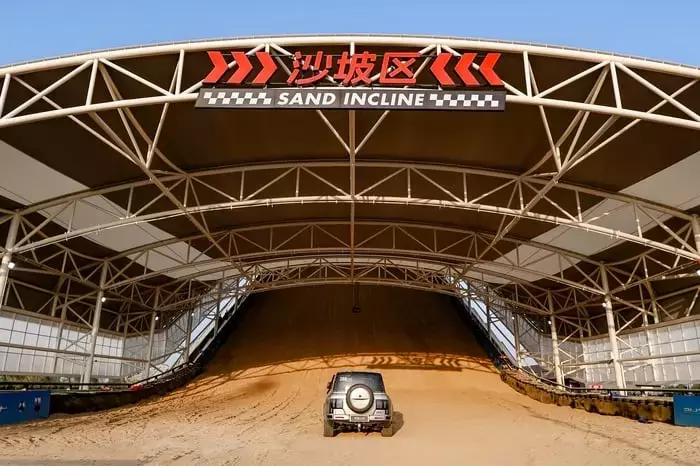
A cornerstone of this ambitious undertaking is the monumental investment of 5 billion yuan (approximately $700 million) dedicated to the development of these state-of-the-art tracks. The inaugural \"all-terrain circuit\" commenced operations earlier this month in the vibrant city of Zhengzhou. These meticulously engineered facilities are designed to immerse enthusiasts and prospective buyers in an unparalleled driving adventure. For a fee of 599 yuan (under $100), participants can experience the exhilarating performance of vehicles like the high-end Yangwang U9, which commands a price tag exceeding 1 million yuan. The tracks offer a diverse range of challenges, from high-speed straightaways and complex zigzag maneuvers to emergency swerve simulations, all meticulously crafted to highlight the vehicles' agility and superior handling. Furthermore, innovative features such as a massive sand dune, sculpted from over 6,000 tons of sand, and a specially designed pool for water hazard testing, underscore BYD's commitment to demonstrating the robust all-terrain capabilities of its luxury SUVs.
This initiative represents more than just a marketing spectacle; it is a profound strategic maneuver aimed at cultivating a new brand image. Unlike conventional private test tracks used for internal product development, BYD's public circuits serve as powerful brand-building platforms. This approach mirrors the "Halo car" concept, where an ultra-high-end model is utilized to generate intrigue and elevate the perception of an entire product line. In BYD's case, however, this strategy is applied across its entire brand, signaling a clear intention to capture the imagination of the luxury market and establish a new benchmark in premium electric mobility.
The transition toward the luxury segment holds the promise of significantly enhanced profit margins for BYD. Companies like Ferrari, renowned for their exclusive high-performance vehicles, consistently achieve operating margins that far surpass those of mainstream automotive manufacturers. By venturing into this lucrative domain, BYD aims to leverage the prestige and higher pricing potential of luxury models, thereby augmenting its overall profitability while maintaining its strong foothold in the affordable EV market. This dual strategy seeks to secure BYD's position as a versatile and formidable force in the global automotive landscape, poised for sustained long-term growth and investor returns.
BYD's calculated shift towards the luxury segment represents a fascinating case study in corporate evolution and market adaptation. It underscores the dynamic nature of the electric vehicle industry, where innovation extends beyond technological advancements to encompass bold strategic repositioning. As BYD endeavors to intertwine its heritage of accessibility with the allure of luxury, its journey will undoubtedly inspire other industry players to rethink conventional market boundaries and explore new paradigms of brand value creation. The future of automotive luxury, it seems, is being redefined by an unexpected challenger from the East.
