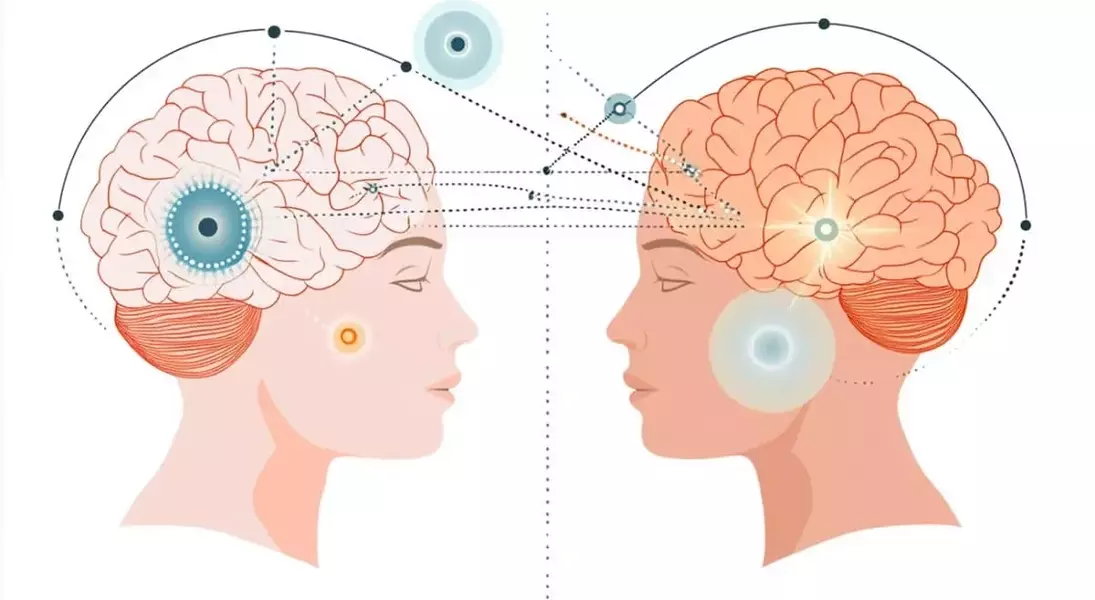
The human brain employs a sophisticated strategy to manage its limited working memory resources, prioritizing essential information for more precise representation. Research conducted at Ohio State University highlights the collaborative effort between two critical brain regions—the frontal cortex and the visual cortex—to allocate cognitive resources effectively when dealing with multiple items.
In this groundbreaking study, scientists utilized functional magnetic resonance imaging (fMRI) to observe how participants remembered the spatial locations of objects. The findings revealed that while the visual cortex encodes all visual details indiscriminately, it is the frontal cortex that plays a pivotal role in deciding which elements require greater attention. For instance, when tasked with remembering two items simultaneously, individuals demonstrated enhanced accuracy in recalling the position of high-priority items compared to low-priority ones. This selective memory mechanism underscores the brain's ability to enhance resolution for significant data while reducing focus on less crucial details.
By decoding brain activity during these trials, researchers uncovered an intricate interaction where the frontal cortex communicates with the visual cortex to modulate resource allocation. This process ensures that higher priority items receive more detailed processing, thus improving recall precision. Moreover, the study achieved a rare feat in neuroscience by successfully decoding memory for two simultaneous items, showcasing advancements in understanding complex neural mechanisms. These insights not only clarify how our brains handle multitasking but also deepen our comprehension of attention and memory control.
Understanding how the brain allocates resources opens new avenues for enhancing cognitive performance. By recognizing the importance of prioritization, individuals can harness their mental capabilities more efficiently, focusing on what truly matters. This research inspires optimism about optimizing human potential and offers valuable lessons in managing information overload in today's fast-paced world. Through continued exploration, we may unlock further secrets of the mind's remarkable adaptability and efficiency.
