
This article explores the remarkable journey of Bing Chen, the visionary behind Gold House, and his profound impact on elevating Asian, Asian American, and Pacific Islander representation and influence within Hollywood and the broader entertainment industry. It delves into his unique leadership style, the strategic initiatives of Gold House, and his transition into film and television production, highlighting how his efforts are fostering greater diversity and market success.
Igniting Change: The Transformative Power of Connection and Vision
Bing Chen's Dynamic Approach to Leadership and Influence
Engaging in a discussion with Bing Chen, the founder of Gold House, is often likened to an invigorating experience, akin to a surge of energy. In what seems like an effortless stream of thought, Chen seamlessly transitions between complex topics, from the foundational principles of the creator economy to the intricate world-building of the Pokémon universe, and even the extensive menu of The Cheesecake Factory. Participants in these conversations consistently gain a wealth of knowledge in a short span, leaving with a clear sense of having experienced something enjoyable and impactful, even if the precise trajectory of the conversation remains a delightful mystery.
From Advocate to Producer: Gold House's Expanding Footprint
At 38, Chen, who has historically operated behind the scenes rather than as a traditional agent, executive, or producer—until very recently—has emerged as a highly influential force in Hollywood. Since its inception in 2017, Gold House, the organization he established, has been dedicated to amplifying Asian, Asian American, and Pacific Islander presence across various sectors, including entertainment and business. The organization has successfully galvanized support for acclaimed films such as "Crazy Rich Asians," "Parasite," and "Everything Everywhere All at Once." Furthermore, it has provided crucial guidance to studios on projects featuring Asian narratives, characters, and talent, invested in ventures spearheaded by Asian and Pacific Islander entrepreneurs, and cultivated a robust network connecting filmmakers, executives, investors, and stars. With the recent inauguration of Gold House Studios, Chen is now directly venturing into the production of films and television, transitioning from facilitating others' work to creating his own content.
The Genesis of Gold House: Responding to Industry Needs
Chen often reflects on the origins of Gold House, stating that "Every significant movement requires a recognizable entity to establish its credibility, and that's precisely what propelled Gold House into existence. I initially resisted formalizing it for over a year." He continues, "I don't even recall the exact moment we decided it needed formal structure, but what truly brought us into the spotlight was an overwhelming number of inquiries from various studios, all acknowledging our capacity to drive projects to success." This demand underscored the growing recognition of Gold House's effectiveness in mobilizing support and achieving tangible results.
A Portrait of Ambition and Authenticity: The Man Behind the Movement
Chen embodies a unique blend of deep ambition and unwavering sincerity. He openly shares that his childhood inspirations were Walt Disney, Martin Luther King Jr., and Mother Teresa, without prioritizing any one figure over the others. Possessing a demeanor and appearance that would easily fit on screen—and an physique he occasionally showcases on social media—Chen's networking style is characterized by an extraordinary degree of personalized attention. He tirelessly connects individuals, follows up on introductions, orchestrates dinners, proposes new contacts, applies strategic pressure, and meticulously follows up again. This relentless and genuine engagement defines his approach.
Unwavering Dedication: A Friend's Perspective
Jon M. Chu, a long-standing friend and collaborator, describes Chen's intensity, stating, "It's overwhelming. Initially, your skepticism might rise, thinking, 'This person isn't real, they're not genuine.' Yet, after five, six, or even ten years, you realize, 'Wait, it's all completely authentic.'" This testament highlights Chen's persistent and genuine commitment to his cause and connections, ultimately dispelling any initial doubts about his fervent approach.
The Gold Gala: A Celebration of Asian Excellence
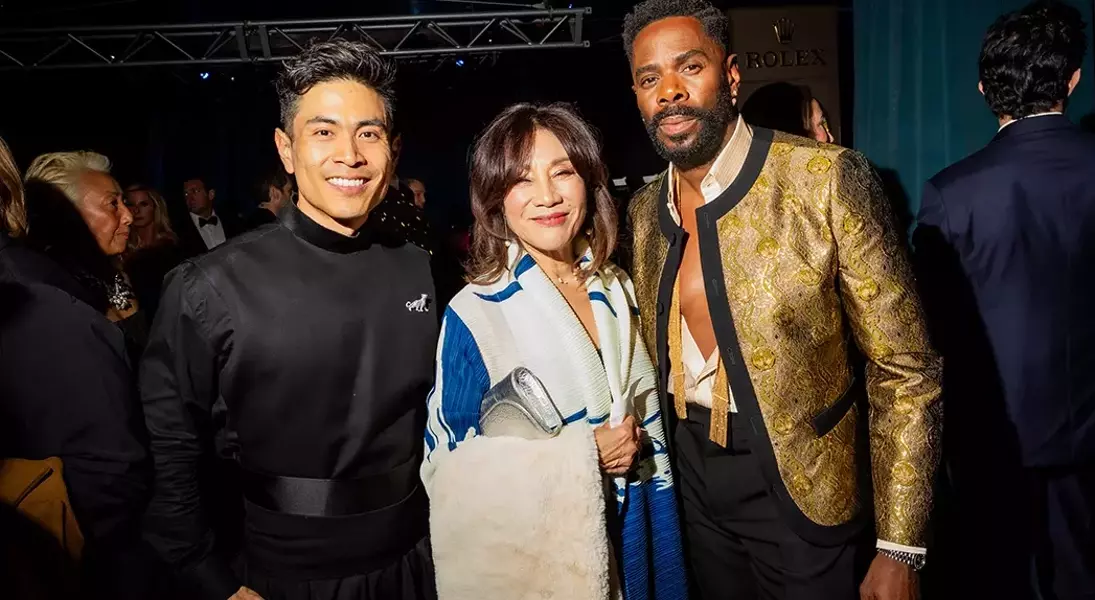
On a balmy mid-May evening, downtown Los Angeles's Dorothy Chandler Pavilion, historically the venue for the Academy Awards for many years, radiated in hues of yellow and gold for the fifth annual Gold Gala. This prestigious event, established by Gold House, recognizes outstanding achievements within the Asian and Pacific Islander community. It has colloquially earned the moniker "Asian Met Gala," though it notably distinguishes itself with superior catering, provided by James Beard Award-winning chef Justin Pichetrungsi of Anajak Thai. Attendees receive luxurious Dagne Dover weekend bags filled with gifts, including Marriott Gold status. The gathering sees prominent figures like Priyanka Chopra Jonas, Mindy Kaling, Charles Melton, and Jet Li mingling, while "Saturday Night Live" star Bowen Yang light-heartedly teases Chen about his dating life. Chen, who identifies as bisexual, playfully notes he is only so "on paper, not in practice, anymore."
Masterful Connector: Chen's Networking Prowess
Observing Chen navigate a crowded room reveals his almost extraordinary aptitude for networking. He doesn't merely host the gala; he orchestrates the entire flow of connections. A filmmaker is introduced to an investor, an actor to a showrunner. Someone signals Chen from across the room, only for another to intercept him before he reaches his initial destination. Each conversation seamlessly transitions into yet another introduction. These introductions, fundamentally, are the core purpose of Gold House. The organization promotes films, advises studios, invests in emerging companies, and now produces its own content. Beneath these increasingly diverse functions lies a timeless Hollywood principle: bringing the right individuals together to create something meaningful and impactful.
Lessons Beyond Hollywood: The YouTube Era
Ironically, Chen's foundational understanding of this networking dynamic wasn't cultivated in Hollywood. After completing his studies at the University of Pennsylvania, Chen joined YouTube during the Great Recession. At that time, YouTube's leadership envisioned its future primarily in licensed content and video rentals. Its creator program, a nascent division dedicated to users producing original videos, was experimental enough that Chen, upon becoming one of its managers, found himself with an unusual degree of autonomy. Today, major Hollywood agencies, studios, and streaming platforms are fiercely competing to sign digital talent. However, fifteen years ago, YouTubers were largely perceived as hobbyists creating videos in their homes. While they had audiences, what they conspicuously lacked was mainstream legitimacy and recognition.
Pioneering Creator Recognition at YouTube
Even in those early days, Chen grasped the immense value of promotion. He recalls thinking, "We needed our own 'Oscars'." He successfully lobbied YouTube to commit $250,000 to VidCon, then a struggling Anaheim conference dedicated to online creators. Drawing inspiration from the music industry's tradition of framed gold records, he also played a pivotal role in establishing YouTube's Gold Play Button, an award presented to channels that achieved one million subscribers. "From a business perspective, those YouTube creator initiatives truly defined my career," he states. "At 25, I was leading an effort that subsequently grew into a $400 million, then $1.5 billion, endeavor." By the age of 27, Chen was recognized on Forbes' 30 Under 30 list, alongside notable figures like Ryan Coogler and Lena Dunham. His career trajectory seemed predetermined, yet he chose to depart.
Pursuing Personal Vision: A New Chapter
Chen recounts his decision: "I thought, 'I can either stay here and do the exact same thing, earning more money, or I can pursue growth and build something of my own.' My aspiration was always to build my own venture." For two years, he exchanged Silicon Valley's fast pace for a Peet's Coffee in Orange County, where he, a former creative writing major, dedicated 14-hour days to crafting a 12-part sci-fi fantasy saga while residing with his mother, a former CFO. He still describes this period as the happiest in his life.
The Inception of Gold House: Addressing a Void in Representation
While Chen immersed himself in fiction writing, his network of friends across technology and entertainment consistently drew him into a crucial discussion. They argued that despite Asian Americans increasingly founding companies, leading businesses, and generating substantial economic value, they remained significantly underrepresented in Hollywood and the stories it chose to tell. These conversations reached a critical point as Jon M. Chu, a longtime friend of Chen's, prepared for the release of "Crazy Rich Asians"—Hollywood's first studio film in 25 years to feature a predominantly Asian cast. Chu had first met Chen years earlier when he was making videos for YouTube and Chen worked there. True to his nature, Chen maintained their connection. Chu laughingly recalls, "He'd say, 'You absolutely must speak with this person. And this person.' I'd think, 'Brother, I can't talk to everyone!' You'd expect his energy to wane eventually, but he simply thrives on it."
"Crazy Rich Asians": A Pivotal Moment and Strategic Intervention
As the release of "Crazy Rich Asians" approached, the filmmakers harbored concerns that the movie's performance would serve as a referendum. Should it underperform in the industry's eyes, Hollywood might conclude there was no substantial audience for films led by Asian casts, thereby jeopardizing other projects in development, such as Marvel's "Shang-Chi and the Legend of the Ten Rings." Chu admits, "It was clear that the early tracking wasn't exceptionally strong. Not disastrous, but not indicative of a major impact." In response, Chen employed his signature strategy: he convened a diverse group of entertainment professionals, founders, and executives from platforms like YouTube, Twitch, and Hulu at Chef Chu's, the Palo Alto restaurant owned by Chu's father. Over a multi-course dinner, the discussion shifted to strategic planning.
Mobilizing Support and Redefining Success
Chen began soliciting contributions from his affluent friends and business leaders, urging them to fund theater buyouts and bulk ticket purchases. He challenged them directly, stating, "All of you claim this is important. If you're unwilling to contribute at least $5,000 to $50,000, then your concern isn't genuine." To incentivize donations, Chen and his collaborators designed special posters for the screenings—leveraging the universal desire for recognition—and enlisted online creators, artists, and musicians to host these events, filling theaters with enthusiastic fans, influential tastemakers, and awards voters. The objective extended beyond merely selling tickets; it was to cultivate the perception that "Crazy Rich Asians" was an unmissable cultural phenomenon that Hollywood could not afford to disregard.
The Gold House Effect: From Campaign to Cultural Movement
The strategy proved highly effective. "Crazy Rich Asians" debuted with $35 million over its five-day holiday weekend and ultimately grossed over $240 million worldwide. Following this success, studios began contacting Chen for assistance with other projects, including future Best Picture winners "Parasite" and "Everything Everywhere All at Once." What originated as an impromptu campaign for a single film organically evolved into Gold House, an organization that developed both a cultural consulting practice and a robust marketing and promotions arm. It now advises major companies such as A24, Lucasfilm, and Pixar on various aspects, from script development to product placement.
Expanding Horizons: Ventures, Galas, and Industry Impact
As Gold House expanded, so did Chen's ambitions. In 2022, the organization launched Gold House Ventures, a $30 million investment fund backed by the founders of prominent companies like DoorDash, Credit Karma, and Bain & Co. This fund has invested in a diverse range of ventures, from telemedicine to direct-to-consumer instant ramen. Gold House dinners themselves began to generate their own Hollywood lore, not solely for the star power they attracted—such as Zendaya and Tom Holland attending a recent dinner honoring "Spider-Man: Brand New Day" director Destin Daniel Cretton. At another event, "Beef" creator Lee Sung Jin met Charles Melton, whom he later cast in the second season of the Netflix series, a role that subsequently earned both Emmy nominations.
Championing DEI in a Changing Landscape
Even as the broader industry has scaled back its Diversity, Equity, and Inclusion (DEI) initiatives—closing departments, halting pipeline programs, and removing mentions of "diversity" from regulatory filings—Gold House has steadfastly continued its mission. Chen asserts, "While the wider industry spent the past few years on the defensive, making corrections, or in some instances, treating inclusive strategies as mere compliance, we adopted an offensive stance. For us, playing offense didn't mean being provocative for its own sake; it meant strategically capitalizing on market realities." This philosophy underscores Gold House's proactive and market-driven approach to fostering diversity.
Gold House Studios: A New Frontier in Production
Gold House had already ventured into production through its creative equity fund, which provided financing for independent films, including the Sundance breakout "Dìdi." Earlier this year, the organization executive produced and financed Laufey's "Madwoman" music video, uniting Olympic gold medalist Alysa Liu and "Heated Rivalry" star Hudson Williams. As of publication, the video has garnered over 21 million views on YouTube. Establishing a studio was a natural progression, allowing Chen to guide intellectual property and engage with projects from their conceptual stages rather than joining midway. Chen notes, "The primary motivation for this was the numerous requests from filmmakers. Frankly, it's been incredibly flattering."
Diverse Storytelling and Personal Aspirations
Gold House Studios' initial slate of projects reflects the wide array of Chen's interests, encompassing a road trip dramedy, a martial arts adventure film, a horror series penned by "Legends of Tomorrow" writer Keto Shimizu, and a movie adaptation of the cult Japanese video game "Slitterhead." Eventually, there may also be an opportunity for a much more personal adaptation: the book series Chen has been meticulously developing for years, which he continues to refine on weekends, though no longer from a coffee shop. Undoubtedly, he possesses the precise network of individuals to bring this deeply personal project to fruition.
