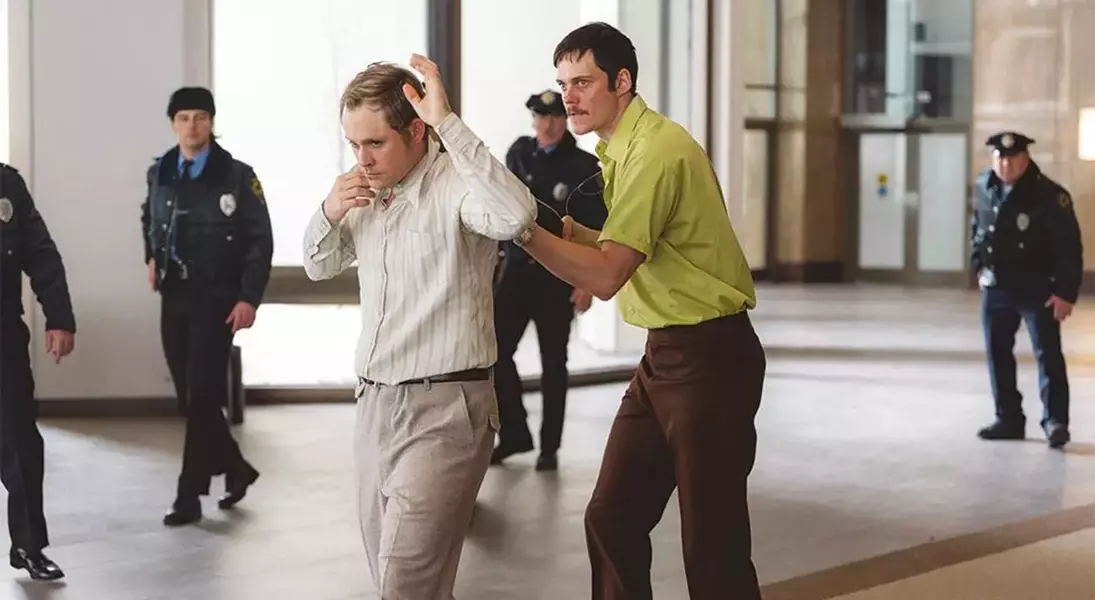
\"Dead Man's Wire,\" directed by Gus Van Sant and featuring a compelling performance by Bill Skarsgard, has made a significant impact following its premieres at the Venice and Toronto film festivals. This drama, rooted in a dramatic true event from 1977, garnered considerable praise, particularly for Skarsgard's portrayal of a character reminiscent of Luigi Mangione. Although currently without U.S. distribution, the film's strong reception suggests it will soon find a home, potentially propelling Skarsgard into the Oscar race, alongside his father Stellan and brother Alexander, who also have potential award-contending roles this season.
Insightful Portrayal of a Hostage Drama Unfolds at Toronto Film Festival
On a recent Sunday, the vibrant Princess of Wales Theatre at the Toronto International Film Festival hosted the North American debut of \"Dead Man's Wire.\" This follows its global premiere a week prior at the prestigious Venice Film Festival, where it earned rave reviews. Penned by Austin Kolodney, the narrative of \"Dead Man's Wire\" centers on Tony Kiritzis, a man from Indianapolis driven to extreme measures after a real estate investment gone awry. Believing his mortgage broker deliberately sabotaged his life savings, Kiritzis, in a fit of rage, confronted the company. Unable to find the CEO, M.L. Hall (portrayed by Al Pacino), who was away on vacation, Kiritzis instead encountered Hall's son, Richard Hall (played by Dacre Montgomery), the company's president. In a dramatic turn of events, Kiritzis took Richard Hall hostage, attaching a sawed-off shotgun to a wire around Hall's neck. In full view of law enforcement and the media, Kiritzis transported his captive back to his own apartment, where intense negotiations commenced. Despite the shocking nature of Kiritzis's actions, his motives resonated with a segment of the public, transforming him into an unlikely folk hero after he articulated his grievances through interviews with a well-known local radio personality, brought to life by Colman Domingo. The film, reportedly shot in a mere 19 days, showcases Van Sant's directorial prowess, reminiscent of his ability to elicit Oscar-winning performances from actors like Robin Williams in \"Good Will Hunting\" (1997) and Sean Penn in \"Milk\" (2008). Its modest budget suggests an accessible acquisition cost for distributors, making it an attractive prospect for those seeking an immediate Best Actor Oscar contender.
As a viewer, one can't help but draw parallels between \"Dead Man's Wire\" and classic cinematic narratives like Sidney Lumet's 1975 masterpiece, \"Dog Day Afternoon,\" a connection further emphasized by Al Pacino's presence in both films. The story also echoes contemporary societal sentiments, particularly the rising resentment of wealth and corporate power, a theme evident in recent political movements and other cinematic works. This film serves as a poignant reflection on the complexities of justice, public perception, and the desperate acts individuals might undertake when pushed to their limits by systemic failures. It challenges audiences to consider the fine line between villainy and victimhood, prompting a deeper understanding of the human condition in the face of perceived injustice.
