

BigBear.ai, a firm dedicated to crafting bespoke artificial intelligence software, primarily for governmental bodies, stands at a pivotal juncture in the burgeoning AI market. While the pursuit of tenfold returns within a short timeframe is a common investor aspiration, particularly in a rapidly expanding sector like AI, BigBear.ai's distinctive operational framework presents an intriguing case study. Its focus on highly customized solutions, rather than scalable, off-the-shelf products, influences its financial dynamics and market standing in ways that diverge from conventional software companies. This unique approach warrants a closer examination to understand its implications for the company's future trajectory and investor expectations.
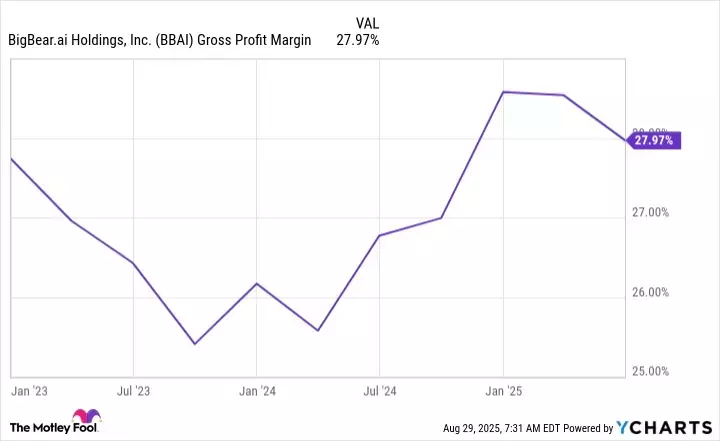
A critical aspect distinguishing BigBear.ai is its margin profile, which sharply contrasts with that of its industry counterparts. Typical software companies benefit from high gross margins, often ranging from 70% to 90%, due to the scalability of their products. However, BigBear.ai's model, which involves developing unique software for each contract—such as the substantial U.S. Army agreement or biometric systems for airports—results in gross margins shy of 30%. This structural difference means the company's path to profitability and its corresponding valuation multiples differ significantly. While conventional software enterprises might aim for 30% profit margins, translating to high price-to-earnings ratios, BigBear.ai's inherent limitations on gross margin necessitate a re-evaluation of its potential earnings and fair market value. Despite trading at a premium in terms of price-to-sales, its custom-solution approach implies a much lower achievable profit margin, suggesting that its current valuation may be disproportionately high given its operational realities.
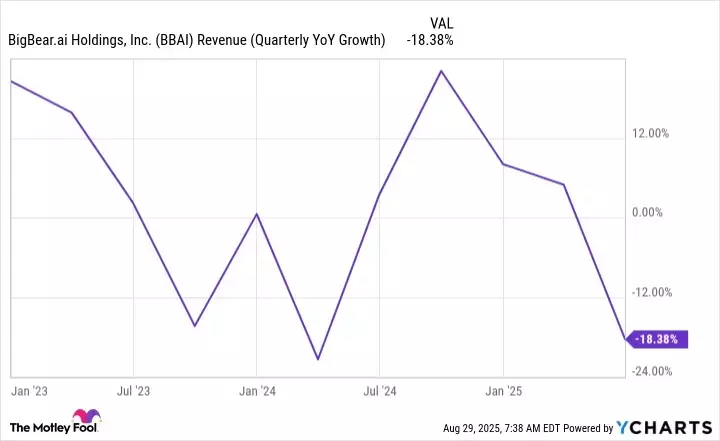
Furthermore, BigBear.ai's performance in capitalizing on the recent surge in AI spending raises concerns among market observers. Contrary to expectations for a company positioned within such a dynamic industry, BigBear.ai has not demonstrated consistent revenue growth since the commencement of the AI arms race in 2023. In fact, it has experienced periods of negative year-over-year revenue growth, indicating a struggle to expand its top line despite the widespread demand for AI solutions. This lack of growth, coupled with an already stretched valuation and a challenging margin structure, prompts a cautious outlook on its ability to achieve significant value appreciation for investors. The current landscape suggests that other investment avenues within the AI sector might offer more compelling opportunities, given BigBear.ai's present hurdles.
In a world where technological advancements are constantly reshaping industries, understanding the nuances of business models is crucial for informed decision-making. BigBear.ai's journey underscores the importance of aligning operational strategy with market expectations and financial realities. It serves as a reminder that true progress is not just about being in a high-growth sector, but about building a sustainable and scalable foundation that can leverage opportunities and overcome inherent challenges. The pursuit of innovation, when paired with sound business practices and a clear path to profitability, ultimately paves the way for lasting success and contributes positively to the broader economic landscape.
