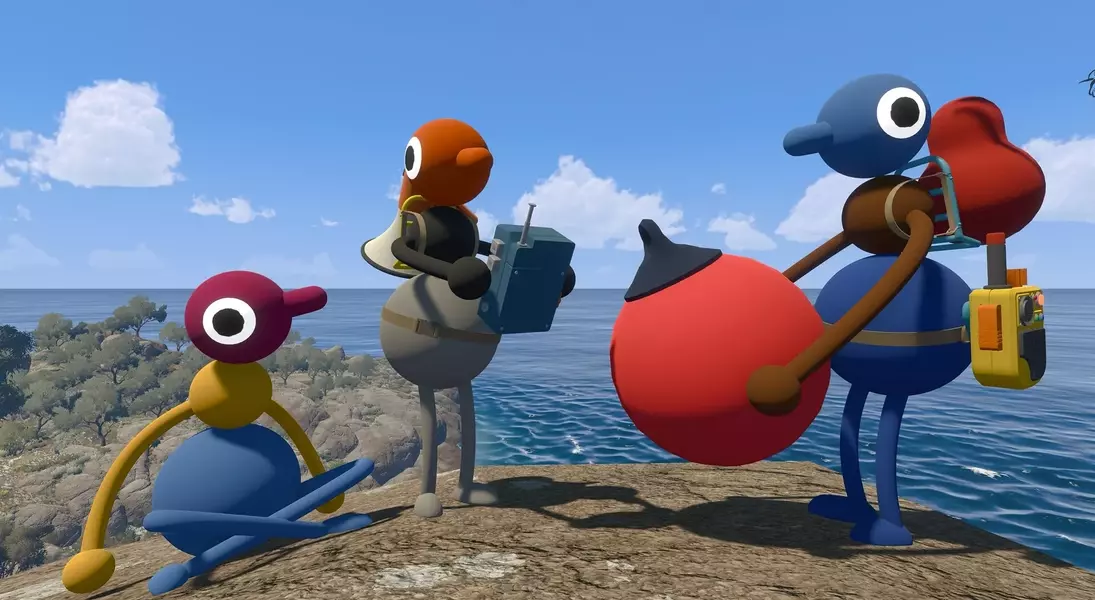
“Big Walk,” an anticipated cooperative online game developed by House House, renowned for “Untitled Goose Game,” offers a refreshing take on multiplayer puzzle-solving. Players immerse themselves in a world where collaboration and communication are paramount to overcoming obstacles and unraveling mysteries. This game distinguishes itself by fostering genuine teamwork, transforming every challenge into a shared triumph and every discovery into a collective celebration. It’s a delightful experience that emphasizes camaraderie over competition, set in a whimsical and inviting environment.
Details of the Cooperative Adventure
During a recent exclusive preview held in Portland, Oregon, participants, including this reporter, delved into the enchanting world of “Big Walk.” The experience began with a concise tutorial, after which players were unleashed into a vast, open landscape adorned with lush trees, rolling hills, meandering rivers, and a dynamic day-night cycle, all serving as the backdrop for a series of ingenious puzzles. The game's characters, described as endearing bipedal figures with expressive features, are designed to enhance player interaction. Their stretchy arms, prominent eyes, and pliable noses, which react to voice communication, contribute to the game’s immediate and engaging charm. The absence of traditional inventories means players must physically transport items, prompting strategic discussions about task delegation and collective responsibility.
The puzzles themselves are meticulously crafted to necessitate cooperative effort. One scenario required a player to secure a button while another activated a related mechanism. Another puzzle demanded the simultaneous manipulation of two distinct switches by different players. A particularly clever challenge involved one player, confined to a room with a puzzle's solution, communicating through a small aperture to their teammates outside, who then had to assemble the solution based on relayed instructions. These self-contained puzzles are ingeniously woven into a larger narrative, culminating in a grander objective, such as mending an impassable bridge. The game deliberately eschews overt guidance, compelling players to rely on observation, mutual discussion, and trial-and-error to progress. “Big Walk” also features a dynamic scaling mechanism, adjusting puzzle complexity based on the number of participants, supporting up to four players for intricate puzzles, while larger groups of up to twelve can engage in free-form activities like painting friends, enjoying music, or simply unwinding by the ocean, transforming moments of rest into shared, joyful experiences. This ensures that every interaction, from solving complex puzzles to painting companions at “the salon,” is a testament to shared effort.
“Big Walk” emerges as a splendid counterpoint to the more intense, fear-inducing cooperative titles prevalent today. It champions a sense of communal accomplishment, proving that shared laughter and collective problem-solving can be just as, if not more, rewarding than overcoming virtual horrors. The game underscores the intrinsic satisfaction of navigating a mysterious world hand-in-hand with friends, celebrating every small victory with bursts of confetti, symbolizing a truly earned success.
