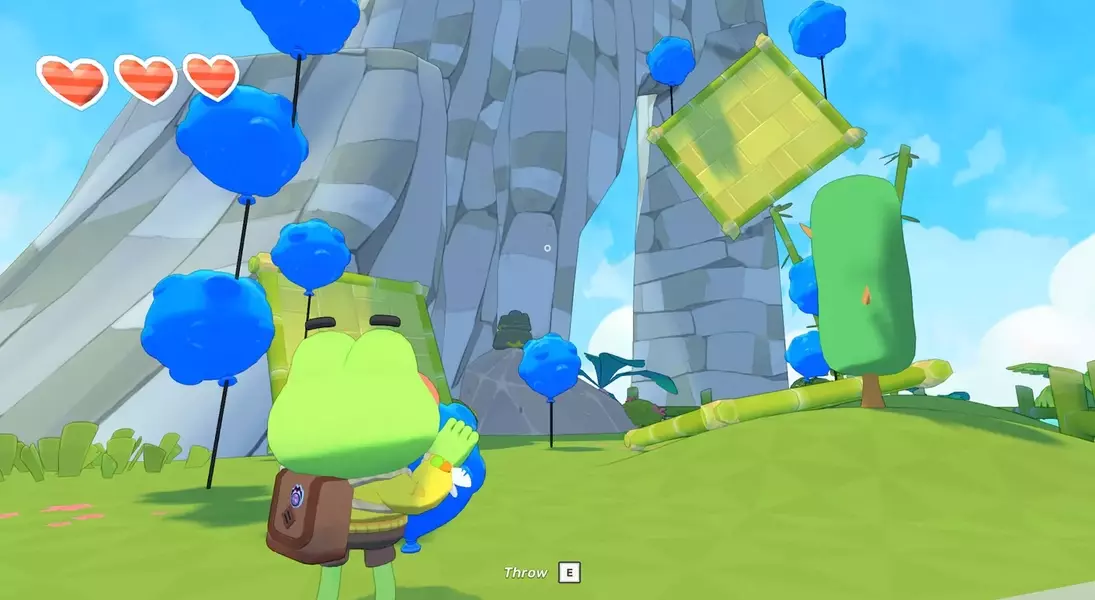
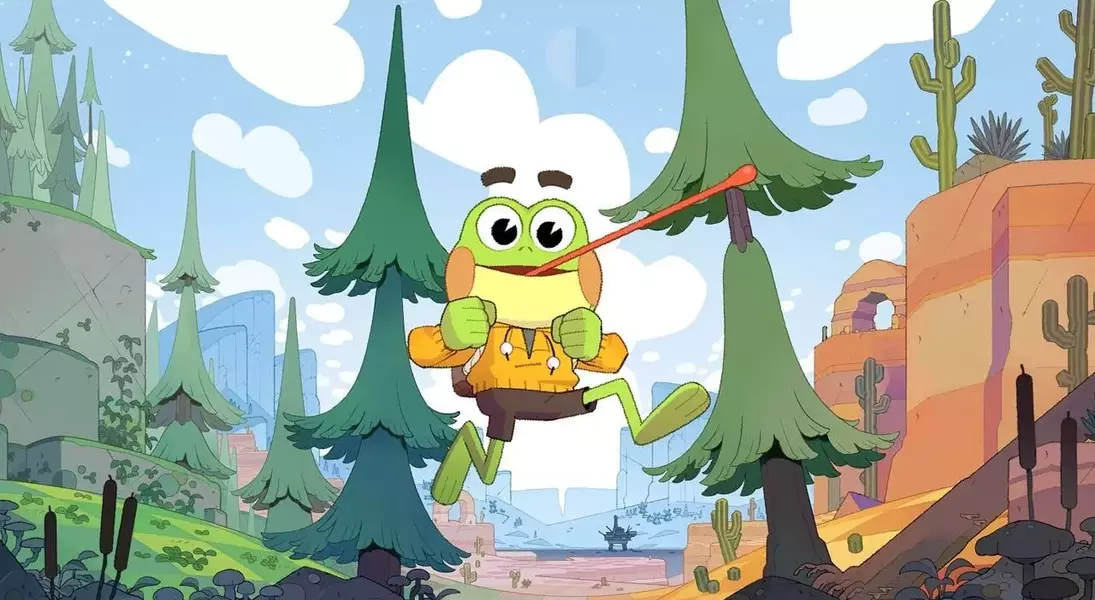
Luckshot Games' latest creation, Big Hops, introduces a delightful 3D platforming experience, challenging conventional gameplay mechanics. Players guide Hop, a charming amphibian, through diverse landscapes, leveraging his unique tongue-based interactions to overcome obstacles and unravel mysteries. This title emerges as a compelling response to recent genre entries, particularly Donkey Kong Bananza, by refining puzzle-solving and traversal through inventive player choice.
In Big Hops, players assume the role of Hop, a endearing frog whose journey begins when he is whisked away from his home by a mischievous entity. To find his way back, Hop must venture through various biomes, each presenting distinct challenges, all while piecing together three crucial airship components. Along this adventure, players can gather numerous 'Dark Drips,' acquire badges that modify gameplay, capture and consume insects, and unearth other concealed treasures. The game boasts cheerful graphics and a sincere tone, reminiscent of the acclaimed title A Short Hike.
What distinguishes Big Hops from its contemporaries is its unique protagonist, Hop, and his primary method of interacting with the environment: his tongue. This versatile appendage can be employed for a myriad of actions, such as opening chests, picking locks, and swinging from grapple points. The latter function is particularly significant, as it underpins Big Hops' momentum-driven movement system, encouraging players to propel themselves across each map. The seamless integration of tongue grappling with air diving creates an expressive traversal mechanic, enabling players to cover vast distances with strategic planning. For instance, players can roll off an edge, jump, and then dive to extend their movement, akin to Mario's Cappy mechanics in Odyssey. This entire system operates with remarkable fluidity, further enhanced by a wall-clinging ability, reminiscent of Breath of the Wild, which allows players to navigate stages in any manner they choose, provided they manage their stamina effectively.
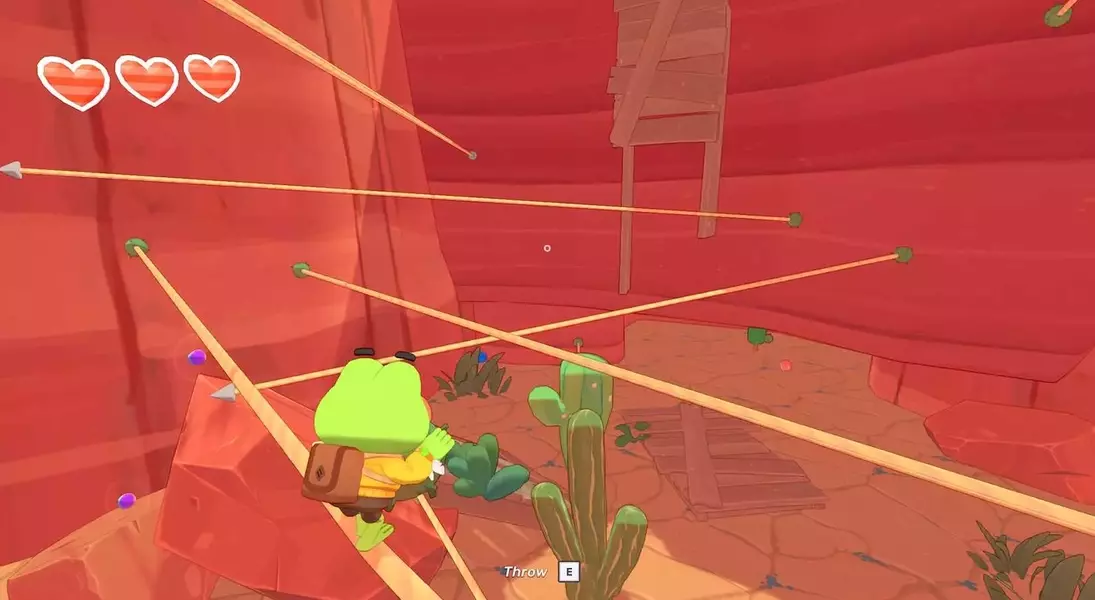
Initially, during my exploration of a desert environment and solving puzzles with Hop's tongue, Donkey Kong Bananza did not immediately come to mind. However, the connection became evident the moment I collected an acorn. Big Hops introduces a distinctive gameplay element where Hop can discover a variety of seeds and fruits, each possessing unique functionalities. For example, a hot pepper can be used to burn dry weeds, while mushrooms act as makeshift jump pads. Acorns, when hurled against a wall, yield climbable vines. This mechanic bears a striking resemblance to an idea present in Bananza's Forest Layer level, where Donkey Kong can toss seeds at wooden surfaces to create new pathways. This parallel highlights an interesting, perhaps unintentional, dialogue between the two titles regarding environmental interaction and puzzle design.
My initial hands-on experience with Bananza's preview filled me with excitement, particularly regarding the terrain-smashing mechanics. I anticipated that this core element would be complemented by environmental puzzles, adding a layer of depth to traversal. However, in the full release, this anticipated depth largely fell short. The innovative idea presented in Forest Layer felt more like an isolated biome gimmick rather than a consistently applied design principle. While other areas introduced intriguing concepts, such as Resort Layer's vibrant rainbow platforms, these were often confined to their respective zones, failing to integrate into a broader, more cohesive puzzle framework.
This perceived missed opportunity contributed to my primary criticism of Bananza: despite its initial appearance as an open-ended puzzle-platformer, it offered surprisingly few genuine solutions. While players could discover Banandium Gems through various means, including smashing through walls and ceilings to bypass designated routes, the more I delved into the game, the more constrained my options felt. Most "puzzles" could typically be resolved in one of two ways: either by executing the intended platforming sequence or by circumventing it through destructive means. This limited player expression ultimately diminished the appeal of its numerous, often similar, layers, even though the inherent satisfaction of demolishing everything remained consistently enjoyable.
Big Hops unexpectedly offers a constructive counterpoint to these observations. Unlike Bananza, where throwable items like acorns often serve as one-time gimmicks strategically placed to guide players toward specific solutions, Big Hops allows Hop to store any item in his backpack for deployment at any time. This seemingly minor alteration dramatically expands the game's puzzle potential, transforming every environment into Hop's personal jungle gym, where clever thinking can unlock a multitude of creative solutions.
For instance, armed with a bag full of cacti, which can form rope bridges, I could strategically combine them with well-placed acorn vines to traverse a vast chasm. Subsequently, I might ascend a wall that would otherwise be insurmountable due to stamina limitations. I successfully navigated one tower, initially beyond my stamina capacity, by deploying several rope bridges and tossing bouncing fruits between them, enabling me to grapple from one rope to the next. Similarly, I bypassed an entire wall-running section by ingeniously throwing water bubbles that allowed me to swim through, completely circumventing the intended solution. When these inventive techniques are combined with Hop's fluid, chain-able movement, the game provides an endless array of possibilities for navigating its world.
The interplay between Big Hops and Bananza isn't a one-way street; there are also lessons Big Hops could draw from its predecessor. While Big Hops excels in platformer problem-solving, it occasionally lacks the polish and clear direction that make Bananza a standout in its genre. Some of Hop's abilities, such as his occasionally inconsistent wall run, can disrupt the otherwise fluid movement. Furthermore, the game's world design, at times, lacks the distinct personality that makes Bananza's environments so engaging to dismantle. Both development teams could undoubtedly glean valuable insights from each other's projects for their future endeavors. This ongoing exchange of design ideas, unfolding before players, is precisely what makes the world of gaming so exciting and vibrant.
Big Hops stands as a delightful treat for those who appreciate the intricacies of game design. It approaches a well-trodden genre with a fresh, playful outlook, discovering novel methods to transform a structured 3D platformer into an exhilarating parkour playground tailored for its diminutive, amphibious protagonist. May its innovations inspire future creators, continuing a legacy of ingenuity that has illuminated the gaming world since the 1980s.
