
When considering investments in the pharmaceutical realm, investors often gravitate towards established players like Pfizer, drawn by its substantial dividend yield. Yet, a deeper examination reveals that while Pfizer presents a compelling case, a comprehensive understanding of industry dynamics and alternative investment vehicles is paramount. The current market environment, marked by patent expirations and evolving regulatory landscapes, necessitates a nuanced approach to sector-specific investments. Diversifying exposure within healthcare, beyond traditional drug manufacturers, can offer unique advantages and mitigate certain risks inherent to the pharmaceutical industry's cyclical nature.
For those seeking to capitalize on the pharmaceutical sector's growth, it's essential to assess not only the direct drug manufacturers but also supporting industries. The stability of a company's dividend payout, for instance, can be a telling indicator of its financial resilience amidst industry-specific challenges. Furthermore, exploring opportunities in related sectors, such as real estate investment trusts specializing in life sciences, can provide a more diversified and potentially less volatile pathway to participate in the pharmaceutical industry's long-term trajectory.
Understanding Pfizer's Investment Landscape
Pfizer, a prominent name in the pharmaceutical industry, currently offers an appealing dividend yield of 6.9%, which naturally attracts investors prioritizing income. The company boasts a history of effective management, although it faces certain industry-standard challenges. These include the cyclical nature of drug discovery, where intellectual property rights eventually expire, leading to generic competition. Furthermore, the regulatory environment in the United States, particularly concerning drug manufacturers, introduces an element of uncertainty. Such factors contribute to the recent subdued performance of pharmaceutical stocks, including Pfizer, consequently elevating their dividend yields. However, these are not insurmountable obstacles but rather typical operational fluctuations that Pfizer has adeptly navigated in the past and is expected to continue overcoming.
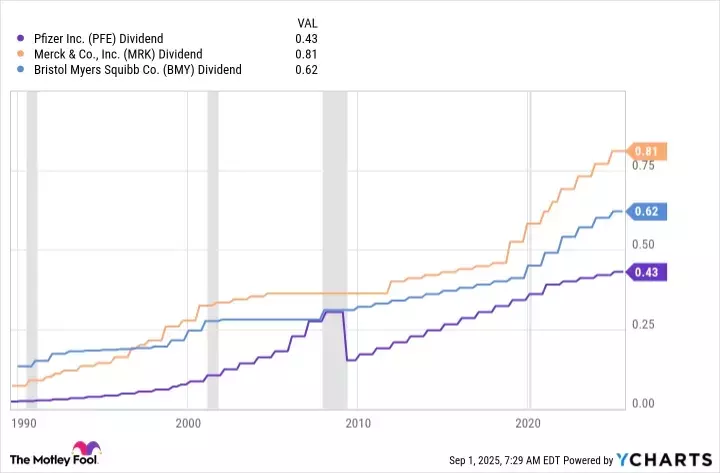
Despite these headwinds, Pfizer's core operations remain robust. The company's resilience is evident in its ability to adapt to market shifts and maintain a healthy financial standing. Its adjusted earnings dividend payout ratio, recorded at 55% in the second quarter of 2025, suggests a stable dividend, indicating that a reduction is improbable. Nevertheless, investors focused on consistent dividend growth might find it beneficial to compare Pfizer's track record with that of its competitors. While Pfizer did implement a dividend cut during the Great Recession, other industry leaders like Merck and Bristol-Myers Squibb maintained their payouts, highlighting different approaches to dividend policy during challenging economic periods. This distinction underscores the importance of evaluating a company's historical commitment to its dividend, especially for investors for whom uninterrupted income streams are a priority.
Exploring Alternatives for Pharmaceutical Sector Exposure
For investors keen on the pharmaceutical sector but perhaps wary of the inherent volatility tied to drug development cycles and patent expirations, alternative investment strategies warrant consideration. Direct pharmaceutical companies, despite their potential for significant gains, are subject to these specific risks. A different approach involves investing in entities that support the pharmaceutical industry without being directly involved in drug manufacturing. One such avenue is through real estate investment trusts (REITs) that specialize in life sciences properties, like Alexandria Real Estate.
Alexandria Real Estate, for instance, focuses on leasing research and development spaces to healthcare and pharmaceutical companies. This model offers a unique form of exposure to the sector, as it benefits from the ongoing need for research facilities regardless of individual drug patent statuses or specific product performance. Tenants, including major players like Eli Lilly, Moderna, and Bristol-Myers Squibb, require continuous research endeavors to remain competitive, ensuring a steady demand for specialized lab spaces. Although Alexandria's dividend yield might currently be elevated due to temporary occupancy challenges, its fundamental business model remains sound, with occupancy rates still exceeding 90%. This type of investment can provide a more stable income stream and a buffered entry into the pharmaceutical ecosystem, circumventing some of the direct risks associated with drug discovery and commercialization. Therefore, while Pfizer presents a viable option, it is not the sole choice for investors looking to participate in the pharmaceutical industry, and exploring these indirect pathways can lead to a more balanced and potentially resilient investment portfolio.
