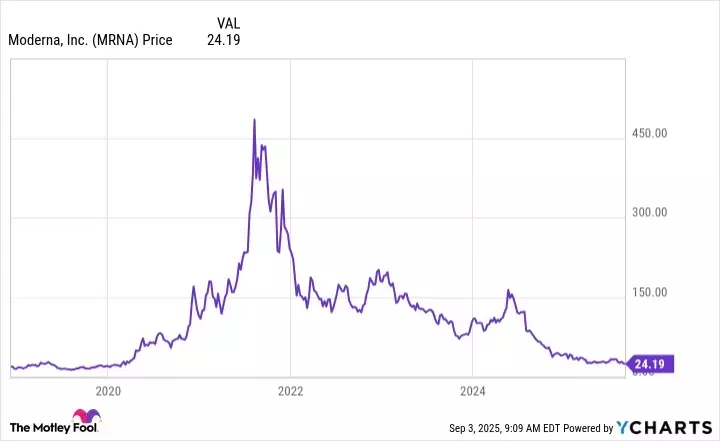

Moderna's name became widely recognized during the global health crisis due to its pioneering advancements in messenger RNA (mRNA) technology. This innovative platform enabled the rapid development of life-saving interventions, including a highly effective vaccine. However, the company's significant success during that period led to inflated investor expectations, culminating in a dramatic surge in its stock price. As the immediate crisis receded, and the market's perception adjusted, Moderna's share value experienced a precipitous decline, dropping more than 90% from its peak.
Despite this substantial correction, the underlying scientific premise that propelled Moderna to prominence remains intact. The company's core mission revolves around leveraging mRNA technology to create transformative medicines, a capability that was undeniably proven by its swift vaccine development. For investors who maintain a long-term conviction in the power of this technology to revolutionize healthcare, the current valuation might present a unique opportunity. However, it is crucial to recognize that market sentiment, often fueled by short-term hype, can significantly disconnect from fundamental value. The exuberance surrounding Moderna's pandemic-era achievements overshadowed a more measured outlook, leading many to extend positive trends too far into the future, a common pitfall in investment cycles. This pattern serves as a powerful reminder of how speculative fervor can distort asset prices, creating an environment where even a robust underlying technology cannot sustain unrealistic valuations.
For those who acquired Moderna shares at their inflated highs, the current downturn presents a challenging scenario, highlighting the critical importance of understanding market dynamics beyond immediate trends. Recovering from a substantial loss requires an even greater percentage gain, emphasizing the long road ahead for such investments. In fact, for certain investors, strategically divesting from these positions could offer a silver lining through tax-loss harvesting, enabling them to offset capital gains from other profitable ventures. This financial maneuver, while not recouping the principal loss, can mitigate its impact and should be considered by those with diverse portfolios. Moreover, the shifting political landscape and potential reduction in government support for vaccine research introduce new headwinds for Moderna, suggesting that its growth trajectory may face challenges in the coming years. This confluence of market correction, investor psychology, and external policy shifts underscores the need for careful evaluation and a disciplined approach when navigating volatile sectors.
The journey of Moderna's stock offers a profound lesson in the perils of herd mentality and the importance of sober analysis in investing. While the company's technological prowess holds immense promise for the future of medicine, the market's initial overreaction to its pandemic success serves as a cautionary tale. Investors must internalize that even groundbreaking innovations are subject to the ebb and flow of market cycles and external influences. By learning from such experiences and focusing on long-term value over short-term speculation, individuals can cultivate more resilient and rewarding investment strategies, transforming potential setbacks into opportunities for growth and financial prudence.
