
The transformative power of artificial intelligence is reshaping industries globally, creating a wealth of opportunities for discerning investors. While major technology corporations often dominate headlines, the true innovation often thrives within a diverse ecosystem of smaller, yet highly impactful, enterprises. This report aims to shed light on two such companies, each demonstrating significant potential in distinct sectors of the AI landscape, proving that strategic investments can extend far beyond the well-trodden paths of market leaders.
Navigate the Future: Strategic AI Investments Beyond the Usual Suspects!
Unveiling the Broad Spectrum of Artificial Intelligence's Influence
The profound impact of artificial intelligence is permeating various industries, from the intricacies of semiconductor testing to the creative frontiers of graphic design, fundamentally altering our professional and investment environments. When contemplating AI, many initially envision conversational agents like ChatGPT. However, these tools represent merely a fraction of a much vaster technological domain. AI is a sprawling discipline, encompassing advanced fields such as generative AI, sophisticated speech recognition, cutting-edge robotics, and nuanced predictive analytics. Its applications are diverse and critical, ranging from accelerating drug discovery in pharmaceuticals to bolstering fraud detection in banking, and even enhancing strategic operations in military contexts through platforms like Palantir Technologies' AIP.
Aehr Test Systems: Navigating Challenges and Embracing New Horizons in Semiconductor Testing
Aehr Test Systems has experienced a period of significant volatility over the past two years. The company's core business involves providing specialized equipment for testing silicon carbide (SiC) semiconductors, components crucial for the electric vehicle sector. Recent softness in demand for these chips contributed to a sharp decline in the company's stock, which fell from a peak of over $50 per share in 2023 to less than $7 by 2025. However, a significant shift is underway, promising a brighter outlook. Aehr's technological solutions are now being adapted to serve the burgeoning demand for chips essential to data centers, particularly those supporting the immense processing requirements of artificial intelligence. The challenge of ensuring extreme reliability in vertically integrated, or 'stacked,' semiconductors – where a single faulty chip can compromise an entire system – highlights the critical need for Aehr's advanced testing capabilities. As major hyperscalers increasingly develop their own AI chips, they are turning to Aehr for indispensable testing support. Despite a dip in fiscal year 2025 revenue to $59 million from $66 million in fiscal year 2024, and an operating loss of $6 million compared to a $10 million profit, investor optimism is growing. The company's backlog surged to $15 million in May 2025, up from $7 million the previous year, signaling robust future demand. While the stock has rebounded from its recent lows, it remains well below its historical highs, suggesting substantial upside potential if Aehr continues to secure contracts with leading AI hyperscalers.
Figma: Revolutionizing Graphic Design and Contending in a Competitive Market
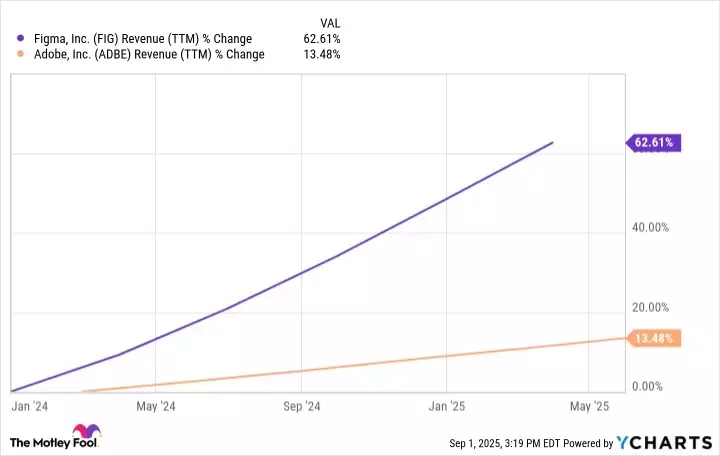
The graphic design industry is undergoing a profound transformation, with artificial intelligence at the forefront of this evolution. AI's impact is twofold: firstly, it automates tedious and time-consuming design tasks such as layout adjustments, background removal, and image cropping, thereby enabling human designers to concentrate on conceptualization and creative execution. Secondly, generative AI is capable of producing novel images based on user inputs, a truly remarkable capability, albeit with certain limitations. While it may not yet possess the inherent originality of human creativity, it serves as an invaluable tool for rapidly prototyping and refining design ideas. Cloud-based design software provider Figma made a highly anticipated debut on the public market on July 31, generating considerable excitement. Its initial public offering price of $33 per share quickly soared, reaching $122 shortly after its launch, though it has since settled around $70 per share, giving it a market capitalization of $34 billion as of September 2. Figma poses a formidable challenge to established industry players like Adobe, which notably attempted to acquire Figma for $20 billion in 2022, only to be blocked by regulators. Figma's sales trajectory is impressive, with revenues climbing from $500 million in 2023 to $750 million in 2024, and reaching $820 million over the last twelve months, outpacing Adobe's growth. The company boasts over 13 million monthly active users and a remarkable 95% utilization rate among Fortune 500 companies. As a newly public entity, Figma is a company that AI-focused investors should monitor closely. However, its current valuation is considerably high, trading at 42 times sales, which, even when adjusted to 34 times on a forward basis, remains significantly more expensive than Adobe's seven times sales. Therefore, a prudent and patient investment strategy is advisable for those considering Figma stock.
