This analysis compares the long-term investment performance and future prospects of Sirius XM Holdings with those of Berkshire Hathaway. While Sirius XM, once a promising satellite radio venture, has seen a dramatic depreciation in shareholder value over the past two decades, Berkshire Hathaway, under the seasoned leadership of Warren Buffett and now Greg Abel, has demonstrated consistent growth and market-beating returns through a diversified portfolio of wholly-owned businesses and strategic stock investments. The article highlights the changing media landscape and the challenges faced by Sirius XM, contrasting them with Berkshire Hathaway's stable and robust investment approach, which includes significant stakes in industry giants like Apple and American Express. Investors seeking enduring wealth accumulation are guided toward the stability and proven track record of Berkshire Hathaway, especially in light of recent market fluctuations and leadership transitions.
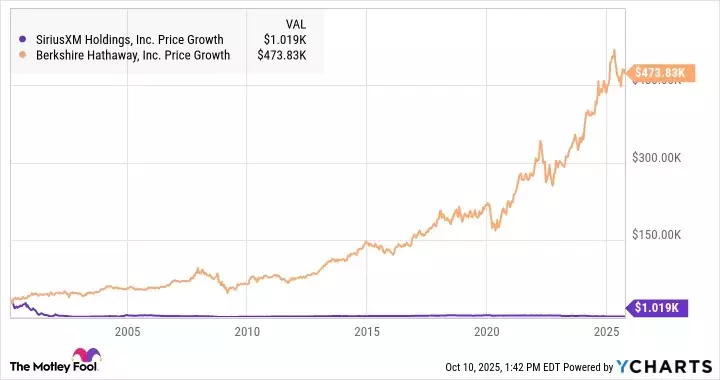
Sirius XM Holdings, born from the merger of two satellite radio pioneers, initially held great promise. In the late 1990s, as new vehicles began to integrate satellite radio technology, the company's early iterations made some investors quite prosperous. However, the stock reached its zenith around the turn of the millennium. Since then, long-term investors have witnessed a substantial erosion of share value, with the stock plummeting by 97% from its peak. For instance, an investment of one million dollars in Sirius XM on February 17, 2000, would be worth approximately $32,000 by October 10, 2025. Even with dividends reinvested, the total return would only amount to roughly $40,850, a profoundly disappointing outcome over a quarter-century.
The contemporary media landscape, characterized by an abundance of streaming alternatives and widespread high-speed internet access, presents significant competitive challenges for Sirius XM. In this environment, the company appears to be an unlikely candidate for substantial future gains. A more prudent investment strategy, as suggested, would favor an entity with a demonstrated history of robust performance and sustained wealth generation. Berkshire Hathaway, the conglomerate steered by the legendary investor Warren Buffett, serves as a prime example of such an entity. It has not only created numerous millionaires but has also consistently nurtured and expanded their wealth for decades.
To illustrate the stark contrast in performance, consider a hypothetical scenario: investing $32,000 in Sirius Satellite Radio and an equal amount in Berkshire Hathaway's Class B shares at the satellite radio company's peak in February 2000. While the Sirius XM investment would have dwindled to approximately $1,000 today, the Berkshire Hathaway investment would have burgeoned to nearly half a million dollars. This dramatic difference underscores Berkshire's consistent market-beating returns, driven by its resilient insurance operations and astute equity investments. This superior performance holds true across various long-term periods, irrespective of specific market entry points, demonstrating Berkshire's enduring strength.
Berkshire Hathaway operates much like a diversified index fund or an exchange-traded fund, encompassing a broad spectrum of industries. Its wholly-owned subsidiaries include well-known brands such as GEICO in insurance, BNSF in railroads, Fruit of the Loom in apparel, and Duracell in batteries. Beyond these, Berkshire Hathaway maintains significant equity stakes in numerous publicly traded companies, often influencing their boardroom decisions. Among its most substantial holdings are Apple and American Express, which together constitute a significant portion (39.5%) of Berkshire's stock portfolio. Interestingly, Berkshire also holds a substantial 37.1% stake in Sirius XM, though this represents a minor fraction (0.9%) of its overall diversified portfolio.
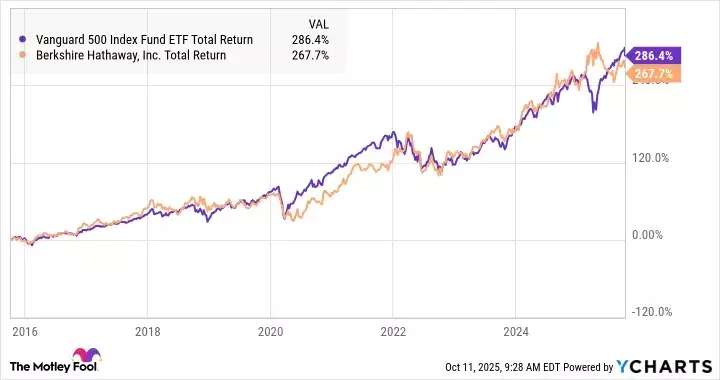
Berkshire Hathaway's investment profile is marked by remarkable stability. Its stock exhibits a beta value of 0.7, indicating significantly lower volatility compared to the broader market. For example, when the S&P 500 experienced a 2.7% decline on a recent Friday due to tariff-escalation news, Berkshire Hathaway's stock only dipped by 1.5%. While both Berkshire and S&P 500 index funds like Vanguard S&P 500 ETF and SPDR S&P 500 ETF Trust offer similar total returns over multi-year periods (with index funds potentially catching up via dividend payouts), Berkshire's inherent stability provides a degree of protection during market downturns.
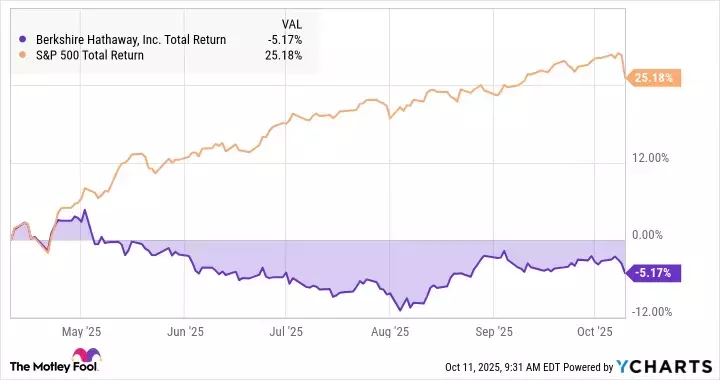
The current market sentiment, following Warren Buffett's announcement of his retirement and the subsequent appointment of Greg Abel as CEO, might present a unique opportunity for investors. Despite a slight dip in Berkshire's stock after the announcement, largely due to concerns about the departure of a legendary leader, the company's strong leadership bench ensures continuity and sustained success. Greg Abel, having served alongside Buffett for decades and actively participating in many of Berkshire's recent investments, is well-prepared to steer the company. This leadership transition, perceived as a mere \"humble speed bump\" by some, offers investors a chance to acquire Berkshire Hathaway shares at a potentially discounted price. Given its history of generating substantial wealth for investors, adding to or initiating a position in Berkshire Hathaway over time could be a strategic move towards building a million-dollar portfolio.
