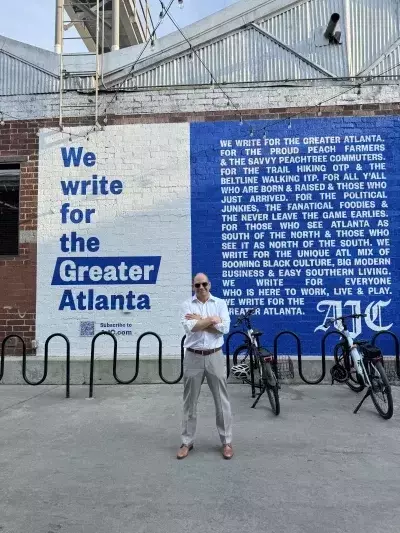

Andrew Morse, a figure instrumental in leading major media organizations like ABC, Bloomberg, and CNN through their digital transitions, set his sights on revolutionizing The Atlanta Journal-Constitution (AJC) in January 2023. He embarked on an ambitious $150 million initiative aimed at transforming the venerable daily newspaper. His core objective was to elevate the digital subscriber base from 53,000 to a monumental half-million by the close of 2026, implementing fresh strategies and content, and fully committing to digital innovation by discontinuing print editions last year. Despite these efforts, the current digital subscriber count stands at 101,000, falling short of the interim target, though Morse maintains the ultimate goal is still achievable, albeit with a revised timeline. His departure, effective next month, is attributed to personal family considerations, as he has been commuting between Atlanta and New York, where his family resides. Paul Curran, a senior advertising executive from Cox Media, will assume his role on June 29.
Morse's strategic overhaul at the AJC has garnered considerable attention within an industry grappling with financial pressures and widespread consolidation. While numerous legacy newspapers have faced significant cuts, including the recent fate of the Pittsburgh Post-Gazette, the Cox family, long-time owners of the AJC, has pledged unwavering commitment to its mission. Having divested from other newspaper holdings, Cox Enterprises leveraged its diverse portfolio, including cable television, broadband, and automotive ventures, to inject substantial investment into the AJC's digital future. Morse, who previously shaped CNN's digital strategy, including the short-lived CNN+, extended the AJC's reach beyond metropolitan Atlanta, establishing a stronger presence in surrounding Georgia cities where local journalism had diminished. His leadership saw the paper embrace newsletters, podcasts, and social media, and earn its first Peabody award for its social media coverage of ICE activities in Georgia, transforming the organization into a digital-first operation, as noted by Shereta Williams of Cox Enterprises.
The transition to a digital-only model has rendered Atlanta the largest metropolitan area in the U.S. without a major printed newspaper, a significant gamble in the eyes of industry analysts like Ken Doctor. Although the digital subscription target has not yet been met, both Morse and analysts suggest the strategy remains sound, merely requiring more time to fully materialize. Morse points to external challenges such as social media platforms deprioritizing news content and the rise of AI as factors contributing to reduced traffic to news websites, a phenomenon he terms 'Google Zero.' Despite these hurdles, the journey towards a sustainable digital future for the AJC continues, driven by a commitment to quality journalism and an adaptable approach to evolving media landscapes.
The ongoing evolution of the Atlanta Journal-Constitution under Andrew Morse's vision exemplifies the critical imperative for traditional media to embrace digital transformation. It highlights that innovation often demands significant investment, strategic adaptation, and resilience in the face of unforeseen challenges. The commitment to fostering high-quality journalism, even when confronted with a shifting digital ecosystem, serves as a beacon of hope for the industry, proving that with strategic foresight and unwavering dedication, established institutions can navigate the complexities of modern media to serve their communities effectively and ethically.
