
A recent federal court decision concerning Google's antitrust practices has delivered a substantial financial advantage to Apple, enabling the tech behemoth to continue receiving considerable payments for making Google Search the default option on its hardware. This ruling effectively eliminates a significant financial uncertainty for Apple, cementing a lucrative revenue stream. However, this positive outcome for Apple is juxtaposed with questions regarding its stock's current valuation, particularly in light of its slowing growth and challenges in the rapidly evolving artificial intelligence landscape.
In a pivotal moment for the tech industry, a federal judge presided over the antitrust lawsuit, United States v. Google LLC. The judgment delivered was a relief for Google, as the remedies imposed for its monopolistic conduct were less severe than market observers had anticipated. Crucially, the court permitted Alphabet, Google's parent company, to retain control over its Chrome browser and Android operating system. This decision was influenced by the judge's view that disassembling Google's consumer services would not serve the national interest, especially given the escalating competition from burgeoning artificial intelligence services.
This judicial outcome has direct and significant implications for Apple. The ruling explicitly allowed Google Search to continue its practice of making substantial payments to Apple, ensuring its position as the primary search engine on iPhones and other Apple devices. While future exclusive agreements were prohibited, the continuation of this existing financial arrangement is a significant boon. Industry reports indicate that Google Search pays Apple upwards of $20 billion annually for this privilege, a sum that constitutes a substantial portion, reportedly over 15%, of Apple's operational profits, which amounted to $130 billion in the past year. This arrangement has been instrumental in Google Search maintaining over 90% market share for a decade.
Although a prior 2024 federal court ruling had indeed identified Google Search as a monopoly, citing these default payment arrangements as anti-competitive behavior, the landscape has since shifted. The emergence and rapid growth of AI chatbots and browsers have introduced new competitive dynamics, which the presiding judge acknowledged. The notable valuation of OpenAI, a significant competitor, at $500 billion, underscores this evolving environment, representing a substantial portion of Alphabet's current market capitalization.
This judgment, therefore, allows Apple to sustain a critical revenue stream without facing immediate disruption, enabling what has been termed a 'cash cow' to continue its operations. For Apple, this is less about generating new growth and more about averting a major financial setback. The company, like its peers, is navigating the transformative impact of artificial intelligence. While Apple has reportedly struggled to develop AI tools that rival those of OpenAI, Alphabet, or Anthropic, leading to a loss of AI talent, it still commands a dominant market position with its iPhone. Although no formal announcements have been made, there are indications that Apple is exploring AI-powered web search and integrating Alphabet's AI technology into its Siri chatbot.
From a broader financial perspective, Apple has transitioned from a period of rapid expansion to one of more subdued growth. The absence of a new groundbreaking product akin to the iPhone, coupled with the maturation of the smartphone market, has led to a deceleration in Apple's revenue growth. Although its software services division has experienced consistent expansion, this segment remains closely tied to smartphone usage, deriving revenue from the App Store and the aforementioned Google Search licensing deal.
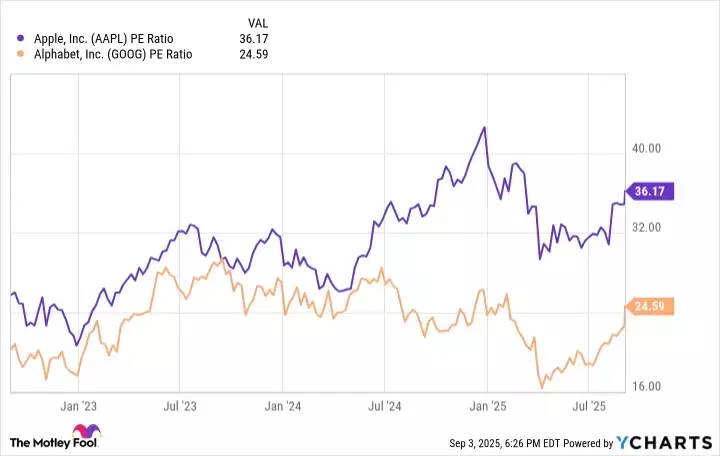
Over the last three years, Apple's cumulative revenue growth has been a modest 3.6%. In contrast, Alphabet has seen a cumulative growth of 32% during the same period, accompanied by numerous AI innovations. Despite this disparity in growth rates, Apple's stock continues to trade at a premium, with a price-to-earnings (P/E) ratio of 36, notably higher than Alphabet's P/E of 25. For investors seeking promising opportunities in the aftermath of the Google antitrust ruling, Alphabet's faster growth trajectory and more attractive earnings multiple may present a more compelling investment proposition compared to Apple, which, while a fundamentally strong enterprise, appears to be valued at an elevated level relative to its future growth prospects.
